
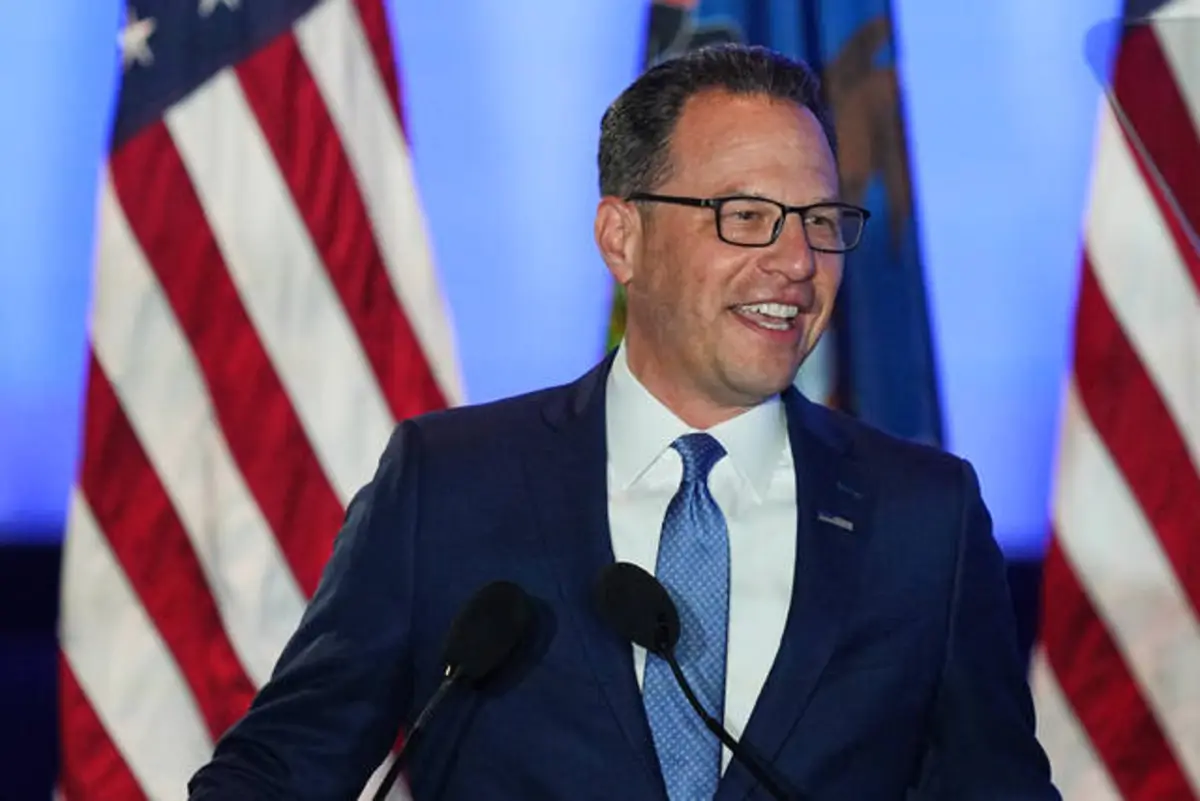
The administration of Gov. Josh Shapiro, and its legion of acolytes, insist that raising the Keystone State’s minimum wage to $15 an hour is a matter of keeping the commonwealth competitive with other states and will bolster population and employment.
But a researcher at the Allegheny Institute for Public Policy calls those contentions “equally untrue assumptions” that fuel “an economic growth red herring.”
“The inability to attract and retain residents and underwhelming economic performance suggests Pennsylvania and most of its neighbors are already highly uncompetitive — even though a majority boast minimum wages at or above $15 per hour,” says Alex Sodini, a research associate at the Pittsburgh think tank.
“As such, there’s little evidence to support the idea that Pennsylvania must increase its minimum wage to attract residents or stay economically competitive with surrounding states,” he says.
Sodini says the governor’s 2026-27 executive budget notes that all six neighboring states have a higher minimum wage than Pennsylvania’s $7.25 per hour. As of Jan. 1, 2026, New York had the highest hourly rate ($16), followed by New Jersey ($15.92); Delaware ($15); Maryland ($15); Ohio ($11) and West Virginia ($8.75).
And as such, the budget narrative claims that not raising the minimum wage in Pennsylvania is a liability for its economic competitiveness: “At $7.25 per hour, Pennsylvania’s minimum wage has remained unchanged for more than 15 years and is lower than all neighboring states and almost every state that’s considered an economic competitor. At a time when Pennsylvania’s workforce is aging, young Pennsylvanians are increasingly considering other places to build their economic futures.”
But the data say otherwise.
“Clearly … the commonwealth has trailed other states in recent years in terms of economic performance. But this is not necessarily due to the lack of a higher minimum wage,” Sodini says.
“Delaware was the only state of the seven sampled which ranked in the top half of all states for overall economic performance. New York ranked 49th in net domestic migration from 2020-2025, with 1,106,013 more residents leaving for other states than vice versa. New Jersey and Maryland similarly fared poorly in terms of net domestic migration, ranking 47th and 44th, respectively,” the think tank researcher found.
Furthermore, Sodini cites a 2026 research brief from Pennsylvania’s Independent Fiscal Office (IFO) that examined domestic migration trends based on IRS tax returns filed and processed during calendar years 2022 and 2023, the latest available.
It found that Pennsylvania ranked 38th in the nation for total net domestic migration. During the two-year span, 14,880 more residents left the commonwealth for other states (and D.C.) compared to those moving in.
“Curiously though, the (IFO) brief also notes that ‘(s)imilar to recent years, the largest net inflows were from the border states of New York (13,691), New Jersey (4,475) and Maryland (2,467).’
“This means that 20,633 more residents moved into Pennsylvania from these border states than vice versa in 2022 and 2023 — a trend which predates the pandemic,” Sodini notes. “Overall, the commonwealth only recorded positive net inflows from 11 states. But the top three accounted for 95% of total net inflows and each had a minimum wage of at least $12.50 in 2022 and $13.25 in 2023.”
It was in Policy Brief Vol. 26, No. 15, that the Allegheny Institute warned that increasing the minimum wage would put upward pressure on wages and increase the cost of labor, likely leading to adverse consequences for businesses and workers.
“If lawmakers are serious about making Pennsylvania more economically competitive, reforming and improving the state’s regulatory and tax climates to help attract businesses, jobs and residents would be a far better solution,” Sodini concludes.
And all red herrings aside.