
Police officers increasingly are asked to make a complex calculation in the field: Is the person in distress an alleged criminal to be handcuffed or a possible patient to be helped?
Although police undergo occasional training on interactions with people experiencing a mental health crisis, a new paradigm in policing is emerging across Allegheny and Westmoreland counties that trades service weapons for social workers.
In Allegheny County, that shift has come with the arrival of the A-Team — behavioral health specialists who respond to 911 calls where police may not be the best option. Responding officers arrive at a scene and determine whether a call warrants the A-Team’s involvement.
The group has a specialized van and members who are hoping to address the intersection of mental and behavioral health and law enforcement. In April, it expanded its partnerships with local police departments and hopes to collaborate with more. Along the way, it is providing police with a tool to not only deescalate situations but also offer a connection to health and human services that officers are oftentimes too busy to provide.
In Westmoreland County, police departments aren’t large enough to support a full-time social worker, according to Mandy Zalich, CEO at Westmoreland Community Action. Her group operates the county’s crisis line and mobile response team.
“If at all possible, the team aims to deescalate a situation and ensure everyone’s safety without involving law enforcement, but a police department can also call us and request support from the mobile unit,” Zalich said. “Our staff has walked into situations that were volatile. But they are trained and their operations stay within the window of making sure a person’s mental health is taken care of. Most of the time, they’re not taking law enforcement with them.”
Police often are a catch-all for any 911 call that isn’t a fire or medical emergency. In Monroeville, police Chief Doug Cole said he noticed these calls surge in the wake of the covid-19 pandemic.
“We used to run maybe two or three a week max, and then it started to become two to four every day,” said Cole, who was a paramedic in Penn Hills from 1979 to 1985. “Back then it was treated as a medical problem. We took them to Forbes Hospital; they got treated.”
Starting in the 1980s, state mental health hospitals began to close, a trend that continued into the ’90s and 2000s with the closure of institutions in Philadelphia, Haverford, Harrisburg, Mayview, Allentown and Polk. State funding for mental health services has declined from more than $350 million in 2000 to just more than $200 million in the 2024-25 budget.
In the mid-1990s, the state created the Community Hospital Integration Project Program, or CHIPP, intended to close state-run hospital beds and direct that funding to counties in the form of grants. Those grants were to be used to establish community-based mental health services.
But since 2015, the state has maintained its number of hospital beds. Over that same time period, new funding for community-based mental health care dramatically slowed. Spending ramped up to expand resources and treatment for people charged with a crime and in need of specialized care to face prosecution, according to a recent Spotlight PA investigation.
“Torrance State Hospital (in Derry Township) is the last place that’s still open (on this side of the state),” Cole said. “And it’s run by the Department of Corrections. You have to have a criminal charge to get in there.”
Torrance — and its only counterpart, Norristown State Hospital in eastern Pennsylvania — provide mental health evaluations, offer forensic-level treatment to restore competency and provide a community-based setting for criminal defendants deemed incompetent. The two hospitals’ 359 combined beds are meant to serve all of Pennsylvania’s 67 counties.
Police are often caught between choosing whether to arrest a person in crisis or connect them with services, Cole said.
That’s where the A-Team can intervene under the right circumstances.
Forming the A-Team
When Allegheny County officials considered options for American Rescue Plan dollars, they tasked the Department of Human Services to work with police on civilian crisis response.
“Police had been coming to us for years, telling us they were responding to an increasing number of situations that required human services expertise,” said Jenn Batterton, the county’s special initiatives manager.
A search for that expertise prompted them to contact the nonprofit Resources for Human Development, which now operates the A-Team under regional director Jon Chillinsky. Working with police in Monroeville, Penn Hills and McKees Rocks, they developed a pilot that responds from 10 a.m. to 10 p.m.
“We’re thinking about this as an additional branch of emergency response along with police, fire and EMS,” Chillinsky said.
Not only does the A-Team provide specialists, but it also can free police for higher-priority calls.
“As a call comes in, police review it to see if it’s eligible for us to respond,” Chillinsky said. “We had police reach out after a traffic accident because the driver’s car was totaled and had to be towed. She was in distress and didn’t know how she was going to get to work the next day. They called us, and we were able to talk with her and help navigate her situation.”
The White Oak Police Department has been working with the A-Team since April 6, and Chief Jason Binder said his officers have had nothing but good things to say.
“They’re very happy to have that resource available,” Binder said. “We’ve used them multiple times, including two instances right outside the department in our borough parking lot, so I got to see them in action.”
Binder said the first month of work with the A-Team has been “very positive.”
“There’s no cost to the borough, and it’s another way of helping us address mental health calls,” he said.
Limitations of the model
The system does have its limits. In February, Monroeville police arrested a woman who set fire to her apartment.
“We think she did it accidentally,” Cole said. “But she is a ‘frequent flier’ — we’ve been to her apartment many times. This time she set the couch on fire around 4 a.m.”
The woman fought with firefighters and police and was taken into custody, with officers discovering she had mental health issues and was supposed to be on psychiatric medication.
“We tried to get her evaluated, she refused, and we took her to the behavioral unit at the (Allegheny) county jail,” Cole said. “And hopefully they will eventually get her into Torrance because she had medication and was not taking it.”
Because of the hour of that call, A-Team members were not available to respond. But Cole said even if they had been, police would not have brought them in because the woman was combative.
“Some individuals, they do have mental health issues, but to me it doesn’t excuse some of their actions,” he said. “She was endangering 30, 40 people in nearby apartments who were sleeping. She was blocking the fire guys from getting into her apartment. Unfortunately, it became a total police matter.”
The A-Team works with each police department to determine its process for responding.
“The last thing you want to do is put a social worker in danger,” Cole said. “Our argument as police chiefs was, ‘We don’t want you going there alone.’ And there was some pushback a little bit, but we compromised, and it’s been working out fine. There are some calls where we now feel comfortable with the A-Team responding on their own. And my officers are aware when they get sent someplace, so they can mosey on over and keep an eye out. They come with access to more resources, and they’re able to take a lot of things off my guys’ hands. It’s been nothing but a win-win.”
Since its inception, the A-Team’s call volume has built steadily. A month after forming in October 2024, it was responding to 29 calls per month across Allegheny County. That number built up to 79 per month by June 2025, reaching a high of 155 calls in October 2025.
County data bears out the “frequent flier” calls that Cole referenced — 44% of calls were additional visits with a previous client. On 17% of calls, police dispatched the A-Team on its own. For the majority of calls, 62%, the A-Team was brought in after police had responded. Responses related to mental health comprised 37% of the overall call volume.
Keeping it in-house
Across the North Hills region, some police departments are undertaking similar initiatives on their own.
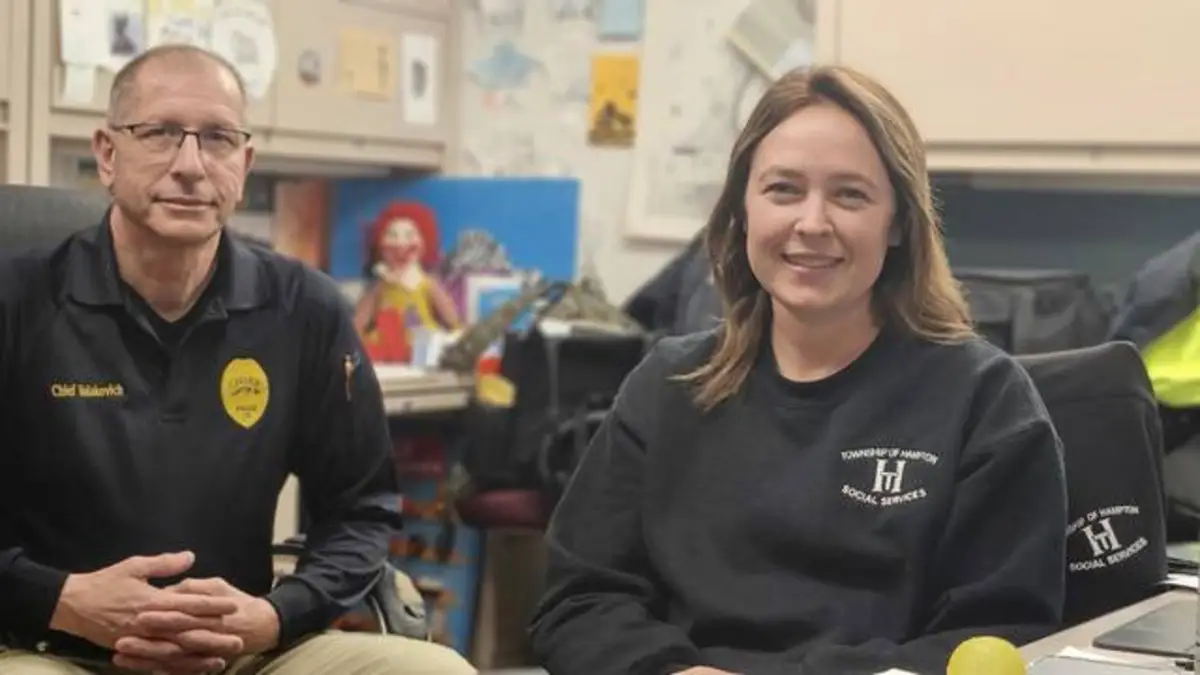
In Hampton, Angela Kenbok came on board in 2019 initially as an intern but soon after as a police social worker, partnering with the police department to accompany officers on any call they thought was appropriate.
“I was at Slippery Rock University to talk about law enforcement in one of their social work classes,” said Hampton police Chief Thomas Vulakovich. “The professor reached out and asked if I would be interested in having an intern work with us — they had just started a curriculum for forensic social work.”
Vulakovich, whose wife was a social worker for nearly three decades, took an immediate interest.
“I presented it to my sergeants, and they supported it,” he said. “So we took it to the township manager and council and they were all on board with it. We interviewed Angela and some other people, and we were so impressed that we ended up bringing on two interns.”
Vulakovich and Kenbok built out the parameters for how their program would work, along similar lines as the A-Team.
“The chief and I both thought we’d be focusing on things like mental health, substance abuse, domestic violence,” Kenbok said. “But I saw very quickly that there are a lot of different situations that we could respond to. In a car crash, a family might need car seats to get their kids home from the scene. There was a fire recently and my co-worker and I were able to provide food, clothes and shelter for that family.”
Kenbok is also part of Hampton’s social services department, a relative rarity at the township level, and her outreach doesn’t stop at the scene of a police call.
“We go with that individual, whether it’s to the magistrate, through the court system, to adult protective services, to CYF,” she said. “That’s my job, to follow through with all the other connecting agencies and make sure we can be a short-term service that connects them to long-term care.”
Like Cole, Vulakovich had reservations about a scenario where social workers would be dispatched to a mental health call without any police presence.
“I’ve been on this job for 40 years and gone to those types of calls, and you don’t know whether a person with severe mental health issues is going to escalate things and become physical,” he said. “Angela is not equipped to handle the physical aspect of a call like that. But if we use this co-response model, my officers can be there to maintain a level of calmness. We can step back, and the social workers can step in.”
Across the county line
In Westmoreland, police have access to the county’s crisis intervention team. Its lead coordinator, Bobby Tanyer, works with police departments and dispatches crisis response teams from one of four mobile centers.
“We had a consultant come in and look at our program and one concern at the time was, we were only dispatching from one location, in Greensburg,” Tanyer said. “We want to kind of treat it like pizza delivery, in that we can respond any place in the county within 30 minutes.”
That has meant expanding to create additional mobile centers in Monessen, Derry and Scottdale.
“We’re in the process of opening one in New Kensington, and we’re going to be opening a new 24/7 walk-in crisis center in Jeannette,” Tanyer said. “It will be located near the DMV on Lowry Avenue in Jeannette, and we’re hoping that will open in late summer or early fall.”
Tanyer’s team also hosts regular training sessions in which police and first responders take a 40-hour course discussing how best to respond to a variety of crisis-intervention scenarios.
“We cover everything from mental health scenarios to someone under the influence of drugs and alcohol,” Tanyer said. “And 90% of the people doing the training are professionals in those behavioral health fields. You’re basically getting it straight from the horse’s mouth.”
‘Fourth branch of emergency service’
Chillinsky said he views the A-Team’s work as a fourth branch of emergency services — alongside police, fire and EMS.
“We know police have a role and that they have to carry a weapon,” he said. “But we don’t come into a situation to enforce anything. We’re there to talk someone through a situation, address their immediate needs and help.”
In early March, the A-Team launched services in partnership with police in Swissvale and Braddock Hills. They’ve worked with police in McKees Rocks, Stowe, Kennedy, Coraopolis, Penn Hills, Monroeville and Allegheny County. Starting in April, they want to expand to the southeast through partnerships with police in White Oak and McKeesport.
“Our goal is to expand strategically to make sure we really can function as an emergency service, which means a rapid response time,” Chillinsky said.
The average response time for the A-Team is about 18 minutes, Chillinsky said. The overall goal, similar to Tanyer’s in Westmoreland County, is to keep response time under 30 minutes.
Initially funded through American Rescue Plan money in Allegheny County, Batterton said the county is able to use some of its Medicaid funding to supplement the A-Team.
Cole said it’s been a huge help in Monroeville.
“It’s really been a positive for our department, and for the residents we deal with here who are coping with mental health issues,” he said.