
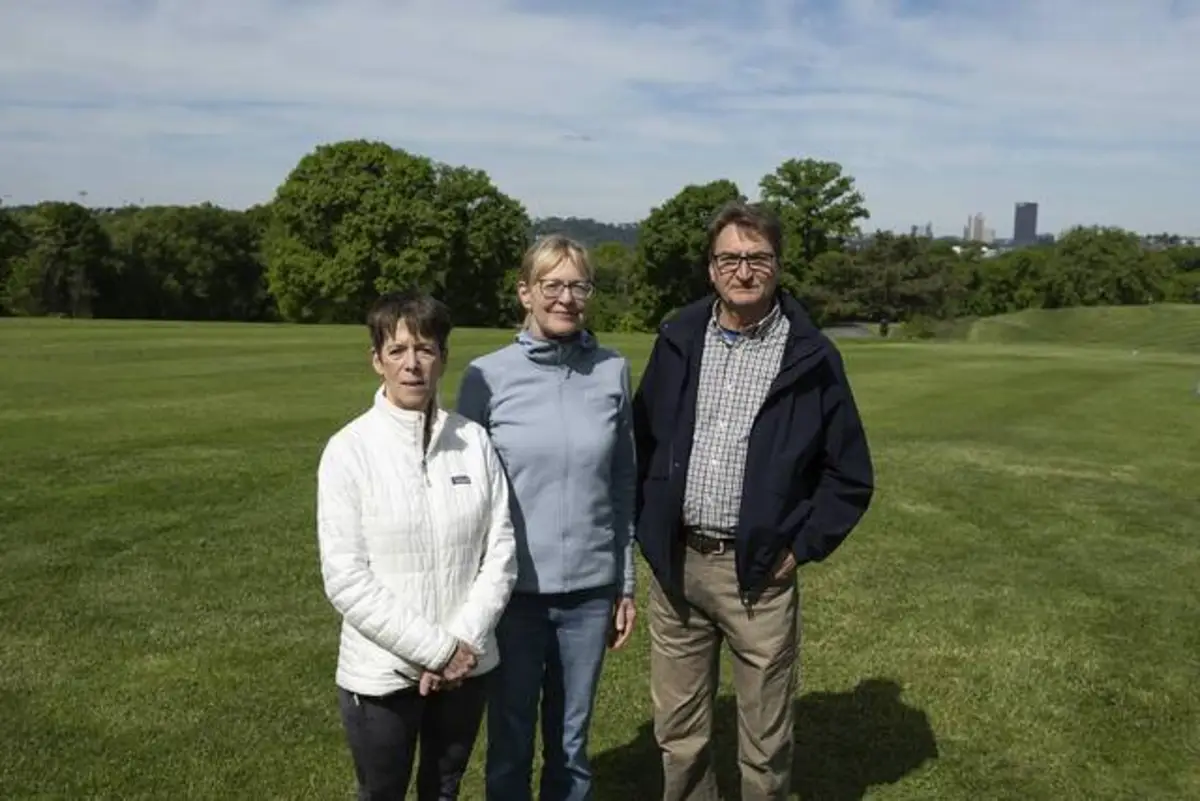
Meg Bernard bought her Squirrel Hill home, in part, because she loved the patio overlooking Bob O’Connor Golf Course at Schenley Park.
The golf course is quiet and tranquil, with scenic views of greenspace.
But she worries that proposed changes to the course — including the addition of a driving range — could upend that.
“They’re going to be losing a lot of greenspace when they put in the driving range,” Bernard, 70, told TribLive. “We love our environment, and we want to have as much natural space as possible because it is a park before it’s a golf course.”
A proposal by nonprofit First Tee Pittsburgh to upgrade the Schenley Park golf complex has been met with criticism from some neighbors. The proposal calls for adding a driving range, electric golf carts and extra parking, changes neighbors worry could worsen traffic, become disruptively noisy and hurt the park environment.
Since 2007, First Tee Pittsburgh has operated the golf course. The nonprofit, which focuses on introducing children to the game, opened the Arnold Palmer Learning Center at the site in 2021, adding golf simulators, a synthetic putting green and a pro shop.
Now, it is planning another round of upgrades.
What’s in play?
Eric Amato said the plans call for replacing the course’s aging irrigation system, adding a public driving range and introducing electric golf carts at a course that currently does not offer cart service. The proposal also includes a storage building for the carts and additional parking.
Amato said he hopes the golf carts will generate new revenue to help support the course.
The project is estimated to cost between $8 million and $10 million, Amato said.
He hopes to start construction next fall and wrap up in 2029. First Tee will fund upgrades. Amato said he does not expect to ask the city for any financial support.
First Tee pays the city $1 per year to operate the golf course, according to the lease agreement. The city can allocate up to $44,000 per year to support its operations.
Any changes to the course require approval from the city and updates to the lease agreement.
Amato believes the improvements will make the golf course more financially stable and expand programming for young golfers who could use the new range to perfect their swings.
“It would be transformative for the kids,” he said.
First Tee currently operates the Schenley Park site at a deficit of about $100,000 per year, Amato said. He expects the proposed upgrades would generate about $300,000 to $500,000 in extra revenue each year.
Local concerns
Friends of Schenley Park, a volunteer organization that advocates for the park, is pushing back on First Tee’s proposal.
“It’s just crazy to think of the environmental impacts on wildlife, and trees might have to be removed,” said Chris Zurawsky, the group’s president.
The driving range, he said, would be an eyesore along Schenley Drive.
“Think about the sound of these titanium drivers and people out there hitting a bucket of balls, 100 balls,” he said. “It’s absurd for such a crowded urban environment.”
In an effort to alleviate community concerns, Amato said, First Tee is not planning to add lighting at the range. That would limit driving range activity to daylight hours and avoid the risk of bright lights shining into nearby homes.
“We want to be a good neighbor,” Amato said.
Cathy Weinert, secretary of Friends of Schenley Park, said she’s not opposed to the golf course generally.
“It’s a beautiful community greenspace right now,” she said, adding people have played golf there for more than a century. “The golfing doesn’t really impinge upon the peace and tranquility of the park for other users. It’s really quiet.”
She worries a noisy driving range and a fleet of golf carts zipping around the course could change that.
Construction would be “tremendously disruptive,” she said.
“I want it to stay a community greenspace and not become a highly commercialized golfing destination,” Weinert said. “I don’t want the golf to take over the park.”
Amato acknowledged some residents are wary of the upgrades he’s pitching. But he pointed out that First Tee has no plans to gobble up more park space. It would remain within the 55 acres it now occupies, a relatively small portion of the sprawling 456-acre park.
“We’re just updating the existing footprint,” Amato said.
Zurawsky worries the changes will have broad impacts. He’s worried about extra traffic in an area already “overwhelmed” with cars. He’s also concerned about the environmental impacts of uprooting trees and swapping greenspace for more parking spots, cart paths and a building to house golf carts.
Zurawsky said he’s also waiting for more detailed information from First Tee about their plans. So far, he said, the community group has not seen three-dimensional renderings to better understand what the changes would look like.
He’s hoping for more community engagement as well.
Councilwoman Barb Warwick, D-Greenfield, represents the area. She said First Tee has maintained the course well and seems to be committed to gathering community input.
“There certainly is an uphill climb on the driving range and any parking or storage infrastructure,” she said.
Molly Onufer, a spokeswoman for Mayor Corey O’Connor, said no formal plans have been submitted to the city.
Maria Cohen, who leads the Squirrel Hill Urban Coalition, said she hopes to see a compromise that works for residents and First Tee.
“On both sides, there’s room to come to an agreement that could work,” she said.
Weinert, however, said she doesn’t see much space for common ground. She doesn’t want to see major changes to the golf course.
“Many of us are golfers. And many of us are First Tee supporters. This isn’t about being anti-golf or anti-First Tee,” she said. “It’s about preserving community greenspace.”