
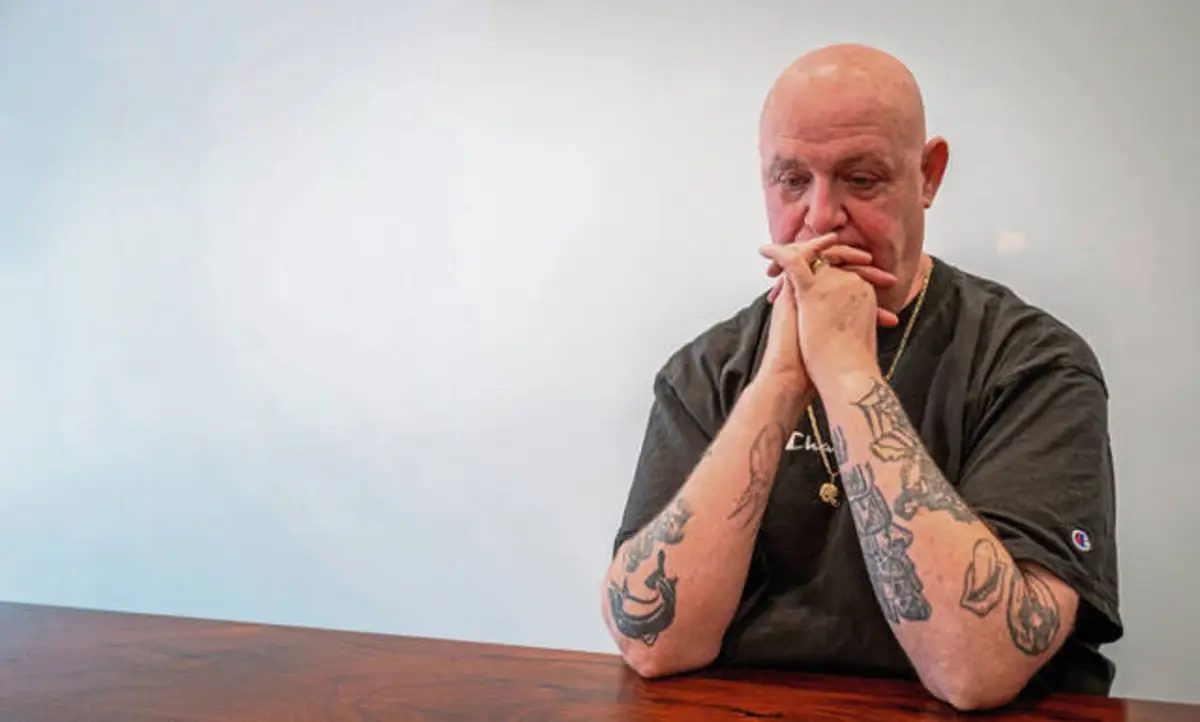
Daniel Carnevale has always insisted he didn’t set the fire that killed three people in Bloomfield more than 30 years ago. That didn’t stop police from arresting him on what his lawyers say was flimsy evidence.
Imprisoned for nearly 14 years after a jury convicted him of murder, Carnevale eventually won his freedom in 2020 after his attorneys dug up new information that undermined the prosecution’s case.
Now Carnevale and his legal team believe they may be closer than ever to winning reparations for the years they say he unjustly lost to prison.
Attorney Alec Wright said there are “fruitful settlement discussions” underway for the first time with the city of Pittsburgh to resolve a federal civil rights lawsuit against the detectives who put Carnevale away.
In September, the suit — alleging fabricated evidence, missing case files and orchestrated false testimony from a jailhouse informant — survived a key procedural hurdle.
“It’s now time to do the right thing,” Wright said. “It is now time for those individuals with the power to compensate Dan for the harm that he suffered, to compensate him for it justly and fairly.”
He and his client are optimistic that Pittsburgh’s new mayor will be willing to settle.
A spokeswoman for Mayor Corey O’Connor said the administration could not comment on pending litigation. But Carnevale has plenty to say.
“They cheated me, took my life,” Carnevale, 62, told TribLive last month. “I feel I should be compensated for all the time I did, and I’m starting to get angry about it.”
The fire
Just before 4:30 a.m. on Jan. 17, 1993, a fire engulfed two apartment buildings on Taylor Street in Bloomfield, killing Chris Stahlman, Florence Lyczko and Anita Emery.
The federal Bureau of Alcohol, Tobacco and Firearms determined the blaze was purposely set and fed by highly flammable lacquer thinner.
Carnevale, who lived nearby, quickly piqued investigators’ interest.
Two people who allowed Carnevale to stay at their home told police Carnevale arrived there on the morning of the fire around 7:30 in a green army field jacket and told them about the fire, calling it “the worst thing that he had ever seen,” according to the criminal complaint against him.
They also told police they found a book of checks with the address of one of the apartment buildings stashed under Carnevale’s bed and that they ultimately kicked him out when two men came looking for him over the checks.
When police interviewed Carnevale, he admitted he had been stealing checkbooks from tenant mailboxes outside the buildings to fuel his drug use. But he denied starting the fire, saying he never had been inside either building.
Carnevale told investigators that on the morning of the fire, he was at a snack shop on Liberty Avenue, heard sirens and went to watch the blaze.
Police had no evidence to prove otherwise. A few months later, a friend in California invited Carnevale to move to the West Coast. Carnevale thought a fresh start would be good.
He was gone for 13 years while the investigation stalled.
The arrest
Trouble followed Carnevale.
Early on in his time in California, police arrested him for stealing a car in Pittsburgh — the one he had driven across the country. He pleaded guilty and served 18 months in the notorious San Quentin prison near San Francisco.
After his release, Carnevale worked to rehabilitate himself. He married, bought a house in Northern California and found a job as a laborer at a lumber mill. Years passed quietly.
By 2005, the investigation in Pittsburgh took on new life. Two veteran homicide detectives, J.R. Smith and Scott Evans, were assigned to review the fire as part of the cold-case squad.
Crime Stoppers offered a $5,000 reward. A man named Shane Evans (no relation to the detective) came forward after a story on the stagnant case appeared in the Tribune-Review.
In January 2006, Evans told investigators he saw Carnevale coming out of the apartments around 4 a.m. on the day of the fire, about a half-hour before flames were spotted.
Using that information, as well as Carnevale’s admission about the stolen checks and their assertion that he “fled” to California, the detectives obtained an arrest warrant.
Carnevale was oblivious to what was transpiring in Pittsburgh. But on Aug. 31, 2006, as he drove home on a freeway, he noticed the sound of a helicopter overhead.
“I get off the exit, and the helicopter is still above me,” Carnevale recounted. “I lived in the woods, and I remember driving past some cars that were pulled over to the side of the road, and I rode by them, and then all of a sudden a light comes on. And I was like, ‘OK, they’re coming after me.’ ”
Police pulled him over a few hundred feet from his home.
“What’s your name?” an officer asked.
“Dan Carnevale,” he answered.
“Then I saw the two other cops walk over, and they had Pittsburgh badges, and I knew.”
Turning down a deal
Smith and Evans had traveled thousands of miles to get him, and Carnevale was soon extradited to Pittsburgh. He stuck to the story he told years earlier: He had never set foot in the apartments or had anything to do with the fire.
As the case wound its way through the courts, a prosecutor approached Carnevale and his lawyer, Frank Walker, with a plea offer, one that seemed remarkably lenient considering he faced three homicide charges.
Then-Assistant District Attorney Jennifer DiGiovanni said Carnevale could plead guilty to involuntary manslaughter and spend 3½ to seven years in prison, Walker said in an affidavit filed as part of Carnevale’s lawsuit.
Walker took the offer to his client. But Carnevale, maintaining his innocence, rejected the deal.
A short time later, Walker said, Carnevale was moved to a different pod in the Allegheny County Jail.
Soon after, according to Walker’s affidavit, DiGiovanni revealed a new piece of evidence that would prove critical: A jailhouse snitch named Sean Burns claimed Carnevale had confessed to him.
The trial
When the case went to trial in August 2007 in Allegheny County Common Pleas Court, prosecutors relied heavily on testimony from Evans and Burns.
Evans testified he had known Carnevale for years from the neighborhood. He said when the two crossed paths at the scene of the fire, Carnevale blurted out, “I was at the sandwich shop.”
Evans said he “thought it was unusual” that Carnevale volunteered the information. “And his face and his hands were dirty, too.”
Evans had never before mentioned that last detail to detectives.
Burns was one of the last witnesses to take the stand. He told jurors he had been in the Allegheny County Jail for 14 months on a gun charge and met Carnevale there in October 2006. Sometimes they would walk laps around the pod together, he said.
On Dec. 27 that year, Burns testified, he saw Carnevale become visibly upset after a phone call.
“He was hysterical. I said what was wrong?” Burns testified. “He said, ‘My wife’s going to leave me.’ I said, ‘What did you do?’ He came over and sat down, and said, ‘I didn’t mean to hurt those people.’ I said, ‘What are you talking about, Dan?’
“He said, ‘I didn’t mean to kill nobody.’ ”
Then, Burns continued, Carnevale offered a full account of what happened: He said he had been stealing checks and had been warned the apartments might have surveillance equipment, so he set out to destroy the evidence.
When Carnevale couldn’t find the equipment, Burns said, he went into an adjoining maintenance room, “found a can of some stuff,” poured it in the office, lit it and left.
Burns told jurors he had no way of knowing any of the details of the case other than what he was told. He said no one had promised him anything in exchange for his testimony. He was almost done with his sentence, he explained, and had nothing to gain.
The jury deliberated less than four hours before finding Carnevale guilty of three counts of second-degree murder. They found he was responsible for the fire victims’ deaths while committing the felony of arson.
There was no wiggle room for the sentence. Carnevale was going away for three mandatory life terms without parole.
The appeals
Carnevale was angry.
“My emotions were really, really messed up for a good year,” he said.
But after a while, Carnevale began to meet other lifers in state prison. They helped him through his lows. He said his personality helped, too. He liked to make people laugh.
Carnevale worked several jobs, including as a baker and at the laundry. He said his fellow inmates called him the “Podfather.” Outside prison walls, he and his wife divorced.
As Carnevale maintained his innocence, he appealed his conviction in state court. He was denied at every turn. When that track ran its course, he turned to federal court for relief, a common step for convicts.
While he didn’t have luck there either, he clung to one section of a 2016 opinion from the 3rd U.S. Circuit Court of Appeals.
“Were we in the jury box at Carnevale’s trial, we very likely would have weighed the evidence against him differently than did the actual jury. And were we the trial court reviewing a challenge to the verdict, we would likely have concluded it was against the weight of the evidence,” the panel wrote. “But we had neither of those roles and cannot assume them now.”
Accident or arson?
Liz DeLosa, the deputy legal director of the Pennsylvania Innocence Project, had been watching Carnevale’s federal appeal play out. She believed he had strong claims to overturn his conviction.
DeLosa filed another appeal for Carnevale in state court in June 2018. Her strategy: Challenge the basis of the case, that the fire was arson.
According to police reports written shortly after the fire, seven residents in the apartments described hearing banging noises from their steam pipes and heating system in the days, hours and minutes leading up to the blaze.
Some of them reported the heat in their apartments had been extraordinarily high.
DeLosa retained a fire science expert, who concluded it wasn’t arson. Instead, Douglas J. Carpenter wrote that the ATF agent who had made that finding years earlier had erred.
Carpenter, a vice president with Maryland-based Combustion Science & Engineering Inc., concluded that the witness statements describing the heat and what they heard supported the hypothesis that the fire was accidental.
The DA’s office sought to have DeLosa’s appeal tossed, arguing that Carpenter’s expert opinion did not constitute new evidence.
A game changer
With her appeal underway, DeLosa turned to hunting down the original case file from 1993, which prosecutors said had been lost.
DeLosa suspected an insurance agency might have investigated the blaze and still have records. She pored over court paperwork and found a name: Northwestern Mutual.
There were scores of possible matches in the U.S.
In summer 2019, DeLosa started working her way down the list. Halfway through, she learned the company’s name had changed. She had to start all over. There were 374 possibilities.
In October, DeLosa got a hit. A woman who answered the phone told her the claim number she provided looked like a match.
They had the file. The woman told DeLosa it was lucky she called when she did because that record was slated to be destroyed the next week.
DeLosa asked the woman to pull the file for her and keep it safe.
“Whatever you do, it can’t be destroyed,” she told her.
Within a couple of days, the woman had scanned thousands of pages and sent them to DeLosa.
New trial
In November 2019, the DA’s office abruptly changed course and agreed Carnevale deserved a new trial.
Tipping the balance was an undated, single-page document the ATF said it found two months earlier and turned over to prosecutors. It analyzed chemicals at the fire scene and rendered a conclusion at odds with the original investigation.
The newly discovered analysis said the lacquer thinner found in the debris — the flammable liquid investigators said was used to accelerate the fire’s spread — was at such low levels as to be “meaningless.”
The DA’s office said it had never seen the analysis before.
With the prosecution’s consent, on Dec. 17, 2019, a judge vacated Carnevale’s conviction and ordered a new trial.
‘Lightning strike’
One of the first things that stood out to DeLosa from the police records provided by the insurance company was what they said about Shane Evans.
During Carnevale’s trial, a detective had testified the case file he reviewed prior to charging Carnevale had nothing showing Evans had been interviewed at the time of the fire.
But the document dump from the insurance company contained reports from three officers at the scene that night who took statements from Evans.
In each of those, Evans described a man he saw on the side of the building at the time of the fire. He was wearing a green army jacket — just as Carnevale’s roommates had described — and weighed about 200 pounds.
But Evans described the man variously as 5 feet 10 inches to 6 feet tall with shoulder-length, sandy brown hair.
Carnevale was 6-foot-4 and — as Evans later told the jury — had short blond hair at the time.
Most importantly, DeLosa said, Evans told every officer he spoke to that morning that he never saw the man’s face — contradicting his own testimony at trial.
“That was like the lightning strike,” DeLosa said.
After DeLosa took that evidence to the DA’s office, prosecutors withdrew all charges against her client, though they never formally exonerated him.
There would be no retrial. Carnevale was a free man.
Life after prison
On March 18, 2020, Carnevale walked out of the Allegheny County Jail and into a world about to shut down during the covid-19 pandemic.
He spent the first few days of his freedom walking through Oakland, Polish Hill and Bloomfield and crying a lot.
“All I kept doing was lifting my hands up and saying, ‘I’m free,’ ” he remembers.
Carnevale moved in with his brother and tried to get used to life on the outside. His brother got him a cellphone, but he had trouble learning how to use it, frequently putting in the wrong password and not understanding how to swipe to answer a call.
Within a month, Carnevale got hired at Oakmont Bakery, where he has remained for six years working as a baker making primarily cookies and pie shells.
Soon after his release, Carnevale also began to reconnect with old friends on Facebook. While looking for one person, Carnevale came across her sister, instead.
Donna Williams and Carnevale talked online, then he asked her to go out with him.
She did her research on his case before saying yes.
On their first date, Carnevale told her: “I’m going to marry you one day.”
“Yeah, right,” Williams said.
They had a wedding ceremony six months later and were officially married the next year.
A malicious prosecution?
Nearly two years after his release, Carnevale sued the prosecutor and detectives on his case, alleging malicious prosecution, fabrication of evidence and civil conspiracy.
By then, DiGiovanni had been promoted to a deputy district attorney. Evans and Smith had left the Pittsburgh Bureau of Police to work as investigators for the DA’s office. Carnevale had readjusted to life outside prison. But he still sought redress.
“Mr. Carnevale’s conviction was part of the disturbing resurrection of a tragic fire that occurred some 13 years prior, where there was no reliable evidence that the fire was caused by arson, let alone that it was intentionally set by Mr. Carnevale,” wrote Wright, his civil lawyer.
Carnevale’s lawsuit claims Smith and Evans put false information in the affidavit of probable cause used to charge him and purposely omitted exculpatory information.
The suit also alleged that after Carnevale turned down DiGiovanni’s plea deal, she found a jailhouse informant and “encouraged Evans and Smith to solicit false statements.”
“DiGiovanni, Evans and Smith knew that the entirety of Burns’ testimony was false,” the lawsuit said.
The complaint also targeted the document the ATF turned over in 2019. Either the ATF withheld it from the prosecution team, the suit claimed, or the prosecution withheld it from Carnevale.
Sorting out the civil case
All three defendants sought to have the case against them dismissed.
Evans and Smith argued they had probable cause to arrest Carnevale, bolstered by the fact a district judge allowed the case to proceed to trial, so there could not be any malicious prosecution.
The City of Pittsburgh Law Department, which represents them, called Carnevale’s claims “baseless,” said he failed to prove any evidence was fabricated and noted a jury found Carnevale guilty beyond a reasonable doubt.
But in ruling against the detectives, U.S. Magistrate Judge Patricia L. Dodge said there is evidence to support Carnevale’s claim that the detectives knew Shane Evans’ 2006 identification contradicted his statements to police 13 years earlier.
A jury, Dodge said, could find that the omission of Evans’ statement was “done in bad faith or with reckless disregard.”
DiGiovanni initially filed a motion to have the case against her dismissed based on absolute immunity — a protection that shields prosecutors from liability for actions taken in the course of their duties, even if they occurred in bad faith or maliciously.
The longtime prosecutor succeeded in beating back two claims: that she directed Burns to fabricate testimony and promised him leniency in exchange for his testimony without disclosing such a deal.
Dodge, however, ruled that DiGiovanni could be sued for allegedly encouraging the detectives to solicit false statements from Burns and meeting with him to give him case information.
The judge also found Carnevale had raised enough questions about the timing of Burns’ introduction as a jailhouse informant that a jury should weigh the matter.
The case, Dodge said, could move forward on the malicious prosecution claim against the detectives, as well as the fabricated evidence claim against all three defendants. She threw out civil conspiracy.
In March, the detectives appealed Dodge’s ruling. The case remains pending, and experts say it could take a year to sort out.
But those same experts agreed there may now be incentive on the part of the defendants to settle.
Attorneys for DiGiovanni declined to comment on the pending case.
‘Black and white’
DeLosa believes Carnevale is entitled to compensation.
In his case, she said, multiple errors snowballed into misconduct. Then, because of the pace of appeals in Pennsylvania, Carnevale lost even more time.
Carnevale and his wife, Donna, speak at national innocence conferences about their experience. Sometimes they hear of other exonerees winning compensation even as they continue to wait.
Wright, his civil lawyer, appreciates their frustration.
“This one is black and white. Dan is the perfect example to make it right,” Wright said. “We can never take away the things that happened to Dan. But we can fairly and justly compensate him for time.”