
Trib Total Media TV writer Rob Owen offers a viewing tip for the coming week.
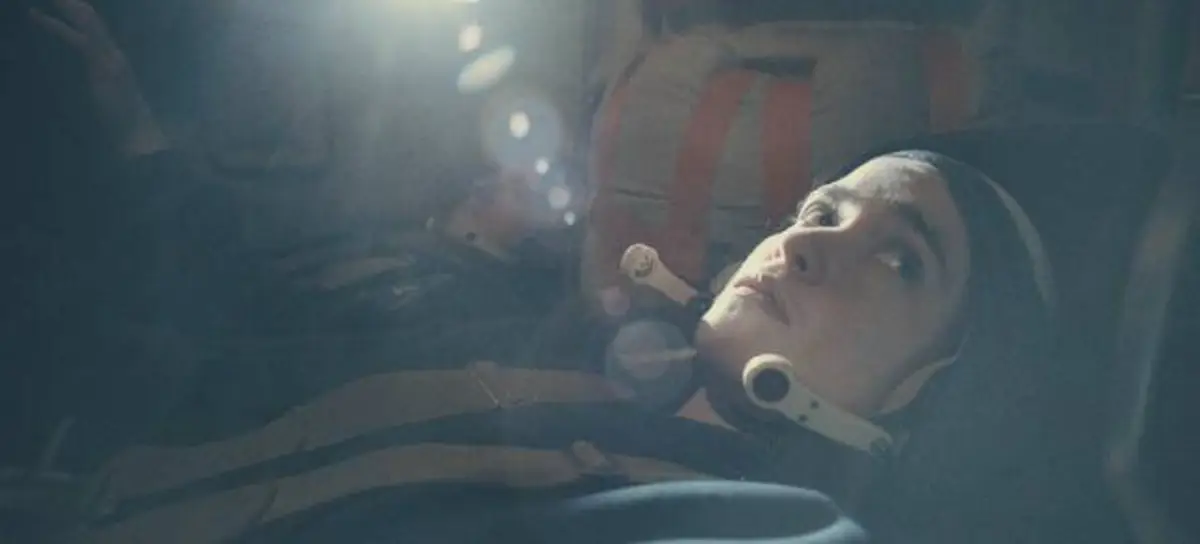
A spin-off from Apple TV’s “For All Mankind” that doesn’t require having seen “FAMK” to understand, Apple TV’s “Star City” goes back to the beginning of human space flight in the 1960s to tell an alternate history of the space race from the Soviet point of view.
Streaming its first two episodes Friday – additional episodes debut Fridays weekly through July 10 – “Star City” is, through five episodes made available for review, more earthbound than “FAMK.” “Star City” adds a layer of cloak-and-dagger intrigue as the Soviet space program’s “chief designer” (Rhys Ifans, “House of the Dragon”) has to not only worry about the dangers of space flight but also the prying eyes of the KGB, embodied by a cold, efficient agent played with chilly appeal by British actor Anna Maxwell Martin (“The Bletchley Circle”).
The younger versions of characters familiar to fans of “FAMK” appear in “Star City,” including the eventually formidable Irina Morozova (Agnes O’Casey), played in the character’s later years on “FAMK” by Svetlana Efremova. Younger versions of two other Soviet characters seen in “FAMK” — Sergei Nikulov, Anastasia Belikova — also have significant roles in “Star City.”
Although set in Russia (and filmed in Lithuania), the characters in “Star City” all speak English, presumably to make the show easier to follow for American viewers. “Star City” comes from the same writers/showrunners behind “FAMK,” so the emphasis on character remains even as the plot centers as much around Soviet secrecy and subterfuge as it does on the Soviet space program.
In a recent Zoom interview, “Star City” showrunners Ben Nedivi and Matt Wolpert said this spin-off came about because of their research for “FAMK.”
“The more we learned about the Soviet space program, the more we wanted to put it in ‘For All Mankind’ … [but] we have a lot of [American] characters and we could not really tell that story,” Nedivi said. “These [Soviet] stories are incredible, they’re insane. We couldn’t believe half of them were real, and that inspired us to tell this story and give it its own show.”
The showrunners don’t intend to repeat beat-for-beat what “FAMK” viewers already saw from the American point of view.
“It was very important to us the shows don’t act as direct counterpoints to each other,” Wolpert said. “We wanted to tell new stories, focused on new characters. … There are so many gaps in our understanding in ‘For All Mankind’ of what was going on behind the Iron Curtain, what was going on in Star City, so those are the stories we’re telling on this show.”
Nedivi notes in “Star City,” that if you make a mistake, you’re dead.
“In this show, it’s more dangerous on the ground than in space,” Nedivi continued. “That added a whole other layer to this show, a whole layer of danger and risk.”
For Tim Carras, a 2000 graduate of Gateway High School in Monroeville, there’s a direct line from growing up using his dad’s Super 8 film camera to create rudimentary special effects to being part of the visual effects teams for “Star City” and the most recent season of “FAMK.”
“When I was very young, my father taught me through in-camera editing how you can do trick shots,” Carras recalled. “You film a scene of my sister riding a bicycle down the street, and then you cut the camera when she goes behind a truck, and then you put me behind the truck [on the bike], and then start the camera again, and I ride past, and it looks like she magically turns into me midway through the ride,” he recalled. “I always thought stuff like that was just super-cool.”
Separately, his family bought a computer and Carras spent time designing graphics rather than writing code. He credits Gateway’s Video Club faculty adviser, Juanita Kollar, with encouraging his interest in video production.
Carras studied in the University of Southern California’s film program, created special effects for student films and for the past nine years has worked as a visual effects supervisor for Barnstorm VFX on projects as varied as FX’s “Clipped” (a greenscreen unit filmed fans to place into stadium shots) and HBO’s “Rooster” (digitally changing the color of leaves for a New England-set story filmed in California), bridging work in production with post-production.
He’d previously worked on visual effects for “Outlander,” which shares an executive producer, Ron Moore (“Battlestar Galactica”), with “FAMK” and “Star City.”
“We’re going back to the ‘60s and ‘70s for ‘Star City,’ so were making modern-day Lithuania look like ‘60s and ‘70s Soviet Union,” Carras said, explaining his team did a lot of environment work, removing high-rise buildings shot on location and replacing them in post-production with period-appropriate, Brutalist, Soviet-style structures.
In addition, Carras worked on scenes set in outer space.
“Something that’s in common with ‘For All Mankind’ is a lot of zero-G shots inside spaceships,” he said. “All the cast is wired up on flying rigs, and so we’re not only removing wires that are connecting them to the rigs but also the pick points where the wires intersect with the clothing. You have to smooth all those out and make them look invisible. In many cases, there’s no ceiling on the set, because that’s where the wires are connected to the crane, so we’re then replacing sections or the entirety of the ceiling of these modules and spacecraft with digital versions of [the ceiling].”
Carras said he learns something new on every series. For “Star City,” printed materials on set are all in Russian with Cyrillic text.
“Cyrillic handwriting is completely different from printed versions, to the extent where the lowercase ‘t,’ which, when it’s printed, looks like a Western ‘t’, but when it’s handwritten, it looks like an ‘m,’” Carras said. “There were a lot of shots where we were adjusting various handwritten memos or printed signage on the spacecraft. I had to completely relearn how this alphabet works to be able to even read what’s in the shot, let alone figure out what we’re replacing it with. I happen to have a colleague named Elena who’s from Russia, and she was absolutely essential to me in helping me read what’s in the shot and she would even do all the handwriting for all the replacement text that we would put in there.”
Although Carras’ work is often done on the computer, he appreciates the chance to be on set, something he did throughout the production of “Rooster” and for a few days on the upcoming sixth and final season of “FAMK.”
“I love the experience of being on that set and watching every department do the thing that they’re excellent at and seeing them collaborate with each other,” Carras said. “Sometimes I’ll be lucky enough to see a rehearsal or watch the showrunner and the director interact with the cast and have them work out a scene together. Takes me right back to film school and I’m getting this masterclass in how to structure a scene and how each character is gonna interact with the others. I love all that.”
But don’t mistake that for Carras wanting to direct.
“I’m blessed to be one of the few USC production graduates who has no aspirations to direct whatsoever, which frees me up to do the cool visual effects part for everybody else who is a director,” he said. “I have all the appreciation in the world for directors and actors, and I love what they do, and I love learning more and more about what they do, but I’ve done enough of it to know that it’s not for me.”