
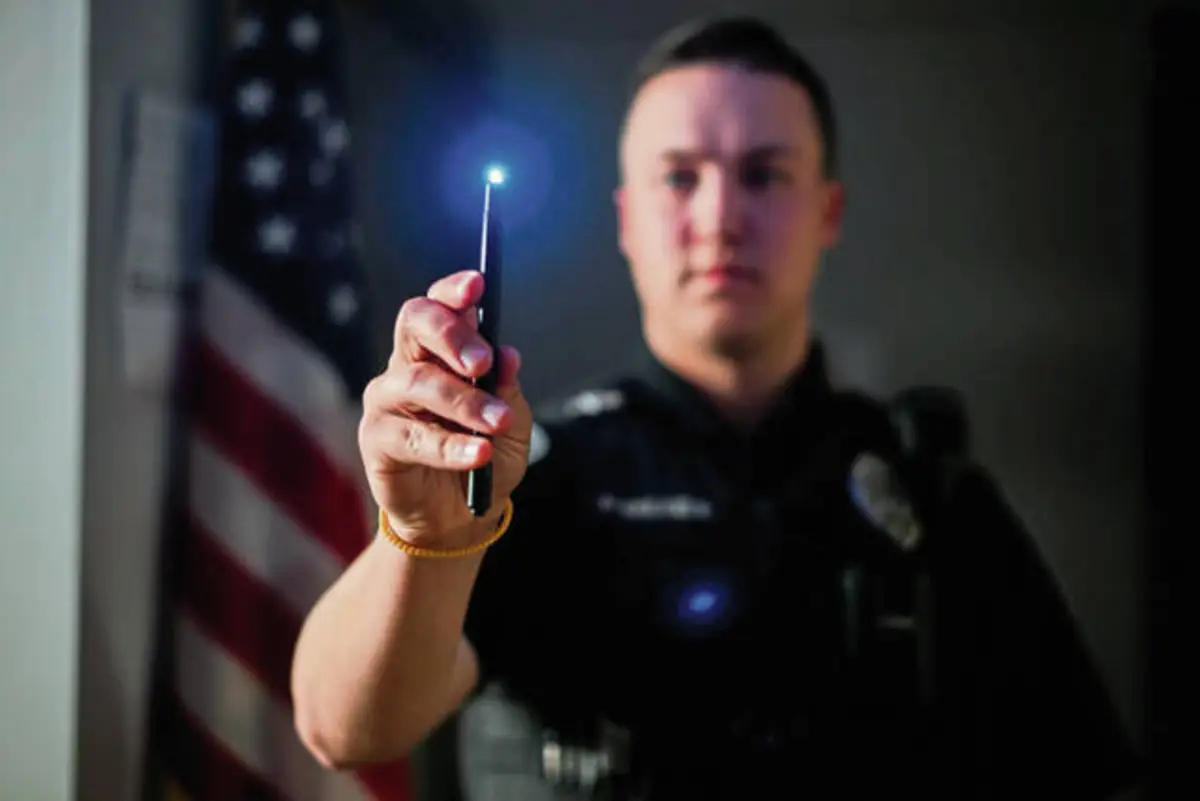
Most police officers can spot a driver impaired by alcohol, but relatively few can tell what drug might be causing impairment, especially when lacking the telltale signs of marijuana use.
Harrison police Officer Ryan Signorella is among a few in the state who can tell if the person behind the wheel sniffed inhalants, smoked crack or used heroin.
Signorella is one of 23 officers in Allegheny County to earn the certification of Drug Recognition Expert through the state DUI Association.
There are 275 DRE officers in Pennsylvania.
“Anyone can usually tell if someone’s been drinking,” said Signorella, 26. “If you have someone taking extra pills, it’s a little more difficult to detect.”
The state’s Drug Evaluation and Classification Program is a strenuous three-week course developed by the National Highway Traffic Safety Administration and approved by the International Association of Chiefs of Police.
It crams a semester’s worth of textbook studies into a two-week classroom session followed by hands-on evaluations at an open-air drug market in Philadelphia. There, officers observe drug users and test physical cues like pulse and temperature as well as motor skills and other commands, according to program coordinator Dave Andrascik. Toxicology is used to confirm their assessments.
Since the inception of DRE officers in 2004, the number of DUI drug arrests across the state has tripled, from 10,000 to 30,000, Andrascik said.
“There’s times when people take prescribed substances and might not even be aware that they’re not able to drive safely,” Andrascik said. “Whether illicit or prescription or even over the counter, these officers are trained in a 12-step process to determine if someone is impaired by a specific substance.”
Signorella said the training, at times overwhelming, taught him to be acutely aware of chemical reactions the body can’t hide.
“When you do a field sobriety test, people can alter their walk,” he said. “What drugs do to the body will betray any attempt at hiding it.”
In addition, DREs are frequently called to differentiate between drug influence and medical/mental health issues, Andrascik said.
“There are a lot of reasons that people can be driving erratically,” Greensburg police Chief Chuck Irvin said. “With the ability to identify a controlled substance, it takes a lot of the guessing out of it.”
O’Hara Sgt. Ben Wolfson, certified as a DRE in 2019, said the expertise can sometimes benefit a driver in peril.
“We look for several things — is this person impaired or suffering from a medical issue that mimics impairment?” Wolfson said. “We’ve had several cases that end with a person getting help. It’s not just ‘This guy is messed up and we’re going to call a DRE.’ ”
The DRE course is two weeks of textbook learning that includes studies of physiology, vital signs and drug classifications. There are three written exams, a standardized field sobriety test and five quizzes — for which officers must achieve at least 80% proficiency.
Students then spend a week on the ground in the Kensington section of Philadelphia, known as the East Coast’s ground zero for heroin, fentanyl and xylazine use.
From 2015 to 2019, police recorded more than 630 fatal overdoses in the 1.4-square-mile neighborhood, according to Washington D.C.-based think tank Niskanen Center.
During the week in Kensington, officers must conduct at least 12 drug influence evaluations, identify people on at least three different drugs and earn a 75% toxicological confirmation rate. The week culminates with a final exam that takes eight to 12 hours.
Andrascik said there are only about 20 DRE officers certified each year across the state.
“It’s a hell of a specialty,” Harrison police Chief Brian Turack said. “The effects (of drug use) are not visible for long.
“When we would call for a DRE before, they would come from Pittsburgh or O’Hara. We were in a desert in this part of the county. It’s a huge benefit for us to have a DRE in our township, not only for us, but for neighboring municipalities.”
Irvin said he is fortunate to have two DREs in his department, both of whom are commonly called to help with investigations across the county.
“It comes down to police officers having niches, things they excel at,” he said. “If you don’t smell alcohol, that’s your next call — to a DRE officer. If the (Breathalyzer) test comes up a zero, there’s a reason. The training of DREs can lead to a determination within a degree of certainty.”
Irvin said officers who aspire to earn the DRE certification put the wheels in motion years in advance of schooling.
Candidate prerequisites include being certified in standardized field sobriety testing and becoming a sobriety test instructor. Students also must complete an Advanced Roadside Impaired Driving Enforcement course and have a minimum of three years of police experience.
Being a Class A Breath Test operator is preferred.
Irvin said his DREs host classes to instruct patrol officers in field sobriety testing at least once a year.
Wolfson, an officer for 29 years, said his passion for thwarting drunken/drugged driving drove him to pursue certification as a DRE instructor in 2023. He was twice awarded the Pennsylvania DUI Association Top Gun Award for his efforts.
When he passed the DRE test, Wolfson was among only seven DRE officers in the county, not including state police.
“I used to run everywhere,” he said. “I’ve been to almost every department in the county doing evaluations.”
Having a newly certified DRE officer in Harrison is huge, Wolfson said.
“The impact is great,” he said. “For so long, I was the closest one to call. It’s big for the program and for the entire area.”
Signorella said he has always had a drive to curb impaired driving. Becoming a DRE not only sets the township apart, but it fuels his passion to help get drunken/drugged drivers off the road.
He’ll be responsible for responding to calls across Allegheny, Westmoreland and Armstrong counties. Westmoreland has eight DRE officers. Armstrong has seven.
“That I can be here when the guys need me, it’s a big deal,” he said.