
Pittsburgh International Airport’s cell service is stepping into the modern age, and passengers and employees alike stand to benefit from improved processing speeds on their mobile devices.
The airport completed its upgrade to the newest mobile network standard — 5G — just in time for the NFL Draft last month, when passengers from all over the world touched down as part of a record- setting turnout of more than 800,000 visitors over three days.
The network was built by American Tower, a Boston- based communications infrastructure company, which sells the 5G space to major cellular service carriers. It will pay the Allegheny County Airport Authority roughly $6 million across its 10-year contract for the privilege of operating at the airport.
The airport authority plans to direct the revenue to its general fund to help offset airline rates, Kerlik said.
Needed upgrades
5G uses a wider radio spectrum and higher-frequency bands than its predecessor, 4G. That enables it to transmit more data and at faster speeds even while connected to thousands of devices, said Amit Shah, American Tower’s vice president of technology solutions and engineering.
Airport customers can take advantage of more efficient mobile check-ins and smoother streaming on their devices, while employees will use the connectivity for real-time baggage tracking, automated maintenance sensors and AI-powered surveillance, Shah said.
“By providing a reliable digital foundation, 5G helps the airport reduce delays, improve security and handle higher passenger volumes more efficiently,” he said.
Pittsburgh International executive vice president and chief information officer Deepak Nayyar said the digital connectivity 5G offers has become a necessity for modern air travel.
Kerlik added that customer and employee demand for the latest cellular network technology is “higher than ever” because of the rise of streaming.
“Whether it’s meetings on Zoom or Teams for staff and business travelers, or leisure travelers watching video, (Pittsburgh International’s) 5G experience is best-in-class,” he said.
Implementation
5G had been available in a limited capacity through three major cell carriers at Pittsburgh International — Verizon, T-Mobile and AT&T — prior to the new landside terminal’s debut last fall, Kerlik said. He said 5G is now available at many major airports in some capacity, but it hasn’t been universally deployed yet.
However, each carrier operated its own system, requiring a maze of equipment and antennas, he said. The expanded network consolidates the cell carriers through a “neutral host” Distributed Antenna System, meaning that carriers can pay American Tower to lease space.
“This approach significantly reduces gaps, boosts coverage and reduces power consumption while also minimizing the amount of fiber cabling and supporting infrastructure required,” Kerlik said.
American Tower’s installation process wasn’t quite as efficient as the upgraded network speeds. 5G’s higher- frequency signals travel shorter distances, making it harder for them to pass through solid objects and requiring a denser infrastructure footprint than 4G, Shah said.
Another wrinkle was that American Tower had to set up Pittsburgh International’s network amid the new terminal’s construction while ensuring that each of the three cellular providers’ networks still were functional during the transition, Shah said.
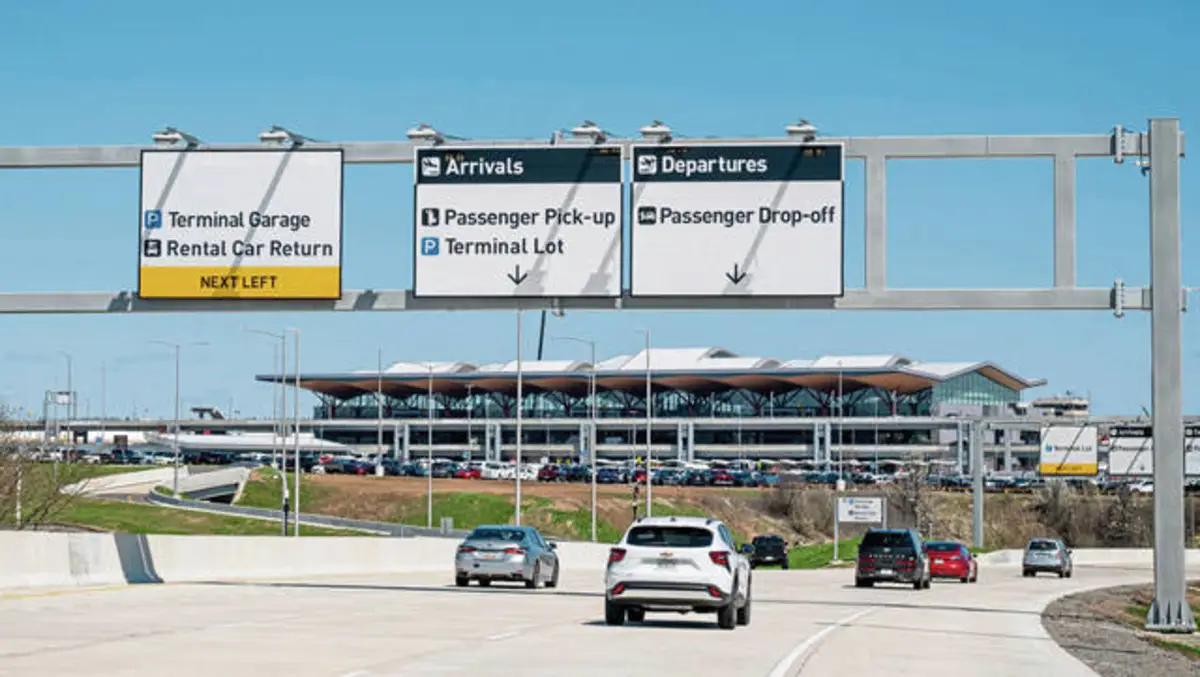
The 5G infrastructure is largely hidden from public view to meet the terminal’s “strict aesthetic constraints,” Shah said. Designed by the firm of Spanish architect Luis Vidal, the $1.7 billion terminal pays homage to Pittsburgh’s industrial heritage and Western Pennsylvania’s natural beauty, from faux trees supporting the roof to a nod to the Fort Pitt Tunnel beyond the TSA checkpoint.
American Tower operates tens of thousands of communications networks across the United States, including Cincinnati/Northern Kentucky International Airport.