
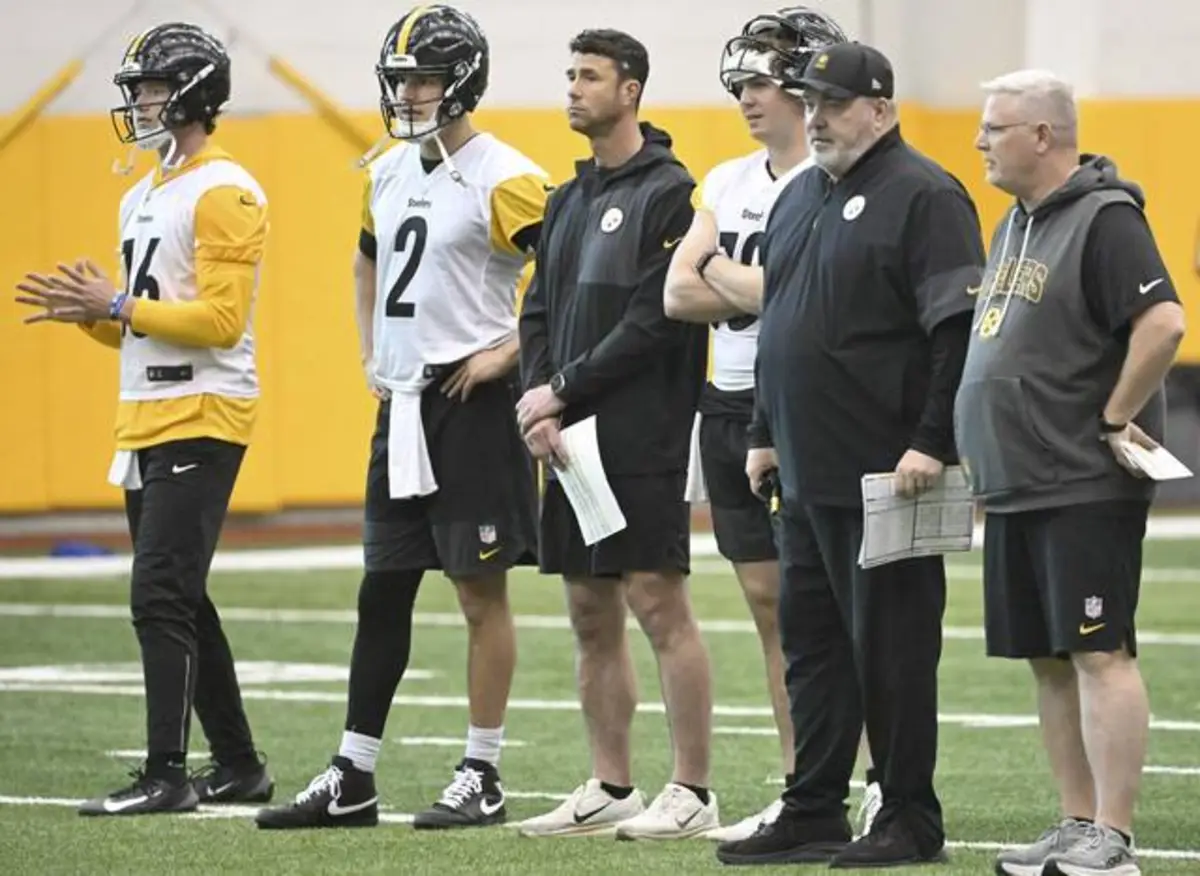
Developing two young quarterbacks can be better than having only one, says Pittsburgh Steelers assistant Tom Arth, himself a former student in coach Mike McCarthy’s QB school.
Second-year pro Will Howard and rookie Drew Allar can bring out the best in one another as “ultimate competitors,” Arth said Wednesday. The Steelers, with Howard and Allar among their four quarterbacks, have started the second week of practice-like organized team activities.
“I think it’s really positive to have two young guys together,” Arth said. “Obviously, a little bit different stages and different players but two guys that are going to be very competitive with one another.
“They get along well. They’re both great, great people. Smart players,” Arth said. “But they’re ultimate competitors. They wouldn’t be here if they weren’t. I’m very excited to see … how the two of them bring the best out in each other.”
Howard, 24, and Allar, 22, are navigating the developmental QB school process designed a few decades ago by McCarthy and tailored in recent years to comply with offseason rules.
A 24-year-old Arth got a close-up look at McCarthy’s so-called school after signing as a free agent in Green Bay in 2006. The former John Carroll quarterback spent a few months with the Packers, and Arth said he was curious to learn how much McCarthy’s system had changed since.
“That was what I was really excited to see, like, the evolution of it,” Arth said. “And really, within the new rules, how is it implemented?”
This is Arth’s third season coaching Steelers quarterbacks. He was a holdover from Mike Tomlin’s coaching staff. As a player in Green Bay, Arth was a late-summer cut in Aaron Rodgers’ second year.
“When I went through it, I feel like … we were there lifting weights at, like, 7 in the morning,” Arth said. “We’d have quarterback meetings from 8:30 until 11. We’d be on the field from 11 to 12. We’d go to lunch, we’d come back, have meetings from 1 to 3:30. And I’m, like, how are we going to do all of that with the current rules?”
Time is the most important element in quarterback development, he said. Restrictions in the collective bargaining agreement have put greater limits on offseason workouts since 2011.
Arth said McCarthy’s QB school nowadays is structured to maximize the available time.
“In terms of the fundamentals of it, it’s all very similar,” he said. “It’s all what I remember, and it’s time tested and it’s proven.”
A core element is a video profile.
The quarterbacks are recorded at the start of offseason workouts and again near the end for film-study purposes. Some of Arth’s old videos from Green Bay surfaced recently, thanks to McCarthy.
“He went back and found some clips from my first profile and kind of put it up there as an example (for the current quarterbacks),” Arth said with a laugh. “It was fun to go back through. … Looking at the quarterback I was fundamentally from the first profile to the second profile, I mean, you look like a completely different person.
“We’re kind of feeling that now. It’s still pretty early for Drew, but Mason (Rudolph) and Will have been in it since the beginning of the offseason program. They look fantastic. They’re doing a great job and really developing through that program.”
McCarthy built a reputation as a quarterback guru, thanks in part to the offseason program he developed since his days as an assistant coach in Kansas City. His resume famously includes success with star quarterbacks Brett Favre and Aaron Rodgers in Green Bay and Dak Prescott in Dallas.
But Arth noted how McCarthy’s QB system also developed backups who played “exceptionally well” when called upon, pointing to Cooper Rush as a good example.
“It’s pretty remarkable,” Arth said. “It’s a proven methodology, and we’re certainly seeing it in our guys in a short amount of time that we’ve been working with them. There’s been a big improvement in a number of different areas.”