
As the former CEO of production house Klasky Csupo, which managed television shows including “The Wild Thornberrys” and “Rugrats,” Terry Thoren knows the way an engaging piece of animation can hold a child’s attention.
And part of his philosophy was to make sure children’s programming carried some kind of lesson.
“My goal is to work with students on project-based storytelling and learning how to create content that’s intentional,” he said. “When I was young, shows like ‘My Three Sons,’ ‘Father Knows Best,’ even ‘Gunsmoke,’ had a moral to the story.”
As CEO of Wonder Media, Thoren has engaged young people to collaborate and help create animated films where students write the scripts, create the storyboards and find their own creative ways to impart lessons.
With support from The Grable Foundation, Wonder Media spent the school year working with students and teachers from nine Western Pennsylvania school districts to create a feature-length animated film about youth mental health — written, voiced, animated and scored entirely by students.
The result is “Finding Alice in Wonderland,” a twist on the Lewis Carroll classic with a focus on positive mental health tips for children.
In the story, Alice struggles through a difficult first week at a new middle school and begins to feel isolated and self-conscious. Through a dream journey to Wonderland, she learns strategies for coping with anxiety, building resilience and supporting friends who may be struggling.
Among the nine districts, Franklin Regional was the only one where elementary students were chosen to take part. Middle- and high-school students from the other eight districts — Highlands, Clairton, Woodland Hills, Quaker Valley, Seneca Valley, California, Cornell and Carlynton — worked on the project, with each taking charge of a certain part of the overall story.
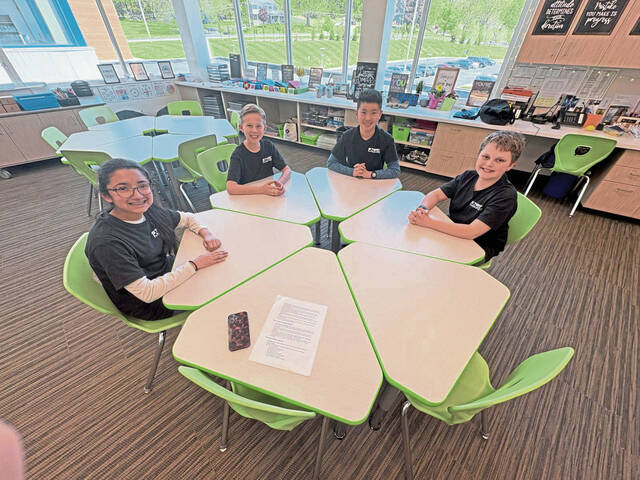
“I always really liked storytelling, so the scriptwriting aspect really interested me,” said Hadiya Anzaar, 11, one of four fifth grade gifted students at Franklin Regional Intermediate School who worked on the project.
“We worked through 12 Zoom coaching sessions with professional trainers from Wonder Media,” said fifth grade gifted teacher Addie Martz. “And each session was guided by their creative director, Amanda Carson. There was a lot of flexibility involved. The kids all really got to have their own say.”
While students did not do the actual animation, they took creative control over the rest of the process.
“I think they sort of gave us the foundation of what we were meant to do, but we got to choose how to do it,” Hadiya said.
For their portion of the animation, Hadiya and fellow fifth graders and gifted students Eli Morris, Cheng Sen and Wesley Arnett created a scene where Alice and the White Rabbit try to seek out the Cheshire Cat.
“The whole mental health aspect of our segment was about not having to cover up your feelings,” Morris said. “The premise of the project, Wonder Media told us, was ‘Show Your Truth.’ ”
“In the story, the Cheshire Cat covers up his feelings with jokes,” Arnett said. “He never explained to Alice that he was lonely until the end of the story when he finally tells the truth about his feelings.”
Cheng was particularly excited about doing voice-over acting.
“I really want to do more voice acting, and I also got to draw the storyboards, where you show how the different scenes in our part will look,” he said.
Wonder Media takes all nine segments and puts them together through animation. The students who took part and guests watched the premiere May 22 at Woodland Hills High School.
“This is the second film we’ve funded,” said Grable Foundation spokesperson Ryan Rydzewski. “Last year, we had 19 districts put their own spin on ‘The Wizard of Oz.’ It’s a great experience, and it’s important especially in this age of ChatGPT where it’s getting more difficult to have students do the challenging work of writing.”
Rydzewski said the “Alice” film’s focus is on the transition from elementary to middle school.
“Forty years of research has shown us that transition can be particularly challenging,” he said. “We wanted to give the kids a reason to research mental-health strategies and give them a way to provide tools for their peers who are navigating that transition.”