
Cancer treatment and the technology and pharmacology that fosters it has come a long way over the decades. But cancer patients, especially those who are elderly or disabled, can’t always get to their appointments on their own.
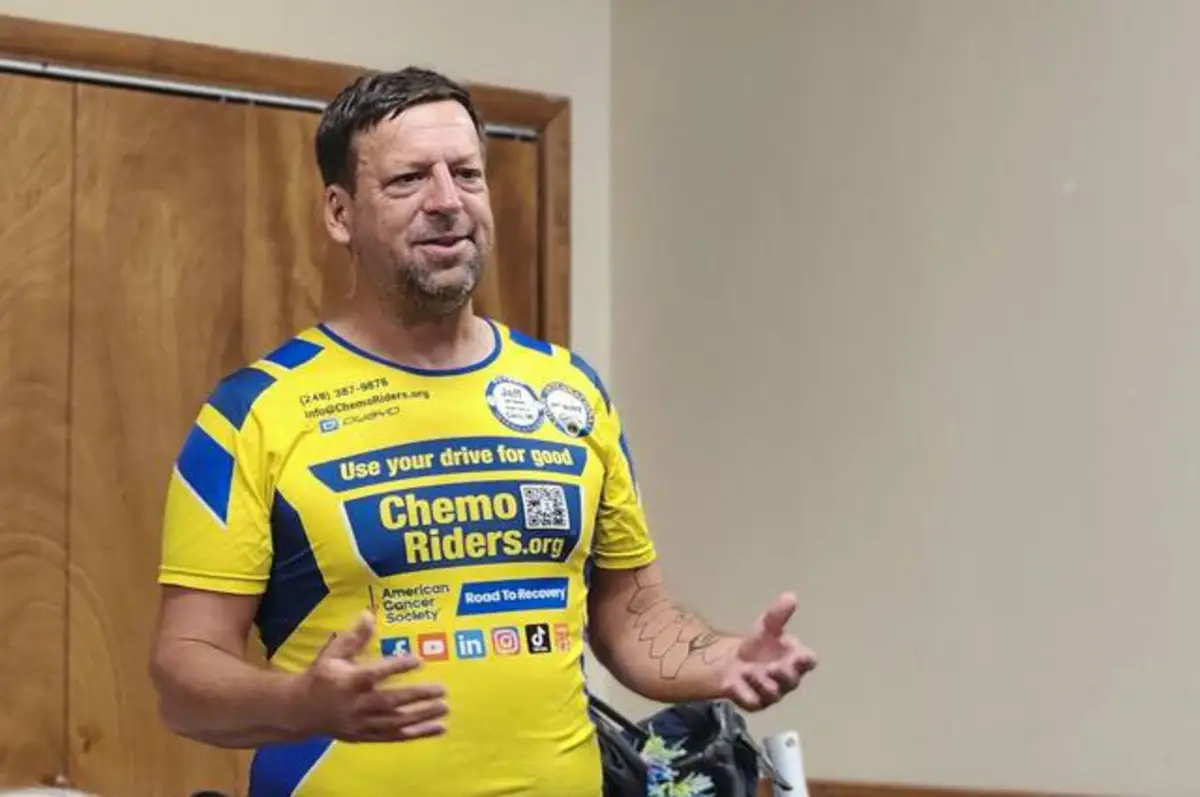
“All the technology in the world doesn’t help if someone can’t get to their doctor,” said Rotarian Jeff Molby, 45, of Caro, Mich.
Molby’s father caught his colon cancer at a very early stage, “and the surgery went so well, I really took it for granted,” Molby told members of the Turtle Creek Rotary Club at their May 29 meeting in Monroeville.
Over the next few years, Molby met several families who were not so fortunate, whose loved ones had gotten a sudden diagnosis of aggressive cancer or who didn’t take the time for regular check-ups and missed the chance his father had gotten.
That’s a big part of the reason why Molby is two-and-a-half years into a three-year cycling trip, biking tens of thousands of miles as he literally spells out the one-word sentence “Help!” across the United States, in an effort to draw attention — and more volunteers — to the American Cancer Society’s Road to Recovery program.
The program is simple: Volunteers sign up to receive notifications when a person in their area needs a ride to the doctor’s office or another medical facility. If they’re available, they provide the ride.
“These (cancer) treatments are often very regimented,” Molby said. “So if someone isn’t able to stick to the schedule, the doctor will make a ‘Plan B,’ but it will never be as good as ‘Plan A.’ So anything we can do to keep people on that primary course of medicine is truly lifesaving work.”
Molby started his cycling journey in October 2023, high-tailing it as quickly as he could out of his home state of Michigan so he could get south before winter weather set in.
Molby admits he embarked on the trip with more excitement than preparation.
His first bike — “One cyclist looked at it and said quietly, ‘That’s a … that’s a bold choice, Jeff,” he said — lasted three months and got him as far as Florida, where it found the end of its useful life.
“This trip has ruined three bikes so far,” he said with a laugh.
The trip isn’t continuous. Molby takes three to four weeks off every few months to return home to his family. His goal on the road is to make between 40 and 50 miles of progress each day. Depending on where he’s at in the country, that goal is at the mercy of the weather.
“There have been times in the Midwest where I’ve had to keep an eye on tornado watches and make sure I know where nearby shelter is,” he said.
He plots his trips in order to spend winters down south, using the past three to loop through Florida, Texas and Southern California. His bike is loaded with supplies, including a tent — “It’s about the size of a coffin” — where he sleeps about 80% of the time. On May 29 when he spoke to the Rotary, a Rotarian was hosting him for the night.
Part of the trip also included forming the nonprofit Chemo Riders, which he uses to document his travels, raise awareness and hopefully boost Road to Recovery’s volunteer numbers.
“Never think that something simple like driving a person to the doctor isn’t important volunteer work,” Molby said. “When I was in Pensacola, Fla., I met a man who would never go around bragging about doing it. But he’d been doing it for 10 years and he was about to give his 503rd ride. And I know there are people out there whose lives were saved because Buzz Windham gave them a ride.”
He said the Road to Recovery program is one of the most flexible and rewarding opportunities he has found to volunteer.
“I bet there are a few people in this room who can provide a few rides each month,” he said.
Molby had traveled 20,437 miles when he arrived in the Pittsburgh area. After a week here, he will head north to Buffalo, N.Y., and will wrap up his trip this October in Raleigh, N.C., on the third anniversary of its start.
He said being a Rotarian also was part of what inspired his journey.
“That four-way test we have — Is it the truth? Is it fair to all concerned? Will it build goodwill and better friendships? Will it be beneficial to all concerned? — those are the values I lean on when I get up some mornings and just don’t feel like biking 40 miles,” he said.
To learn more about Molby’s journey, visit chemoriders.org. To volunteer for the Road to Recovery program, visit cancer.org and enter Road to Recovery in the search box.