
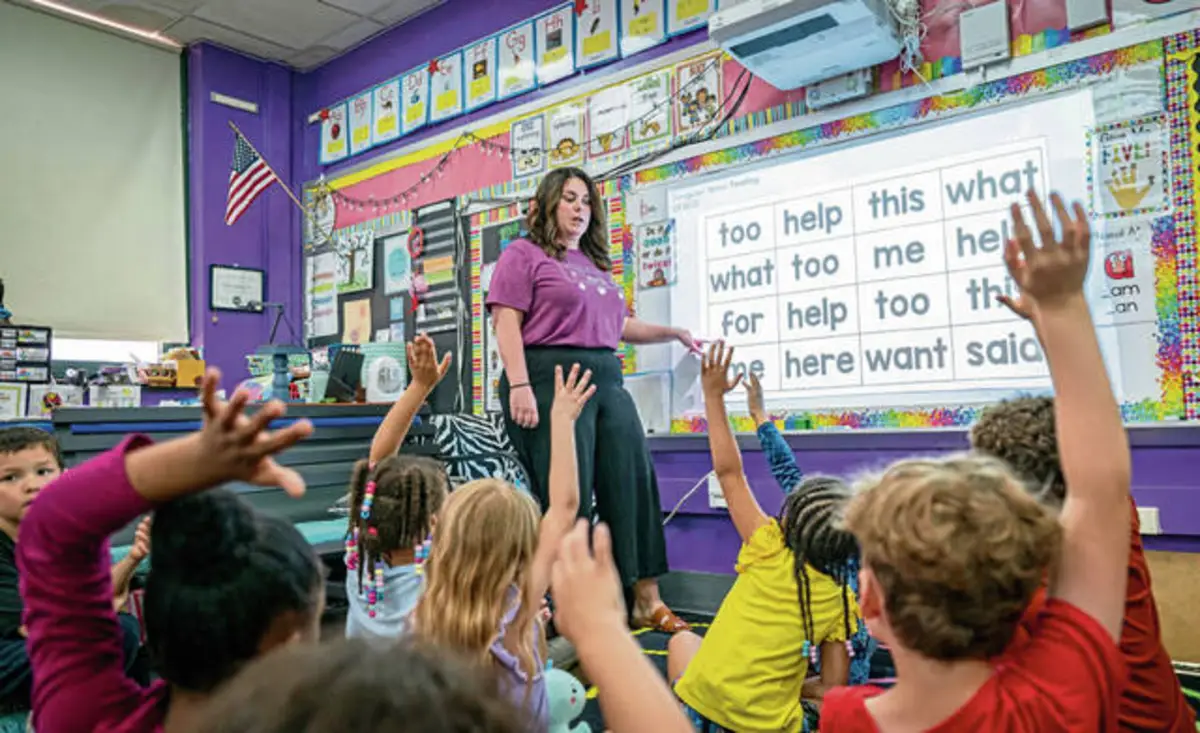
No one was a greater skeptic than Martin Elementary kindergarten teacher Alissa Szewczak when New Kensington-Arnold administrators announced the district would switch reading curriculums.
Two years into using the program, Szewczak’s doubts have evaporated, as she has watched students demonstrate marked improvements in reading and writing.
Now, the state Department of Education is requiring Pennsylvania’s 500 public school districts to adopt the same system — dubbed “structured literacy.”
Gov. Josh Shapiro in November signed into law updates to the Public School Code that require schools to adopt the structured literacy curriculum — in kindergarten through third grade — by the start of the 2027-28 academic year.
The 2025-26 state budget allocated $10 million in grant funding to assist schools with implementation, said Erin James, spokesperson for the Department of Education.
Legislators in October 2024 sent to Shapiro a bill that would provide schools resources to improve early literacy, including information about the structured literacy curriculum. Shapiro signed it into law that month.
Sen. Ryan Aument, R-Lancaster, a co-sponsor of the bill, cited data from the 2022 Nation’s Report Card to demonstrate the legislation’s necessity.
The Nation’s Report Card details the results of the National Assessment of Educational Progress. The assessment — administered by the U.S. Department of Education’s National Center for Education Statistics — is given to a sample of students from randomly selected schools each year.
Nearly half of Pennsylvania’s fourth grade students scored below grade level on the 2022 assessment, according to Nation’s Report Card data.
The structured literacy curriculum focuses on teaching students literary comprehension, phonemic awareness, vocabulary, how to identify the individual sounds in words, how to pronounce written words and how to translate spoken words into writing.
These lessons are not necessarily new to Pennsylvania classrooms. But structured literacy directs educators to teach them using a specific order and language.
Topics such as verb tenses or use of commas are no longer taught in isolation, said Emily Di Cocco, a fifth grade English, language arts and social studies teacher at Canon-McMillan’s Cecil Intermediate.
Rather, the curriculum strategically weaves topics and prompts teachers to use the same vocabulary during lessons, she said.
For example, during lessons about the Latin origins of word parts, all of Cecil Intermediate’s fifth grade teachers tell students that “The origin of the root mit/mis is Latin and means ‘to send,’ ” Di Cocco said.
“Although teachers are still able to differentiate instruction based on the needs of their students, it is vital that they follow the chosen structured literacy curriculum as closely as possible,” she said.
Initially, Szewczak was wary of that approach.
“I am a naturally creative person,” she said, “and having to do direct instruction and … kind of read from a script was a dagger to my heart a little bit.”
Szewczak soon discovered that structure was what her students needed.
The district’s former curriculum gave teachers the flexibility to select different literature for students to read and to decide how much instruction time to spend on each lesson.
“The benefit of that was that we could use our creativity,” said Szewczak, who has taught in the district for 17 years. “The downside of that was that everybody was on a different page. We were all teaching to the same standard, but how we were getting there was a little bit different.
“The kids were all getting the same information in a different way.”
Structured literacy, she said, evens the playing field by ensuring students learn the same material in the same timeline.
“I’ve noticed significant changes in the students in this last year — their readiness to go to first grade, their willingness to read,” she said. “They’re not afraid to make mistakes. They get more excited when they can do it.”
Declining literacy rates
Education advocates nationwide have expressed concerns in recent years about declining literacy rates.
Nonprofit Pennsylvania Literacy Coalition, for example, has called it a literacy crisis.
Not quite half of the state’s third grade students — 48.6% — scored proficient or higher on the reading section of the 2025 Pennsylvania System of School Assessment, according to results posted on the Department of Education’s website.
The reading assessment — taken by students in all of the state’s 500 public schools — is based on the state’s core standards, the academic expectations for K-12 students.
Ten years earlier, 62% of third graders achieved that benchmark.
Poor literacy rates among students can have an impact later in life.
Pennsylvania’s adults fall in the middle of the pack when comparing literacy rates nationwide, according to the National Center for Education Statistics.
The center assessed the literacy and numeracy skills of 12,330 U.S. residents ages 16 to 74 in 2012, 2014 and 2017. Combining the results with data from the American Community Survey, the center created its “U.S. Skills Map,” highlighting the nation’s literacy rates.
The average literacy score for Pennsylvania adults fell at 266 out of 500 possible points. Those who scored between 226 and 276 points are defined as “nearing proficiency but still struggling to perform tasks with text-based information.”
Pennsylvania tied with five other states for the 11th highest average literacy score nationwide, according to the center. The state’s average score is not statistically different from the national average, the center said.
Education expert weighs in
The decline can be attributed in part to a lack of focus on phonics and background knowledge in classrooms, said Julia Kaufman, researcher at RAND Corporation, a global, nonpartisan research organization.
Kaufman, the director of education and employment, spends much of her time in RAND’s North Oakland office conducting K-12 education research.
Studies in recent years have shown elementary classrooms are using a method called “three-cueing” in place of a more robust phonics curriculum, she said.
Three-cueing prompts students to use the context of a sentence to decipher a word they do not recognize. Students might, for example, look at the picture next to the unknown word in a storybook or the meaning of the words in the rest of the sentence to guess the definition, she said.
Phonics, however, instructs students on how to break down words into parts and use the meanings of those parts to define the unknown word — a more effective approach to teaching students how to read, she said.
But too great a focus on phonics, Kaufman said, can prevent students from gaining sufficient background knowledge: the collection of facts, experiences and vocabulary that help a student make sense of the world around them.
“Kids need — all along — good vocabulary, good building of background knowledge,” she said. “Background knowledge is just critical for comprehension.”
Canon-McMillan reports more students reading at grade level
Students’ declining reading and writing performance is what prompted the Canon-McMillan School District to rethink its reading program in 2023, said Superintendent Greg Taranto.
By the end of the 2022-23 school year, about 14% of the district’s fourth grade students were not meeting their grade-level reading standards, Taranto said.
“The kids’ writing was not up to par, and it was hard to get them to write multi-paragraph papers,” he said. “The kids didn’t seem interested in reading.”
Since installing the structured literacy curriculum in 2023-24, Taranto has observed a shift in his students’ approach to reading.
“It’s the polar opposite now,” he said. “The kids love reading.”
Today, all but 4% of the district’s fourth graders are reading at grade level, Taranto said.
Program addresses ‘learning gaps’
Di Cocco witnessed that transformation firsthand in her Cecil Intermediate classroom.
Di Cocco, who began teaching at Canon-McMillan in 2016, left in May 2023 for maternity leave and later resigned to address health concerns. She was rehired to teach fifth grade in December.
While Di Cocco was away, the district transitioned to structured literacy. She said she was shocked upon her return to see her students working on a text-dependent analysis project.
“I was immediately just blown away with the level of true understanding of the text and the connections they were able to make with higher level vocabulary,” she said. “They were able to answer complex questions.”
Prior to Di Cocco’s leave, Canon-McMillan used a curriculum called balanced literacy, which focused on students reading and completing work in small groups. The literature that students read was often less informative and featured simpler words, preventing students from building a strong world knowledge base and vocabulary, Di Cocco said.
This resulted in learning shortfalls as students moved from one grade level to the next, she said.
“There were gaps in learning from when the students were coming from fourth grade to fifth grade,” she said, “and truthfully, when we were sending them from fifth grade into sixth grade, we weren’t completely confident that they had everything that they needed.
“It felt like we were teaching so many different concepts but never really digging deeply into any of them as much as they deserved, because we were just trying to do everything and more.”
Under structured literacy, Di Cocco’s students are exposed to more advanced vocabulary and a greater variety of history and science topics — including the Renaissance, Protestant Reformation and ancient Greece.
“Now, because we have these high level texts, we are diving deep,” she said. “They are getting that vocabulary and they are able to … produce higher quality pieces of writing, therefore improving their communication and comprehension.”
Transitioning to structured literacy wasn’t without challenges, Di Cocco said.
“At first, it might feel like, ‘This is so unorthodox,’ ” she said. “And then after you see the kids coming up from lower grade levels and coming to you with that background knowledge and everything just slowly starts to piece together, I think teachers and districts will be like, ‘OK, wait, now we get it.’ ”
Kaufman is encouraged by Pennsylvania’s shift to mandated structured literacy. But the new curriculum alone is not enough to address literacy gaps among students, she said.
Professional development and monitoring of teachers using structured literacy are keys to ensuring the success of the curriculum, she said.
“Schools need to have people that are monitoring use that are really knowledgeable about structured literacy and the things that work,” Kaufman said. “When they walk into a classroom, they know if the teacher is engaging in good practices, whether or not they’re using the curriculum the whole time.”
Structured literacy a staple at Greensburg Salem
Hutchinson Elementary first grade teacher Madalyn Leonard has incorporated some components of structured literacy into her classrooms since 2016-17, her second year working in the Greensburg Salem School District. Administrators implemented the program district-wide during the 2021-22 school year, said Superintendent Ken Bissell.
The district previously used a program called basal literacy. Although it incorporated similar phonics components to structured literacy, it spent more time introducing the basics of reading, she said.
“It would take you the entire school year to just introduce all of the letter sounds, and by that point, you’ve wasted so much time,” she said. “The kids that were ready to start sounding and blending and reading decodable words, they are waiting and waiting for those letters to be introduced.
“And then the students that needed more time with the letters don’t get it, because by the end of the school year, you’re moving on to the next level, and things just keep getting harder and harder as you go.”
Structured literacy has given Leonard’s students more confidence and interest in reading and writing, she said.
“Any teacher you would talk to that teaches this program, this is the one thing that we all have found a lot of success with,” said Leonard, a former reading specialist for the district. “You can see it really helps the kids, especially when they’re at this level.
“As soon as they pick the patterns up, they have them forever, and you can see the difference between who gets them and who doesn’t.”
Pittsburgh Public Schools students have shown improvement in their reading accuracy and phonological awareness — the knowledge that words are made up of individual sounds — since the district implemented structured literacy in 2023-24, said K-5 Curriculum Director Naomi York.
“We’re seeing gains in our data. We’re also seeing that our students are so confident,” she said. “I walk into classrooms with kindergarten and first grade students, and they come to me and tell me they’re a reader. It gives me goosebumps knowing that they’re so confident.”
New Kensington-Arnold saw significant improvements to students’ reading comprehension skills at the end of the 2024-25 school year — the district’s first year using structured literacy. Students achieved the highest scores the school had seen in five years on the DIBLES test, an end-of-year literacy assessment, according to Principal Angela Manchini.
Mid-year literacy assessment results showed students were on track to achieve similar scores this school year, Manchini said.
“Now we’re streamlined,” said Szewczak, the Martin Elementary teacher. “And we’re noticing a significant improvement in how quickly they’re reading, how quickly they’re writing, even just their willingness to try.”