
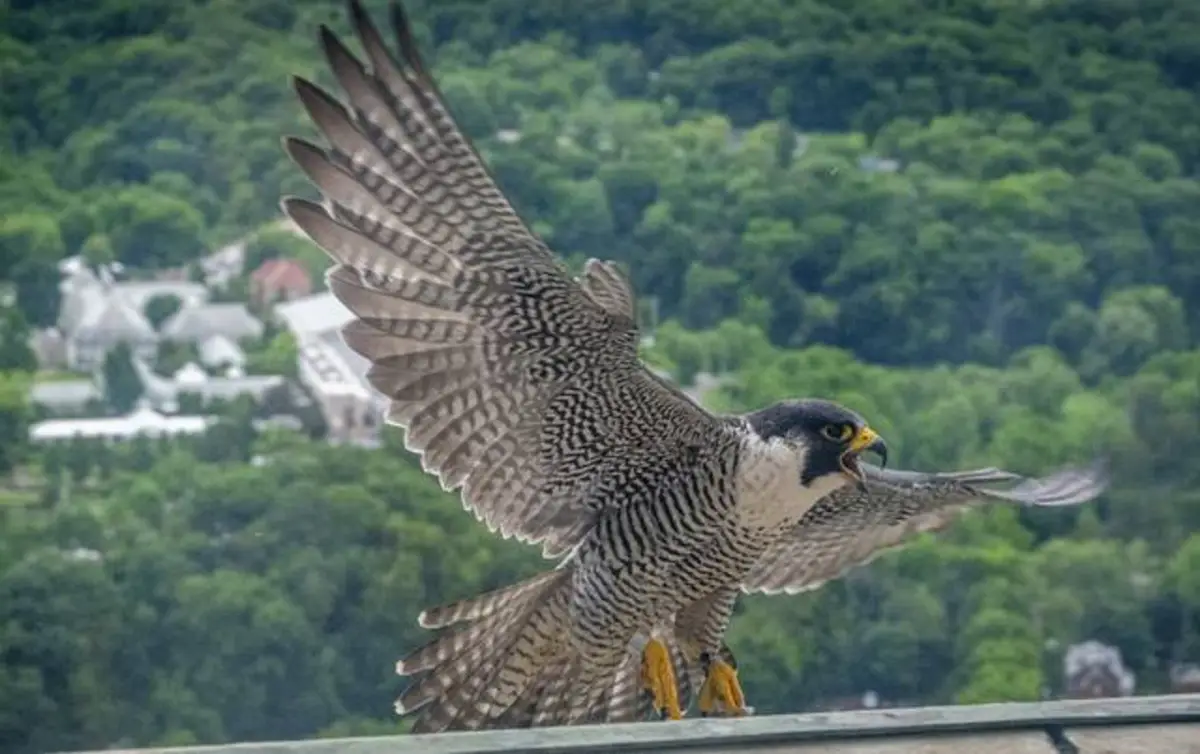
A mother peregrine falcon named Carla circled above the Cathedral of Learning on the University of Pittsburgh campus, briefly landing near its towering windows before launching back into the air. With a wingspan of more than 3 feet, she darted around the building’s familiar perch, watching closely.
Behind the 40th-floor windows, wildlife experts from the National Aviary and the Pennsylvania Game Commission gathered. The curtains, usually drawn, had been opened, and the shades raised — signals Carla recognized immediately.
From outside the glass, she peered in. Carla knew the routine. This was her third brood, and the bird knew the open shades could mean only one thing: Her babies were about to be banded.
Last week, Patricia Barber, an endangered bird specialist with the Pennsylvania Game Commission, tagged Carla’s four chicks, attaching identification bands that will help researchers monitor their movements and survival as they mature.
Today, peregrine falcons are a familiar sight nesting on bridges and skyscrapers across Pennsylvania. In the state’s southwestern region, there are 16 known adult peregrine falcons and an estimated 14 chicks. Decades ago, the species had nearly vanished.
Like bald eagles, peregrine falcons were devastated by widespread use of the pesticide DDT, which caused birds to lay eggs with shells so thin they often broke before hatching. They were endangered for more than 25 years.
The need for speed
Peregrine falcons typically lay between three and five eggs, said Robert Mulvihill, the National Aviary’s ornithologist. One of three types of falcons found within Pennsylvania, they are widely considered the world’s fastest animal.
“They’re among the most aerially capable birds in the world. There are very few birds that fly anywhere near as fast as a falcon can fly. They have very long, pointed wings, and it’s a design that is perfect for speed in flight,” Mulvihill said.
Peregrine falcons have been clocked at more than 200 mph.
After being nearly wiped out by chemicals, the speedy falcons slowly recovered due to the work of wildlife specialists and Pennsylvania legislation.
In 1999, the species was removed from Pennsylvania’s endangered species list. In September 2021, Pennsylvania removed the bird from its register of threatened species.
The recovery began after The Peregrine Fund, a nonprofit headquartered in Idaho, was founded in 1970, followed by the U.S. Environmental Protection Agency’s ban on DDT in 1972.
“Society decided these were things we valued, and we wanted them to be improved, and all of that set the stage for the recovery of peregrines,” Barber said. “The peregrine community came together — and by that I mean conservationists, falconers, anyone who was interested in wild birds — and The Peregrine Fund bred as many peregrine falcons as they could.”
The Peregrine Fund successfully bred the birds in captivity and released more than 4,000 of them into the wild, according to its website.
By 1989, a pair of peregrine falcons had returned to Pittsburgh for the first time in 33 years. They were spotted hunting among Pittsburgh’s skyscrapers by the Western Pennsylvania Conservancy.
For peregrine enthusiasts like Kate St. John of Oakland, the birds are easier to spot than many people realize — if you know where to look.
So far this year, there has been peregrine falcon activity on several bridges in Allegheny County, including Pittsburgh’s West End Bridge between the North Side and West End, the McKees Rocks Bridge between McKees Rocks and Stowe, the Spruce Run Bridge in Ben Avon, the Sewickley Bridge between Sewickley and Moon, the Tarentum Bridge between Tarentum and New Kensington, the George Westinghouse Memorial Bridge between East Pittsburgh and North Versailles, and the 62nd Street Bridge between Lawrenceville and Morningside.
In addition to the Cathedral of Learning in Oakland, the species also has been spotted around East Liberty Presbyterian Church and Duck Hollow, a section of the Swisshelm Park neighborhood along the Monongahela River.
Bird watching
St. John was the first to report peregrines around the University of Pittsburgh area in 2001 and has since tracked their presence in Southwestern Pennsylvania on her blog called Birds Outside My Window.
“I knew that they would nest there and I reported it into a bird forum,” St. John said. “I knew that there were such things as nest boxes, because they had one at the Gulf Tower. So I made it my mission as a volunteer to get all the players together to get a nest box in the Cathedral of Learning.”
Since then, the Cathedral of Learning has been the birthplace of 67 peregrines over the years. Some have stayed in Pittsburgh, but others have either died or flown away.
While peregrine falcons have adapted well to nesting in the city, they still experience unique challenges, including fatal collisions with reflective glass and vehicles.
“Adult birds are attracted to the structure and the food, but it’s a very difficult place to raise young, and actually all of our young peregrines that were raised in a city that have shown up as breeders somewhere else were all handled by people,” the game commission’s Barber said. “So it really does suggest that they need that human intervention in a city environment.”
For more than a decade, Barber has been ensuring peregrine falcons don’t go extinct.
On May 20, she provided human intervention once again. Barber climbed out a 40th-floor window onto a walled ledge outside the Cathedral of Learning to band each bird born on the building.
Wearing a protective hat and gloves, Barber carefully placed the chicks into a cloth bag and brought them inside the building.
While inside the bag, the birds became quiet and docile because of the dark environment, but as Barber took them out, they began to screech, temporarily disoriented by the change.
Molly Cochran, a wildlife technician with the state game commission, cradled the falcons in her hands, gently holding their wings down by their bodies while Barber attached bands to both legs.
Despite the squawking, the bands do not hurt the peregrines. Barber said they are similar to bracelets.
This year’s Cathedral of Learning brood includes at least two females and one male. Barber was unsure about the sex of the fourth chick.
The baby falcons cannot yet fly, but eventually they will venture away from the building, possibly traveling to surrounding states in search of a nest and a mate.
Mulvihill, the ornithologist, said banding is important because it allows researchers to associate data with an individual bird, including its age, sex, measurements and movements.
“Basically you just grow this fantastic story about the bird and its travels and its successes, and maybe ultimately their failures,” Mulvihill said.