
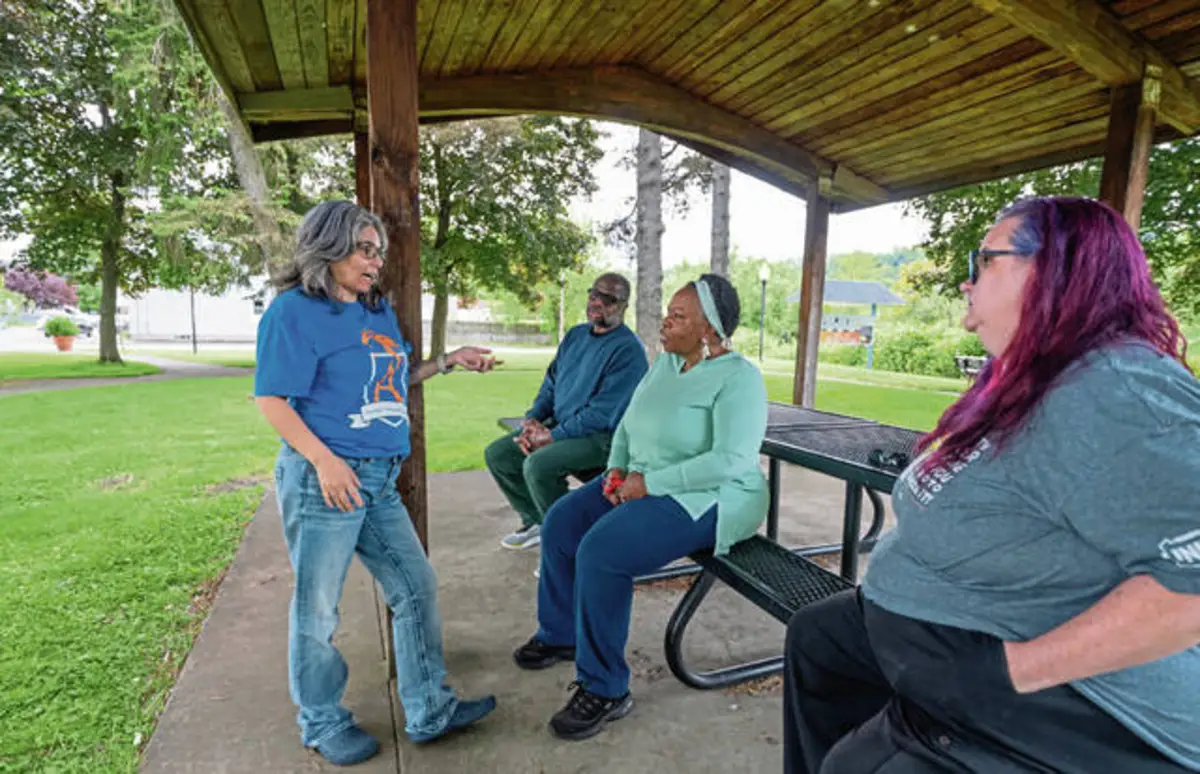
Jocelyn Burns retired to New Kensington in 2017 because it was cheaper than living in Montgomery County, Md., where she built a career as a nurse.
The move, however, didn’t protect her from what many are calling an “affordability crisis” in the country.
It started with unexpected repairs to her ranch home: a new garage door and $7,000 to fix her front sidewalk. Then the medical bills from Achilles tendon surgery rolled in on top of her rising utility bills.
“I was fine when I came here, financially,” Burns said. “Now, I’m looking (at) maybe pinching pennies.”
On Sunday, Burns will be among residents riding a bus to Harrisburg to advocate for state-level solutions to what nonpartisan grassroots organization Voice of Westmoreland and its umbrella organization, Pennsylvania United, say are ever-increasing strains on personal finances.
Pennsylvania United will gather residents from all six of its chapters across western and central Pennsylvania in two buses.
They will meet Monday with state lawmakers and later will hold a public display outside the state Capitol Building, said Kyla Rollins, Pennsylvania United’s communications director.
“We’re going to make some demands face-to-face,” Rollins said.
The group will be asking lawmakers to support a package of bills focused on things such as closing corporate tax loopholes and taxing unearned income.
Rollins said about 200 people are expected, including Pennsylvania United members and members from other organizations across the state.
Local efforts
Voice of Westmoreland launched its affordability crisis campaign at the beginning of the year. It is engaging more New Kensington and Arnold residents to join its efforts in local policy advocacy through canvassing and regular public meetings.
“We all understood the importance of the affordability crisis that people are feeling and the need for those elected officials to feel that,” said Billy Reeves, governing power manager at Pennsylvania United. “This is an opportunity to organize these communities around this shared experience — albeit not good experience, but shared experience.”
Reeves said the crisis is that more and more people are getting priced out of basic necessities.
“They have to choose whether they’re going to pay a medical bill or their health insurance, or are they going to buy groceries?” Reeves said. “No one should be put in that position.”
Though Reeves acknowledges that local officials don’t have power to make widespread systemic changes, they do have tools, such as funding local food, health, transportation and housing programs, to ease symptoms of rising costs.
Reeves said 1st Home Allegheny, a county home-loan assistance program launched by Allegheny County Executive Sara Innamorato, is a prime example of local aid.
“We’re inviting elected officials (to our meetings), especially those that are co-sponsored — also those that aren’t, but are interested in this work — to be able to hear the pain and suffering of the community,” Reeves said.
The cost of the crisis
Earlier this year, Voice of Westmoreland surveyed 469 people across Westmoreland County on their financial anxieties.
Amanda Rose Piern, a chapter director, said utility and healthcare costs are the two biggest stressors for many of the organizations resident members.
Housing, rent and food costs are hurting them, too, she said.
“They’re thinking about things differently when they go into the grocery store,” Piern said.
One of Voice of Westmoreland’s biggest concerns, Piern said, is how federal decisions affect the county, noting that last year’s passage of the One Big Beautiful Bill cut stipends for the Affordable Care Act and caused some to opt out of health insurance altogether.
Looking for solutions
For other residents, family is a salve for the cost of living, but it can ease the struggle only so much.
Lori Hernandez, 53, visited family in Arnold in 1993 and never left. She loved the small-town feel and the lower cost of living.
Now, she watches her three grown children struggle with money in the city that once was a financial haven for her.
“As a family, we eat dinner once or twice (a week) to save money for the other households,” Hernandez said. “My grown child with three kids comes to my house to eat to save money.”
Hernandez and her husband bought their house in the early 2000s after renting it for $250 a month for a few years and have lived there ever since.
Now, the average rent in Arnold is $1,040, according to Zillow rental market data.
Arnold City Councilman Aaron Moore hasn’t done work with Voice of Westmoreland’s affordability campaign, but he has been a member since 2018 and was aided by the organization in his campaign for office in 2023.
He said the group’s presence in the community has rallied more residents to engage with local government.
“There’s more people that are showing up to meetings to express their concerns,” Moore said. “I think they are bringing awareness to the community.”
He said more state-level change would help offset the affordability crisis as rising costs also are affecting local government.
Moore said Arnold is facing uncertainty about federal grant funding, including for its Community Development Block Grant program, which it relies on for public infrastructure, housing, economic development and community projects.
“We’re trying to make things easy not only for our community, but for ourselves also because things are expensive for us, too,” Moore said. “It’s something (that has happened) recently — the fear of the unknown when it comes to federal funding. I think its something new and, unfortunately, where we’re at on a government level.
“All the surrounding areas are in fear of the unknown about how we’ll be able to get funding.”