
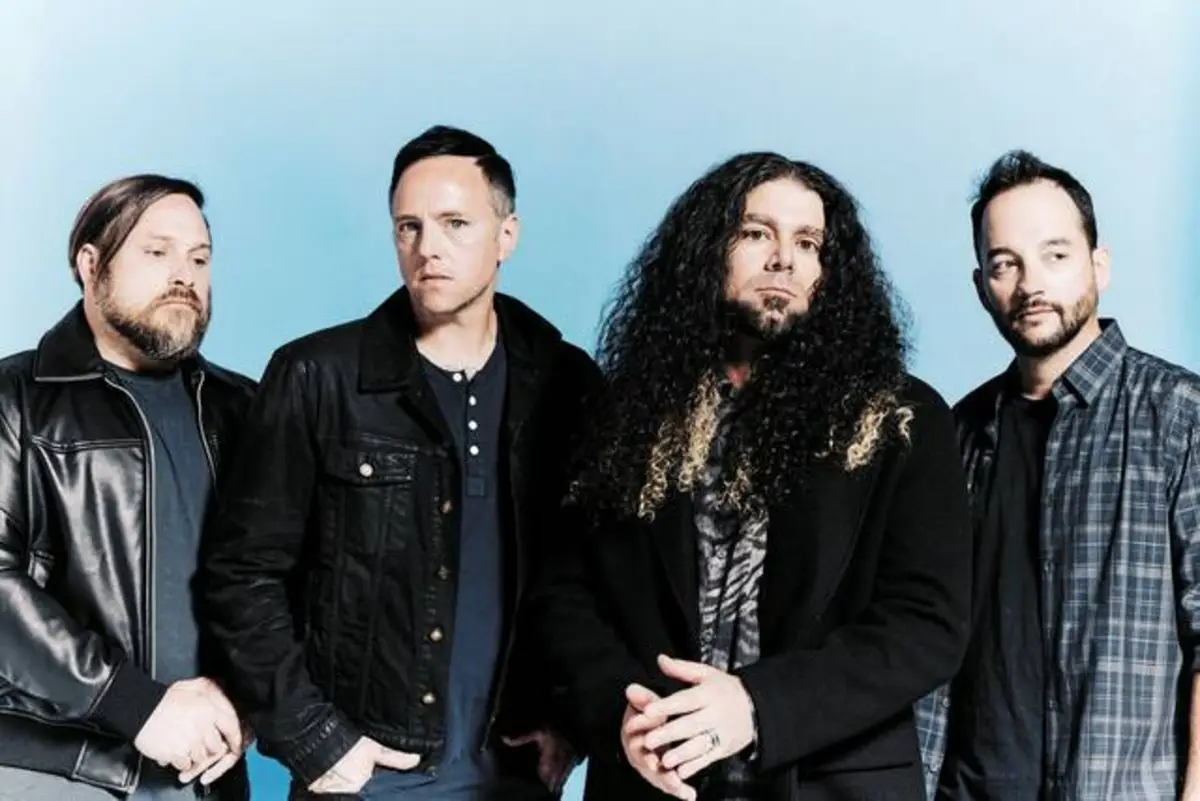
Something of interstellar origin is descending on Pittsburgh.
On 2003’s “In Keeping Secrets of Silent Earth: 3,” New York rock quartet Coheed and Cambria took their first major steps on a cross-galaxy journey that would bring progressive music to fans of the mainstream rock mean with pleasantly airy songs like “A Favor House Atlantic” and “Blood Red Summer.”
Through an alchemy combining elevated composition with classic rock thump and sweet hooks, Coheed would go on to conjure an 11-album discography accompanied by a cargo hold of accompanying comic books. Together, they craft a sweeping and continuous original sci-fi storyline set in a universe of 78 planets. Soaring upper-octave vocalist Claudio Sanchez chronicled it all in his lyrics, obfuscating deeper personal meanings hidden within.
But the universe his words created almost collapsed in on itself before it could expand, explained drummer Josh Eppard, recalling a performance that threatened to derail the band’s path to success.
“[The music] being such a left turn almost had us dead in the water,” said Eppard.
By the time the Woodstock, N.Y., native Eppard was a teenager, he had already signed to a major label and toured with 3, he and his brother Joey’s well-regarded prog band. By 14, he’d played Woodstock ‘94 on national TV as a self-described sweaty, nervous and slightly chubby kid who, at the time, compartmentalized it as “just another reason for kids to beat me up in middle school.” By 16, he’d played CBGB in New York City around 30 times and crossed paths with Sanchez, who frequently rode the bus into town to find people to jam with.
“Claude told me when I was 15 that we were going to be in a band together one day,” said Eppard. “I thought he was just drunk.”
At 20, Eppard left his job, his band and the accompanying hype to join Coheed and Cambria.
“I kind of learned a long time ago if Claudio is dead set on going there, I should probably get … on board,” said Eppard of his bandmate. “Because my man is dope, and every time that Claudio is dope, I’m rewarded because I had the vision to follow his songs when I was young.
“No one thought it was a good idea,” emphasized Eppard. “But I knew it in my heart.”
At the outset of Coheed’s career together, the band was set to play a try-out with Equal Vision Records amid a 16-year-old’s birthday party with Eppard’s brother — for the first time in his life — working sound. Eppard remembers around 30 kids attending, all of whom bailed mid-set, leaving only the record company reps.
“I hear people talk now, some of the elders, and they say, ‘Oh, we were close on signing Coheed, but they went with Equal Vision.’ That is completely fabricated,” said Eppard. “There was zero label interest from anyone. In fact, Equal Vision Records had voted ‘no’ on Coheed.”
One rep’s review claimed, “They didn’t bring the rock.” Just one among them vouched for building up a young band with potential.
“When we started, Claud and Travis (Stever) couldn’t stay in tune, I couldn’t play the songs at record tempo,” said Eppard. “We were just excited kids. But that excitement was like a black hole to people. It pulled people in because it was real.”
Switching up the strange name Shabutie for the equally strange Coheed and Cambria (after two central protagonists of the band’s unfurling sci-fi story), the outfit would rocket to five Billboard Top 10 albums steeped in Earthling nerd acclaim.
With 2005’s “Good Apollo, I’m Burning Star IV, Volume One: From Fear Through the Eyes of Madness,” even terrestrial radio fans and grounded jocks nodded along to “The Suffering” or picked up Guitar Hero to jam the stunningly monolithic “Welcome Home.”
That Equal Vision Records rep who doubted them?
“He quit the music business,” said Eppard.
Life as the left-turn
Still, the band’s sense of otherness lingered on past their breakthrough.
”Most bills, we’re the odd band out, most places we’re kind of the left turn — badge of honor in a way. But in the kind of immediate, intimate moments of that, it can be really ostracizing and create anxiety,” said Eppard.
With Sanchez and Travis influenced by bands like At the Drive-In, The Get Up Kids and Thursday, they found an unlikely home on the Warped Tour.
“I give the scene a lot of credit for letting us in. We weren’t bursting in and saying, ‘Hey, we’re here.’ We were sheepishly knocking, like ‘Hey, you guys are playing cool shows. Can we come in?’ ” said Eppard. “Everything would be different had it not been for that.”
While Eppard refers to the genius of Sanchez’s weaving his own feelings into a continuous space odyssey as “undeniable” now, he admits to a few less-than-courageous moments in defending it and the cardboard cutouts of characters that would sometimes join them on stage.
“It took years for me to appreciate and really understand what he was doing,” said Eppard, noting he always identified with the source experiences of his “favorite lyricist.”
“This is so different,” he remembers thinking of early output, “I feel like it’s putting a target on us.”
While touring “Silent Earth,” a member of a “big band” from Chicago complimented the band’s sound but ripped its themes.
“I feel like, once again, I’m in middle school, getting picked on immediately. I feel embarrassed to be myself because of the story,” said Eppard. “Claud had the courage to put that out there, and I regret not being a more sturdy support beam in the early years for that, because I didn’t have the vision.”
For the outwardly cocky Eppard, who grew up with deep anxiety in a poor neighborhood amid uncommon circumstances in a musician’s family, it was a tough position.
Josh’s father, Jimmy Eppard, founded Applehead Studios and toured with The Band for two years in the 90s while Rick Danko was jailed in Japan. His son met George Clinton at age 13.
“Levon [Helm] told me when I was like 11 — I’ve been playing drums for like probably less than a year — he said, ‘How many piece kit you play? Nobody ever asked me that before. I counted in my head, snare, bass drum, tom, tom, tom — ‘five piece!’ And Levon goes, ‘That’s great. That’s three drums too many.’”
It hadn’t made him cool among his peers.
“When I was a kid, my mom had to sew sponges into my T-shirts because I’d sweat so much from how nervous I was just around people,” said Eppard. “I always had girlfriends and all that stuff, but inside … ”
Black hole
In his early adulthood, Eppards’ anxiety coalesced with the ego of a successful musician to spiral the drummer into heroin addiction. He was nodding off at and disappearing from rehearsals before leaving the band the day before a tour in 2006.
“I really, really torched my life. Everything good had been properly dismantled, burned away,” said Eppard.
With his now wife’s encouragement, he got help working on addiction and his self-image.
“The greatest gift I ever got from getting sober was being honest,” said Eppard. “I’m not cocky. I’m terrified.”
“Stupid honesty will set you free.”
Upon hearing through the grapevine he was clean, his former Coheed bandmates invited him to jam on some songs disguised as those from Sanchez’s side project, The Prize Fighter.
“They tricked me at first,” said Eppard.
In reality, they were new Coheed tunes.
“I cost the band hundreds of thousands of dollars, priceless opportunities and these guys had that within them,” said Eppard. “I get teary talking about it.
“I said it in feeling, but it was clearer than words, that I’m going to make them trust me and earn their trust.”
A full 15 years later, that mission has long since been completed.
“It’s a great gig being in Coheed and Cambria,” said Eppard. “[Replacement drummer] Chris Pennie [of Dillinger Escape Plan], the guy can play circles around me, but he’s not me. The way I play is so weird, even the way I hit a four-four groove, the way the hat dances. I think they missed that. And I felt missed. And I needed that.”
For two years, Eppard has helped run his own rehab clinic DSC, guided by the refrain “You gotta come clean to get clean.”
Sanchez is still writing songs set in far-off worlds, now grounded in themes of fatherhood.
“No band has ever done what Coheed has done where the entire discography, sans one record, follows one story,” said Eppard with pride.
“Pavilion” speaks to leaving home for tour.
“I feel like I wrote Pavilion, because in a lot of ways he’s speaking for all of us,” said Eppard. “Because I know what that feels like to walk out of the house and you’re so excited to be here, but a piece of your soul wants to stay.”
With any luck, their June 9 show at Roxian Theatre will go half as well as the last time they landed in Pittsburgh, playing with Primus at Stage AE in summer 2024. As it turned out, one of the Pirates’ assistant GMs was a fan. He invited them to throw out the first pitch during a day game ahead of their show.
“It’s the whole band, Claudio’s catching. They let me throw it because I’m a big baseball guy,” said Eppard. “We did like a funny bit. Zach, the bass player, he pulled out some Vaseline and some scratchy stuff for the ball and nobody got it — except the camera guy who said the booth is dying laughing.”