
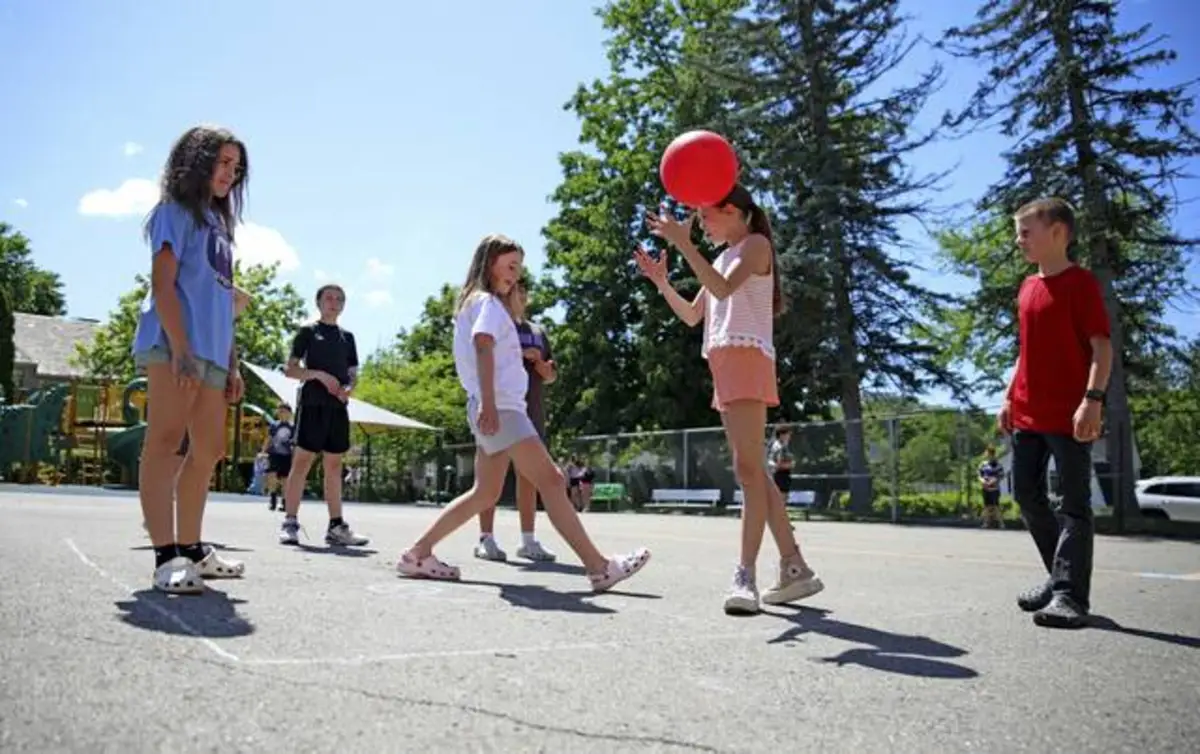
Tyler Roberto only needs a few seconds to scan across Crafton Elementary’s school playground to highlight the lessons she sees students learning during recess.
On the blacktop, a group of second-grade boys talk to each other to work out an issue during a kickball game, notes Roberto, the school’s principal.
Around the play structures, children play tag in the backdrop of rule-following and communication.
And throughout the playground, pockets of children interact or play games with each other.

“In elementary school, they absolutely need the opportunity to take a break from school work and have 30 minutes of time to decompress,” Roberto said. “It’s important they step away from learning and have time to be with friends and engage in physical activity.
“This is a time for them to learn to problem solve on their own, and build friendships on their own.”
Pediatricians agree.
This spring, the American Academy of Pediatrics published new guidance for the first time in 13 years emphasizing the importance of recess. They say breaks are essential for children’s academic success, and mental, physical, social and emotional growth.
“Free play that is vigorous play, preferably outdoors, has multiple benefits for children. There’s no doubt about that,” said Istvan Kovacs, chair of the Physical and Health Education department at Slippery Rock University. “It has a lot of social and emotional benefits, kids learn communication, problem solving and conflict resolution. A lot of development happens in free play.”
Pennsylvania does not require recess, but recommends it, Kovacs said. Gov. Josh Shapiro has indicated support for public schools to guarantee daily recess for students. Kovacs said many schools already do.
However, the national picture tells a different story. Data from Springboard to Active Schools and the CDC shows that, since the mid-2000s, up to 40% of school districts have reduced or eliminated recess.
Physical activity at recess helps prevent obesity, a condition that affects about 1 in 5 American children and teenagers. Kovacs said recess is just one factor to address childhood obesity.
“Obesity is much more complex,” Kovacs said. “Recess adds a good deal to the daily moderate-to-vigorous activity, but only a small percentage of children will meet the CDC recommended daily minimum of overall health benefits. Every child up to 18 should be engaged in 60 minutes of daily moderate-to-vigorous physical activity.”
Moderate physical activity increases one’s heart rate or muscle work more than an everyday task, Kovacs said, and examples of vigorous physical activity are climbing or pushups.
Researchers said recess should not be taken away as a punishment.
“(Recess) shows a better connection between behavioral issues than academic performance,” Kovacs said.

Roberto, the Crafton principal, said her school provides recess equipment. Staff members monitor recess periods but activities are largely unstructured.
There are “teachable moments,” she said: At one point, the school removed football and kickball games because students became “too competitive” with each other, but those sports have since been restored. Additionally, the school counselor will sometimes observe students at recess to monitor students’ social and emotional skills. That drives classroom lessons on topics like good sportsmanship or respect.
Jack Muszalski, a Crafton fifth-grade student, said he likes recess because of the freedom and break it provides from classwork.
“Recess is really important for school,” said Jack, 11. “Coming to school is fun, because you know in the middle of the day, you’ll be able to play and talk to friends.”