
Pittsburgh’s Astrobotic, whose Griffin-1 lunar lander is set to launch later this year, is being acquired by Denver-based Voyager Technologies for up to $300 million, the companies announced Tuesday.
The cash-and-stock deal is expected to close in July, pending regulatory approval.
Voyager, a publicly traded firm serving the defense and aerospace sectors, is taking over the former Carnegie Mellon University start-up at a time of rising interest — and urgency — in space exploration.
NASA is in the middle stages of its Artemis program, which aims to put humans back on the moon in 2028 and establish a permanent American base there by 2032. Billions of dollars in government contracts have been awarded through the program, and billions more will likely be up for grabs.
The scramble for federal dollars was turbocharged in March when NASA said it’s accelerating its lunar initiatives, providing a catalyst for the proposed acquisition, Astrobotic CEO John Thornton told TribLive on Tuesday.
Astrobotic has earned $600 million across 38 federal contracts since it was founded in 2007, but hopes to further grow its share of the pie.
“We have to beat our competitors, and some of our competitors are very well financed and they’ve got a big backing,” Thornton said. “We don’t until this deal closes… and then we’ll be able to compete for the biggest contracts.”
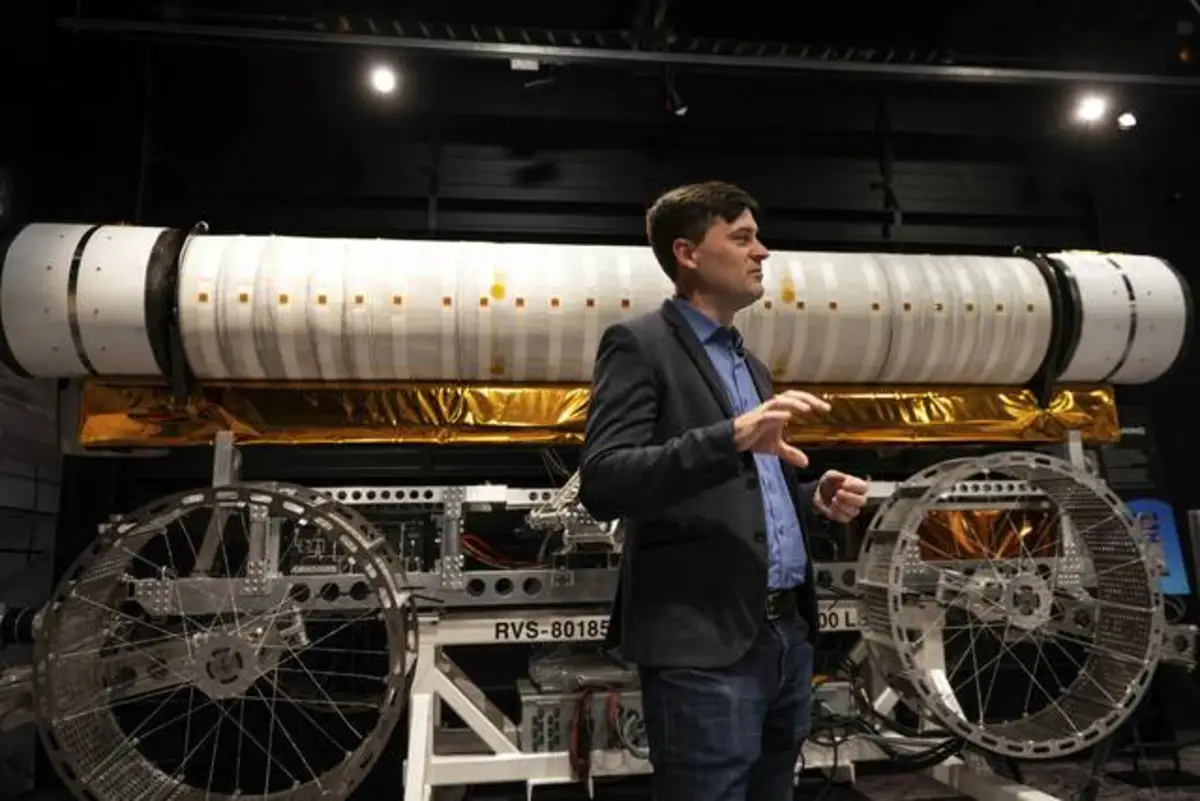
Astrobotic’s signature products include its Griffin and Peregrine lander models, designed to bring cargo to the moon’s surface, as well as its LunaGrid electricity generation and distribution service that can power rovers, human habitats and more.
A Peregrine lander set off toward the moon in 2024 but never touched down due to a fuel leak. The Griffin-1 lander will soon be sent to Cape Canaveral in Florida ahead of its late 2026 trip aboard a SpaceX rocket. An exact launch date has not been announced.
Buying Astrobotic would allow Voyager to “span the full arc of lunar operations,” the companies said in a press release. Voyager, which boasts a market cap of almost $3 billion, has developed or invested in rocket propulsion technologies as well as inflatable space habitats and a dust-proof coating for spacecraft.
“With Astrobotic, Voyager is now a lunar platform that will have capability at every infrastructure layer needed to put Americans on the lunar surface and keep them there,” said Voyager CEO Dylan Taylor.
Astrobotic’s North Side headquarters will become the hub of Voyager’s lunar program. Between its Pittsburgh and Mojave, Calif., offices, Astrobotic has about 300 employees, compared to about 800 workers at its potential corporate parent.
Thornton expects the sale would help Astrobotic expand its Pittsburgh presence.
“We’re going to be building space and moon missions in Pittsburgh for a long time to come,” he said.