
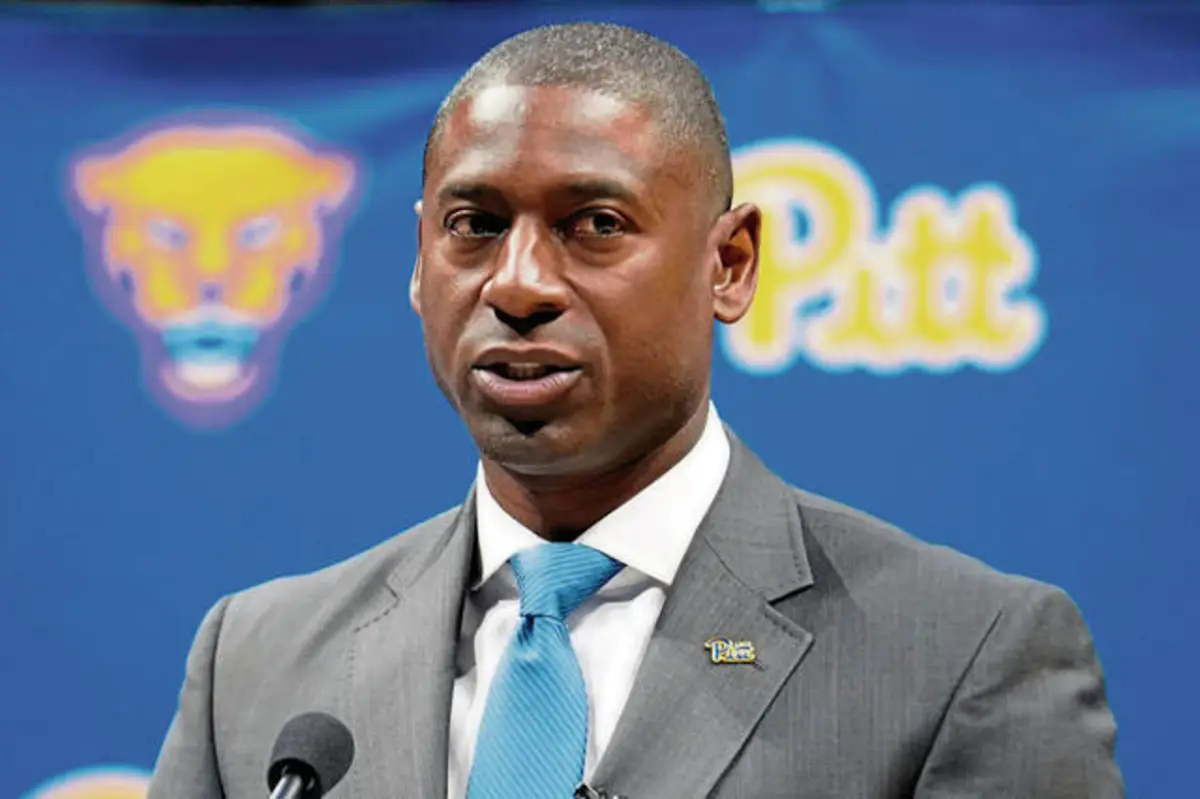
Allen Greene is acutely aware of billionaire Mark Cuban having pumped in a massive amount of money to boost Indiana’s football program.
He knows of Nike founder Phil Knight’s longstanding support of Oregon and the increasing perception (or perhaps reality) that to get ahead these days in college sports, athletic departments need to have billionaire backing.
If such a donor dialed Greene’s number, he’d surely be receptive, but Pitt’s athletic director wants prospective contributors large and small, as well as the Pittsburgh community in general, to know that they can make a difference.
Take the recent $3 million anonymous donation to Pitt’s wrestling program, for example. Whether it’s one $3 million gift or three million $1 gifts, Greene is imploring the greater Panthers nation to step up.
“The wrestling gift that we announced is the perfect example of someone putting their money where their mouth is, and someone being passionate enough and having the capacity to support the program,” Greene said. “Gifts of all sizes matter and have an impact. For those who are waiting or wanting the billionaire to fund everything — that is not the only game plan we have in our arsenal.
“Everyone has an opportunity to participate. Everyone has an opportunity to make a difference. Now is the time for them to do something to participate, to buy a season ticket, to come to a game, to give to the Panther Club, to give to the sport that they love the most. Their participation matters more than where their participation goes. Just support and be positive about your team.”
Greene, chatting at-length with reporters Thursday, delved into a wide variety of matters, such as the decision to retain men’s basketball coach Jeff Capel, expectations for 2026-27 and the new-look roster Pitt has assembled, among many other topics.
Per Greene, Pitt reached the inaugural $20.5 million revenue-sharing cap this past athletics season, providing every dollar allowable in Year 1 of the post-House settlement landscape, with an unsurprising focus on football and men’s basketball.
However, in that relatively short amount of time dating back to last summer when the House ruling came through, the competitive gap between athletic departments across the nation has been plain to see.
Programs with mega donors who can utilize millions of NIL money allows for huge advantages, allowing programs like football or men’s basketball to vastly exceed the allowed revenue-sharing cap in terms of total compensation offered to student-athletes.
For Greene, Pitt’s route to reaching that level involves more involvement from local businesses and the community at-large.
Whether that’s securing more NIL deals for student-athletes or simply improving attendance at Pitt’s games, Greene seeks more across-the-board buy-in.
“The athletics department and the university have pushed all of our chips in football and men’s basketball,” Greene said. “What’s needed now is for the community to push their chips in. The more that we can do that, the more we’re going to be and the better chance we’re going to have to have consistent success — competing for conference championships consistently and also making some noise on the national level. It’s going to take everybody.”
Of course, buy-in among fans is usually preceded by on-field success by the teams they root for.
Few of Pitt’s programs failed more notably in that regard than men’s basketball, which went 13-20 (5-13 ACC) in 2025-26, leading to intense speculation that Capel would be fired.
Instead, Greene retained Capel for a ninth year, fired a pair of his assistants (including Capel’s younger brother, Jason) and oversaw the crafting of a nearly entirely new roster.
While Capel’s buyout, which was rumored to be in the eight-figures, must have weighed on Greene’s mind, faith in Capel, as well as general manager Jay Kuntz’s ability to recruit a competitive team, impacted the decision Greene made.
“We’ve built an infrastructure around this program that is going to allow us to compete,” Greene said. “Hired a GM, and this is his first roster that he’s building. We’ve invested a significant amount of money in this roster, more than I thought we were going to invest. But we’re committed to this program being successful and making it to the NCAA Tournament. That’s our goal, that’s our start-off goal and we’re looking forward to this team competing.”
So is it March Madness or bust for Capel in 2026-27?
“No, there’s too many uncertainties in this industry for it to be a hard line,” Greene said. “Coach Capel is competitive as heck. He wants it just as bad if not more than everybody else.”
Other matters Greene weighed in on included:
• Could an oft-hypothesized on-campus stadium for Pitt be feasible? “It’s probably too premature to talk about an on-campus stadium,” Greene said. “Right now, we have a relationship with the Steelers down at Acrisure (Stadium). We’re going to work our tails off to bring Pitt down to the North Shore.”
• Greene also addressed Pitt continuing to share the UPMC Rooney Sports Complex practice facility on the South Side with the Steelers. For now, conversations about the future of that relationship have yet to begin.
“We enjoy sharing a facility with the Steelers,” Greene said. “I think it’s a huge advantage for us. We know that our staffs are growing, their staffs are growing — we’re going to have to do something together in terms of the South Side facility. I don’t know what that looks like at the end of the day. There’s only so many places we can go. We’re not going to necessarily move our football team 30 minutes away from campus. We’ll see what happens. I’m sure the conversations are going to start to occur here soon on the future of that facility and that location.”
• Naming rights for Pitt’s new Victory Heights facility in Oakland are on Greene’s radar.
“Naming just in general are assets that athletic departments are looking to monetize,” he said. “Whether it’s the (Petersen Events Center) court, whether it’s Victory Heights — all things are on the table. … As we think about our strategic plan and revenue generation, being able to attract naming opportunities for our facilities is going to be really important.”
• Pitt Athletics’ partnership with Nike as apparel provider runs through 2026. Greene responded with a simple “yes” when asked if the Panthers intend to extend that relationship.
• Last month, senators Ted Cruz, R-Texas, and Maria Cantwell, D-Wash., introduced the Protect College Sports Act to “to stabilize college sports, protect athletes and expand revenue-sharing.” The bill, among many other things, seeks to enact NIL standards at the federal level, limits transferring without having to sit out a season to one time and prevents the creation of a Big Ten-SEC superleague. Greene laid out Pitt’s position on the legislation:
“By nature, we are supportive of a defensible model in college athletics,” he said. “At one point in time, and it maybe still is, was the SCORE Act, and now its the (Protect) College Sports Act — call it what you want. It doesn’t matter. We want there to be a legally defensible model where we can all operate under the same rules, with rules that are actually able to be enforced without losing legal battles.”
• Beginning in August, commercial logos or patches on uniforms, equipment and apparel for any non-NCAA championship competition will be allowed. Greene revealed nothing specific about potential logos on uniforms at Pitt for this upcoming season.
“We’re actively having conversations with businesses about putting sponsorship patches on uniforms,” Greene said.
• Of the ACC’s 17 members, where does Greene think Pitt ranked last year in revenue-sharing and NIL compensation?
“I’ll do quartiles — probably in the second kind of tier,” Greene said. “Somewhere in the second tier, maybe upper-level of the second tier. … Where in that second part, I don’t know and we don’t know. We’re kind of guessing in many cases.”
• A number of athletic departments, notably in the Big 12, have become involved with private equity firms as a way of securing an influx of cash to help offset growing financial obligations in the revenue-sharing and NIL realms. Per Greene, Pitt won’t be following suit.
“That is not something we’re currently considering.”