
During World War II, President Franklin Roosevelt called the United States the “Arsenal of Democracy.”
He wasn’t reaching for poetry. He was describing factories. Saturday marks the 82nd anniversary of D-Day — the moment when American industrial might, translated into ships, aircraft and armor, made the liberation of Europe possible. The soldiers who stormed those beaches didn’t get there by accident. They got there because American steel put them there.
Today that lesson is overdue for a revival as the United States confronts renewed geopolitical instability and an increasingly competitive global marketplace. National security begins with industrial capacity.
China produces approximately 60% of the world’s steel. If you’re not alarmed by that number, consider what steel actually builds: aircraft carriers, armored vehicles, energy pipelines, the physical infrastructure of a functioning military. China’s dominance in steel production didn’t happen through innovation. It happened through sustained state subsidies that flooded global markets, suppressed prices and left American producers in a structurally weakened position.
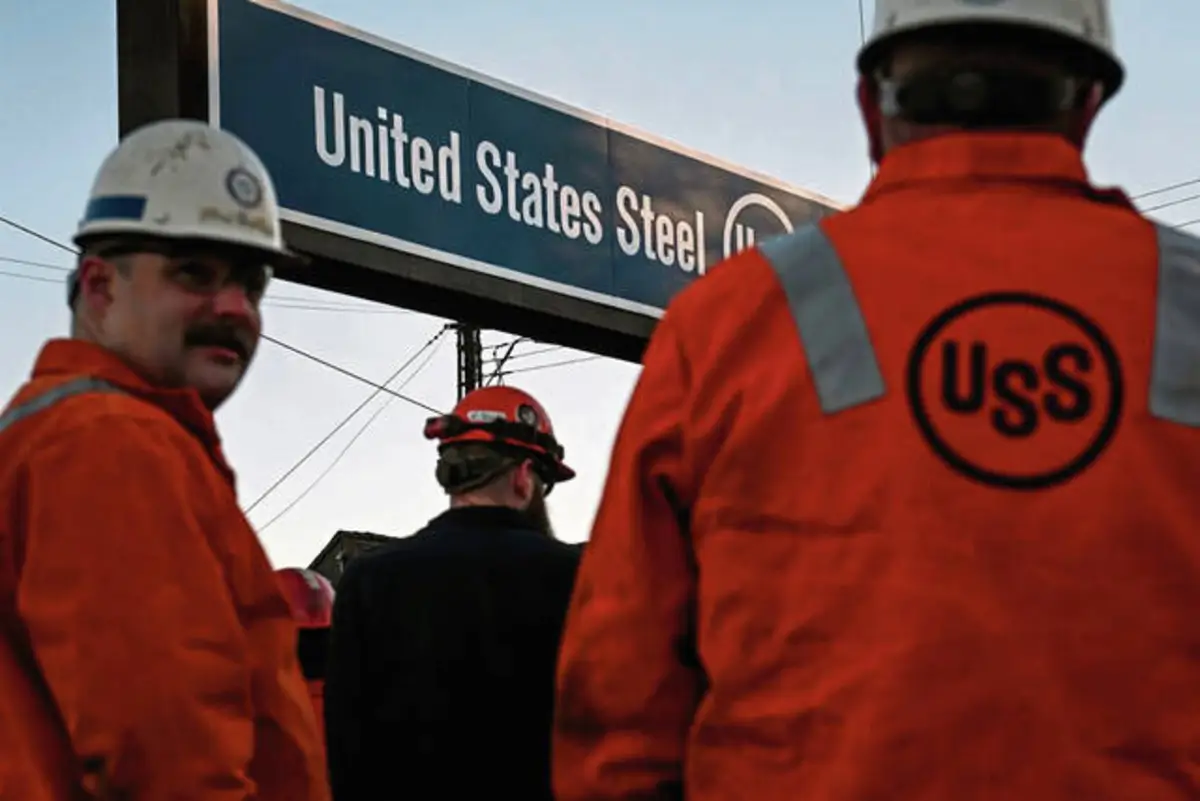
That is why last year’s proposed $14.9 billion acquisition of U.S. Steel by Japan’s Nippon Steel commanded national attention. This was never just a corporate transaction. It was a recognition American steel remains geopolitically consequential — and worth investing in.
The revised agreement included approximately $11 billion in investments through 2028, commitments to honor labor agreements and protect production capacity, a $5,000 retention bonus for steelworkers, and a U.S. government “golden share” with veto authority over any decision touching national security. That last piece transforms a foreign acquisition into something closer to an allied partnership pairing outside capital with sovereign control in a way that serious industrial policy has long called for but rarely achieved.
Japan is one of America’s closest military allies, and it has signaled broader strategic alignment with U.S. industrial priorities. In February, Japanese entities agreed to invest an additional $36 billion in U.S. oil, gas and critical mineral projects. It’s part of a broader pattern of allied capital flowing into American strategic industries at exactly the moment when reshoring and supply chain resilience have become bipartisan priorities. Steel cannot be the exception to that logic. If anything, it should be the proof of concept.
In 2023, U.S. mills produced nearly 90 million net tons of raw steel, supporting roughly 70,000 iron and steel manufacturing jobs. These are communities that have already been through decades of contraction, of watching good jobs migrate to places where labor is cheaper and environmental standards are lower and governments will subsidize production at a loss indefinitely. The workers in Pennsylvania’s steel towns deserve investment that actually modernizes their facilities, not political theater about protecting them. Now, with collective bargaining approaching and new leadership at the United Steelworkers, Pennsylvania stands at an inflection point.
From my time in Congress, in uniform and now leading the Hilco Global Geopolitical Unit, I have seen how strategic sectors weaken when politics overtakes pragmatism. Industrial policy works when three pillars move together: capital investment, labor stability and sovereign oversight. This partnership attempts to align all three.
Pennsylvania’s steel workforce is leaner, more productive and deeply skilled. They deserve enforceable investment commitments, production certainty and pension protection. They also deserve leadership — corporate, political and union — that understands who the actual competition is. It isn’t a Japanese ally with an $11 billion modernization commitment. Our competition is a Chinese government that has spent two decades subsidizing its way to market dominance.
The tension that emerged during the deal’s review period — between past union leadership and rank-and-file workers, compounded by Cleveland-Cliffs running its own competing acquisition strategy — showed how fast a straightforward investment case can get swallowed by politics. When corporate rivalry, labor negotiations and political positioning all arrive at the same moment, the environment becomes exactly the kind of unstable that scares off the long-term capital this industry needs.
The union now faces its first major test of the stability the Nippon deal created. Roxanne Brown, who took the helm as union president in March, is leading negotiations on a new collective bargaining agreement this summer. Brown holds in her hands a historic opportunity to help cement the investment, stability, and oversight the steel deal promised.
But early signs suggest Brown risks squandering that opportunity. The union’s decision in late April to forgo early negotiations raised immediate red flags.
If America intends to remain the Arsenal of Democracy, it cannot afford to undermine one of its foundations over a negotiation it hasn’t even started yet.
Roosevelt had to build the arsenal from scratch. We have the mills, the workforce, the allied capital and the governance framework to back it up. Whether we use them is, at this point, a choice.
Patrick J. Murphy was the 32nd under secretary of the Army and a U.S. congressman (D-PA). He is a nonresidential fellow at the Penn Wharton Budget Model Office and leads the Geopolitical Unit at Hilco Global.