
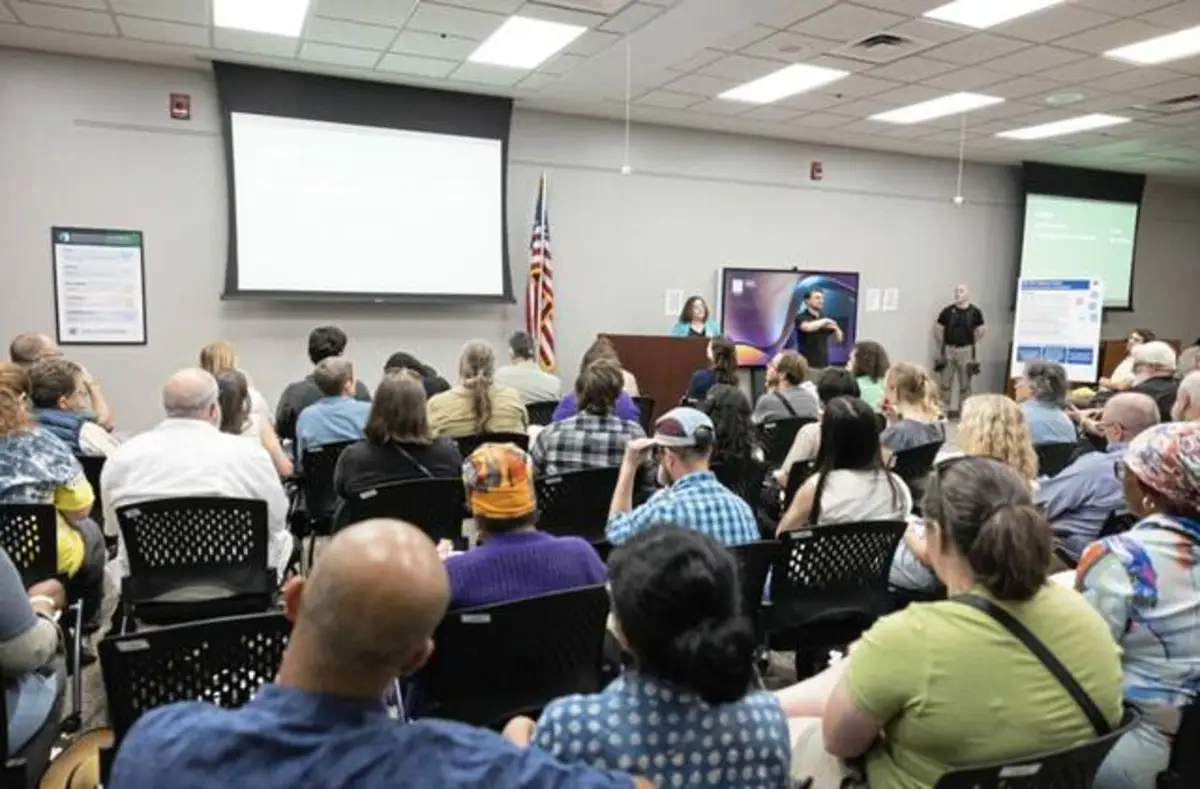
Allegheny County’s Department of Sustainability held its first in-person open house Thursday evening to gather feedback on its developing Climate Action Plan, which aims to reduce emissions over the next two decades, drawing about 70 residents.
Attendees said they were encouraged by the county’s effort to engage the public but questioned whether the plan adequately addresses industrial emissions tied to existing and proposed development projects.
Phoebe Shackeroff Reese, a volunteer with the environmental nonprofit Climate Reality Project Pittsburgh, pointed to data centers as a potential source of significant greenhouse gas emissions.
She cited proposed data center developments in Springdale, which are expected to be discussed by planners next week, as an example of the types of projects she believes should be fully considered in the county’s climate planning efforts. Shackeroff Reese said she does not blame the county for the actions of fossil fuel companies but remains skeptical.
“Does our Climate Action Plan account for these things, and how can we possibly meet our climate goals as a county and as a state when gas fossil fuel expansion is part of that?” Shackeroff Reese said.
During the event, Brittany Prischak, director of the Department of Sustainability, said residents raised concerns about environmental justice, pointing to both historical government decisions and the region’s industrial legacy that have left some communities facing disproportionate environmental and health burdens.
“Environmental justice is a huge concern of many folks who live in Allegheny County,” Prischak said. “There are concerns about past harms due to how government has operated over the years, but also recognition that we have an industrial past and certain communities are more burdened by environmental and health impacts than others.”
Shackeroff Reese said the organization delivered a petition signed by about 1,000 people to Prischak on Thursday and plans to bring another petition to Allegheny County Council. The petitions call for greater investment in clean, affordable renewable energy.
“Just by virtue of which ZIP code children are being born into, they are at a disadvantage because of the air they breathe,” Shackeroff Reese said. “We can’t choose — we must breathe air.”
Prischak said the county is developing an acknowledgment statement addressing those past harms and intends to use the Climate Action Plan to reduce existing inequities while ensuring future decisions do not place additional burdens on vulnerable communities.
The Climate Action Plan draft includes seven sectors, 29 strategies and more than 180 proposed actions.
The sectors are buildings and infrastructure, electricity, transportation, industry and fuels, waste and resource use, natural systems and food and water.
Chris Cieslak, COO of environmental nonprofit Green Building Alliance, said so far the proposed plans, while ambitious, have been practical and pragmatic.
Cieslak, who has participated in discussions about the building sector, said the planning process should begin by considering all possible strategies and then narrowing them down based on what is realistic and adequately funded.
“It’ll be interesting to see how that shapes up at the end,” Cieslak said.
A draft greenhouse gas inventory found that activities across Allegheny County generated approximately 21.9 million metric tons of carbon dioxide equivalent emissions in 2024 — roughly equal to the annual emissions of 5 million gasoline-powered vehicles or the yearly electricity use of 9.5 million homes.
The inventory found the county produces about 17.1 metric tons of greenhouse gas emissions per person annually. That is lower than Pennsylvania’s statewide average of 18.7 metric tons per person but higher than the national average of 16.4 metric tons.
Cieslak said the data reinforced that existing buildings, not new construction, account for the vast majority of building-related greenhouse gas emissions.
“When they actually calculate the total amount of greenhouse gas emissions coming out of new construction versus existing, you realize that you really need to focus and prioritize how you tackle greenhouse gas emissions in the existing building sector,” Cieslak said.
Prischak said another major topic of discussion that came up during the meeting was mental health.
She heard from multiple residents during the meeting that mental health is an important part of the climate conversation.
The county plans to continue gathering public input throughout the summer.
A virtual public meeting is scheduled for June 24, and county staff will attend community events such as block parties, farmers markets and neighborhood gatherings in June and July.
Officials hope to participate in at least 15 events, with details to be posted on the plan’s public engagement website.