
In the most severe cases of peanut allergy, the faintest trace of a peanut can alter the course of someone’s life.
But the number of those diagnosed with the leading cause of fatal or near-fatal anaphylaxis in the U.S. has dropped by 43% since 2017, thanks to treatment advances and modernized guidelines, according to a new study published in Pediatrics.
In 2015, a New England Journal of Medicine study found that regularly feeding infants peanuts early in life — rather than at 2 to 3 years old as once advised — reduced the rate of allergy development by more than 80%. Since then, the National Institute of Allergy and Infectious Diseases has called for exposure at 4 to 6 months.
“Inadvertently, what we were doing is exposing these children to peanut dust without exposing it to their gut first,” said Dr. Christin Deal, pediatric allergy and immunology specialist at UPMC Children’s Hospital of Pittsburgh.
With feedings, the body can grow comfortable with the allergen.
“The gut is a very tolerant immune system,” Deal said. “If you were to rub mold into an open wound, your body should have an aggressive immune reaction. … If you accidentally ate a piece of moldy bread, you would be fine.”
In the U.S., the most common food allergy is a bigger issue.
“Dry-roasted (peanuts) create more dust, so it’s more in our environment than in other cultures where it’s in sauces or hard-boiled,” Deal said.
Infants can now be exposed once upright and eating semi-solid food, Deal said, which is typically between 4 and 6 months.
Some 20 million Americans have food allergies, according to the Asthma and Allergy Foundation of America.
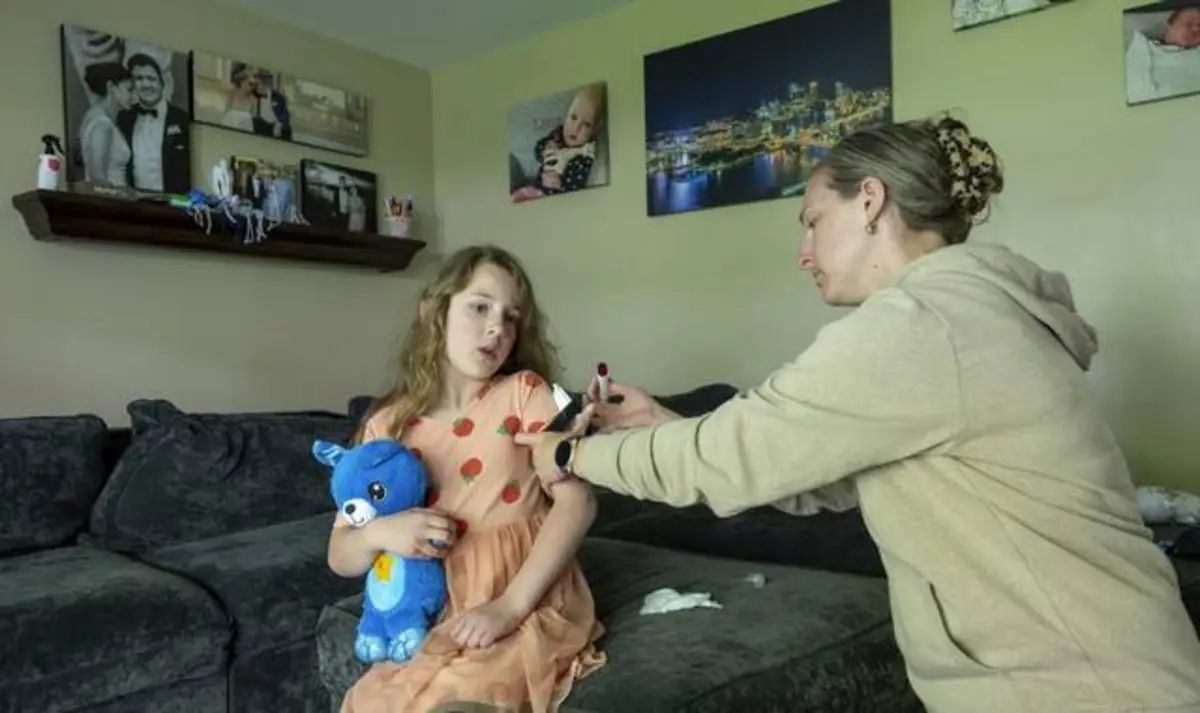
Among them is 7-year-old Lucy Schultz, who lives in Mt. Lebanon with her mother Katie, a nurse; her father Jon, a teacher; and her 5-year-old twin siblings. Lucy was diagnosed with a peanut allergy at 8 months old.
“We’ve realized how isolating this can be because we don’t have that many people in our lives that truly understand what we’re dealing with on a daily basis,” Katie said. “It affects every decision we make.”
Katie remembers exposing her daughter to peanuts for the first time.
“I (gave them to her) at home, without thinking. I took for granted that it was going to be fine,” said Schultz, recalling irritability and a red rash. “I was like, ‘Oh, my God, I just fed her peanuts. I’m here by myself at the house.’ ”
Lucy was covered in hives by the time they arrived at Children’s Community Pediatrics in Mt. Lebanon. They waited 45 minutes until symptoms subsided, but it speaks to why there is hesitation about exposure.
“We’ve really scared people,” Deal said of parents’ fears about exposing their kids. “And so now they think, ‘Am I going to cause my child to have an allergic reaction?’ ”
Risk in infants is typically minimal and fleeting.
“The risk of having a full-fledged, severe anaphylactic reaction in an infant is extremely low because they just haven’t had time to generate the number of antibodies it would take to really cause a severe allergic reaction,” Deal said.
Some parents give the first exposure in emergency room parking lots or schedule a controlled exposure.
“Typically, we do peanut butter because it’s the most readily available form and you can just thin it out with water or breast milk,” Deal said, advising one to two feedings a week. “We recommend feeding early and often.”
Months-long gaps can cause the body to revert to overreaction, she said.
Life with a peanut allergy
Lucy’s introduction began six years of learning and changes for her family.
“That night, after she finally was in bed and we sort of put the day behind us, I remember emptying out our cabinets because I just was like, ‘There’s so much stuff in here that isn’t safe anymore.’ I just had this visceral reaction that I needed those things out of my house.”
Symptoms vary by individual, from mild on ingestion to life-threatening on contact.
“You can have some sort of cross-contamination where somebody was preparing food with peanut on it and then they washed their hands maybe not so well, and prepared something that the patient was eating,” Deal said of “specks or crumbs” of peanut protein.
Low reaction thresholds can make it difficult for families to go to restaurants and gatherings or on vacation.
“It’s been a learning process to figure out things as we go,” Schultz said. “We’re six-plus years into this, and we’re still learning things.”
When Lucy was young, her grandmother could stand in for day care.
“That’s really huge because we had all the control still. So we just avoided things we needed to avoid,” said Schultz. “Being that little, you can do that for them. As she got older, it became much harder to do, and you start to lose some of that control. As a parent, that is very scary.”
Treatments
Lucy has relied on Palforzia — an oral immunotherapy treatment for peanut allergies approved in 2020 — since she was 3.
“(Oral immunotherapy) does have the ability to change long-term trajectory and potentially help them outgrow their allergy,” Deal said.
But at age 6, Lucy had what her mother termed a “horrifying” reaction to walnuts that reinforced her parents’ careful nature.
“You have these moments where you’re like, ‘Am I blowing this out of proportion?’ ” Schultz said. “And then you have a moment like that where you’re like, ‘Wow, nope.’ ”
Since the walnut reaction, Lucy has also received injections of the biologic Xolair.
“It helps them with tolerance,” Deal said.
Palforzia is the only FDA-approved oral immunotherapy available for kids with peanut allergies, but it will be discontinued this summer due to a low adoption rate. (According to a 2022 study in the National Library of Medicine, reasons for the low adoption rate include time commitment, safety concerns and it necessitating new treatment plans by those prescribing it.)
A study published in JAMA found that 10% to 30% of children outgrow food allergies. Treatments such as Palforzia, Xolair, EpiPens and nasal epinephrine sprays have improved management and outcomes for many patients.
“I’m so thankful for the time that we live in … because I can’t imagine having to do this years ago when all of these things weren’t available,” said Schultz.
Looking to the future
There is reason for added hope.
“We’re hopeful that there’ll be a new product available on the market later this year, where it’s a [skin] patch. It’s like a Band-Aid that has peanut protein in it that can also help with desensitization,” Deal said.
Children have “done well with it,” Deal said of Viaskin clinical trials.
“It’s an exciting time to be an allergist,” Deal said. “I think it’s much more hopeful, thinking of where things were when I started my job.”