
From church pulpits to political pundits, Americans who fall under the LGBTQ umbrella often hear that they aren’t welcome in religious spaces.
While the majority of Americans across all religions support non-discrimination protections for LGBTQ people, according to a recently published study by the Public Religion Research Institute, people within the community still encounter homophobic and transphobic rhetoric, both in person and from public figures.
“There’s an intrinsic kind of connection between folks who were raised in homes where religion was prominent and the unintended consequence of — whether coming out or not — them feeling the conflict of perhaps a family member, religious leader or member of their faith community, feeling like they’re not accepted by those people,” said Ray Sidney-Smith, president of Pittsburgh Equality Center.
Sidney-Smith said that the organization, which has supported the LGBTQ community in Pittsburgh since its founding in 1973, has seen plenty of people who have been ostracized because of their identity.
“Not just in my congregation, but throughout my denomination, we have people who have been told they’re not worthy, that they don’t matter,” said the Rev. Dr. Kate Walker, minister at First Unitarian Church of Pittsburgh. “And if anything, that they’re causing harm to others by being who they are. What a horrendous message to give to another human being.”
A study published last year by Pew Research Center showed that LGBTQ Americans tend to be less religious and have a more negative view of religion than non-LGBTQ people, but that there is less of a gap when it comes to essential spiritual questions like whether or not human beings have souls.
But there is hope: Sidney-Smith said that the Pittsburgh Equality Center regularly receives requests from faith organizations to be added to their list of welcoming places.
“There are more and more of these faith communities coming online. I think that’s a testament to the work being done,” he said.
Looking for a home
For many LGBTQ people, finding a welcoming congregation can take years.
Amy Bialek, 51, of Ross Township, grew up in Western Pennsylvania, attending Catholic churches and schools.
“I loved going to church, and I felt at peace in church,” she said.
But she was young when she realized that she didn’t feel about boys the way that her female classmates did — even without a word to express it, the feeling was still there.
She went to Presbyterian-affiliated Westminster College, where she felt a new depth to her spiritual life for the first time. But that also came with steps back.
“I went to college in 1993, during the AIDS crisis. Our social media was sidewalk chalking. There was a sidewalk chalking about AIDS awareness, and the Christian group on campus just sidewalk chalked everywhere that gay people are going to Hell, that it’s Adam and Eve, not Adam and Steve … and I got really, really scared,” she said.
After college, she started to attend an evangelical church in hopes of forcing herself to change.
“I didn’t want to be gay. I knew it was wrong,” Bialek said. “I wanted to change and I wanted to be different. I just loved God so much and I didn’t want God to stop loving me.
“That was a really, really low point in my life,” she said.
Fortunately, she got in contact with her mother’s best friend, who was a pastor and pointed her in a better direction.
“I eventually found a church where I feel comfortable and I feel accepted. I’m learning every day that God loves me for who I am,” she said.
That church is Community Presbyterian Church of Ben Avon, which describes itself as “an inclusive North Boroughs faith community.” It’s also the church home of Patti Rice, the president of PFLAG Pittsburgh.
“Part of my decision to attend and then join the church was that it was not just stated as open and accepting, but that it actually is,” said Rice, 62, of Ben Avon.
She became part of PFLAG — an organization that helps parents and relatives of LGBTQ people support the community — after her son came out.
Pastor Louis Martinage, of Metropolitan Community Church of Pittsburgh, welcomes people of all types.
“We’re nondenominational. Part of our creed is that we have many different interpretations. It says we are people on a journey learning to live into our spirituality.”
The church, which is now located in Squirrel Hill, has existed since 1975. Martinage has served as pastor since 2018. The preamble to their Statement of Faith reads, in part, “In the midst of our diversity, we build community, grounded in God’s radical inclusive love for all people.”
The Rev. Dr. Walker feels similarly about her church; she grew up with two Unitarian ministers as parents, so inclusivity has never been questioned.
“It’s being welcoming, whether it is about gender expression or sexuality or race or disabilities,” she said.
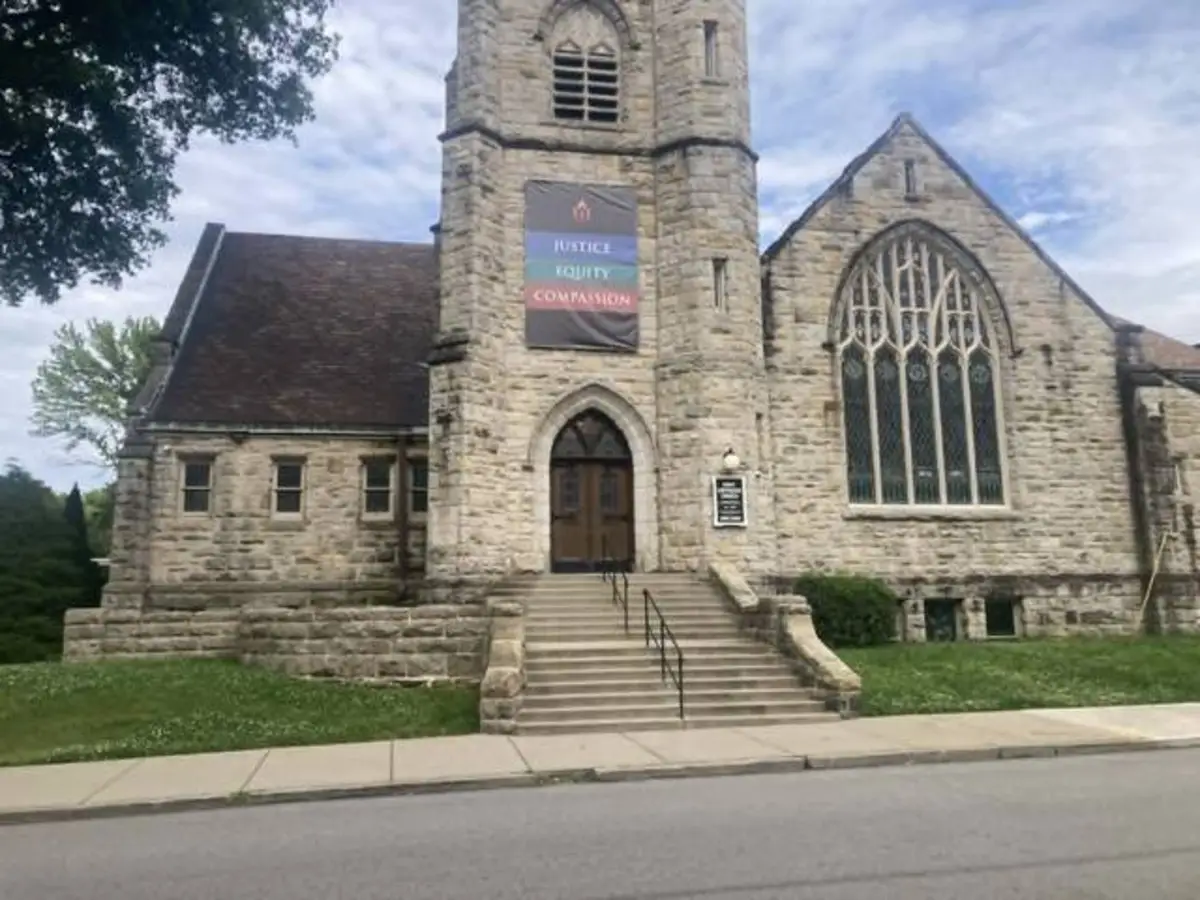
The First Unitarian Church, situated in Shadyside, sports a banner that reads “Justice, Equity, Compassion.” Walker said that the multitudes of humanity are beautiful and representative of God’s love.
“I was raised with the view that the world needs more of those who are often pushed to the margins,” she said.
Religious acceptance isn’t by any means exclusive to Christianity in Pittsburgh. Susan Blackman is the co-founder of Pride Tribe, a Jewish LGBTQ organization affiliated with Temple Sinai that has existed since 2012.
“We held our first Pride Shabbat service in 2015,” Blackman said.
She didn’t come out until she was in her 40s, and discovering both her lesbian and Jewish selves later in life was a revelation. “What I was trying to do was walk into many rooms and present with my lesbian self because I thought that was really important,” Blackman said.
Pride Tribe was created to give a voice to the LGBTQ members of the temple’s congregation.
“I wanted to be in my congregation and be able to be queer within my congregation,” Blackman said. “That’s what it’s all about.”
All about love
Sidney-Smith absolutely believes that faith and LGBTQ people can coexist.
“In the metropolitan area of Pittsburgh, you have a particular subset of the community that’s trying to grow their faith communities and they see the LGBTQ population as an opportunity,” Sidney-Smith said. “And I think that’s a good thing, because the more people mix with other diverse people, the more they tend to become more inclusive and tolerant of people who are different than them.”
The constant theme among people, from faith leaders to congregation members, was love.
“We believe that God’s love is for every person; every person needs it,” Martinage said.
Metropolitan Community Church’s congregation is majority LGBTQ , but their attendees come from all backgrounds and identities.
“Nobody is left out,” Martinage said.
He pointed to Scripture for the basis of this philosophy: “When Jesus was asked, ‘What is the first commandment?’ he said, ‘love the Lord your God, and secondly, love one another.’ Everything that we do must be based on that because that’s what Jesus told us to do.”
Rice calls herself “the real kind of Christian,” the kind who stresses the importance of loving thy neighbor.
“I believe that Jesus calls all His children to Him,” she said.
In her opinion, churches should not only be welcoming, but also actively affirming of different identities, both in the clergy and in the congregation. She’s found that mindset at Community Presbyterian Church of Ben Avon.
The First Unitarian Church of Pittsburgh actively participates in Pittsburgh Pride as a way of showing this radical acceptance and welcoming.
“It’s a wonderful celebration of the incredible spectrum of how people express their sexuality and their gender and just their nonbinary world can suddenly come through,” Walker said. “We all have inherent beauty, inherent dignity, inherent worth. When we connect together in that ecosystem of love, then truly people are invited in to celebrate the fullness of who they are.”
Blackman is grateful to be part of a faith that hasn’t caused her strife for her sexuality.
“Reform Judaism is a nice, wide tent, so no one was against people being queer,” she said.
For Bialek, it’s taking time to undo the damage that her life experience has taught her, but she has hope for the future. She sees younger generations of LGBTQ people having better experiences than she did. And her experience with her church is teaching her more every day.
“I do believe that God is a God of love for everyone,” she said. “And God created us to be exactly who we are.”