
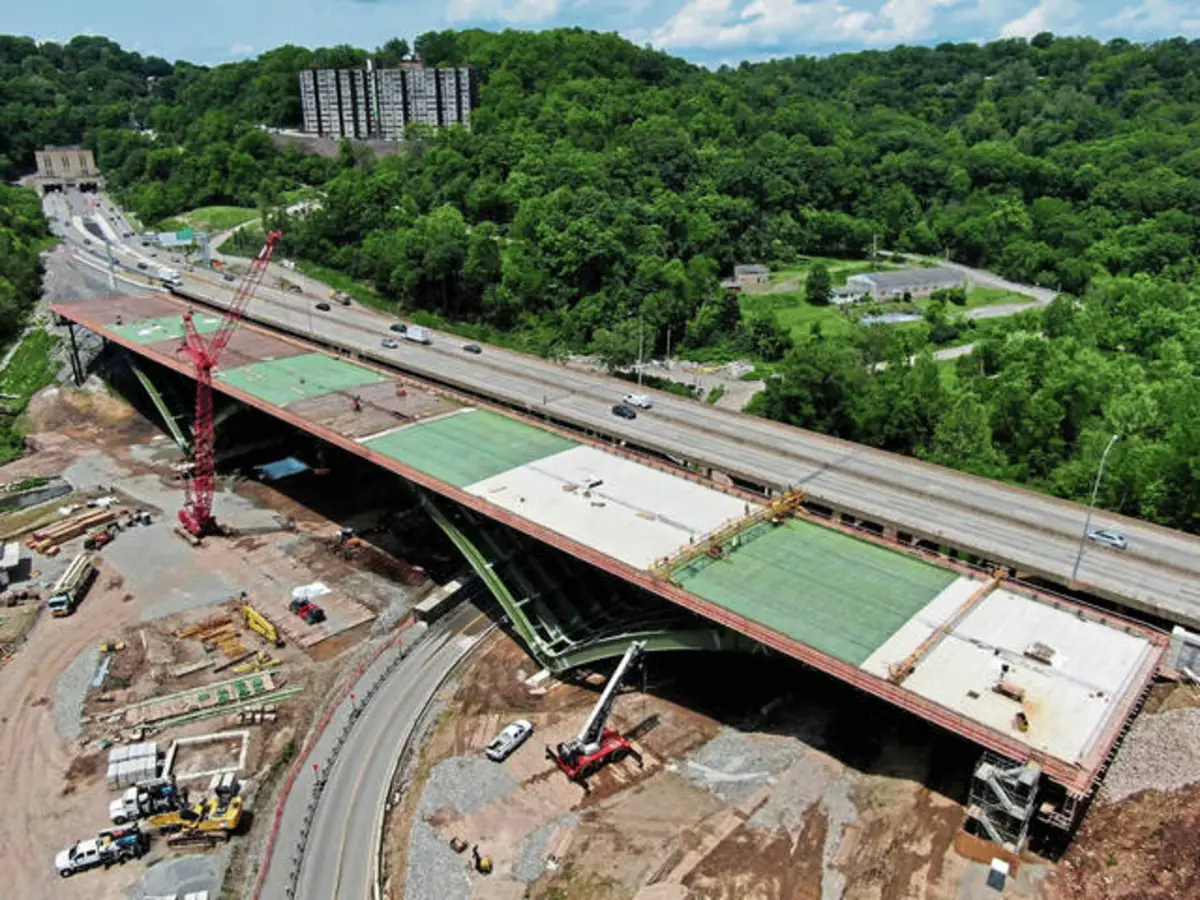
Vicki Yann has a front-row seat to one of Pittsburgh’s most ambitious — and disruptive — bridge projects. From the back deck of her Swisshelm Park home, where she has lived for 26 years, she can see the Parkway East’s Commercial Street Bridge just outside the Squirrel Hill Tunnel.
Next month, she expects to watch the bridge disappear in a cloud of dust as crews demolish the aging structure and slide its $95 million replacement into place on a rail system. The replacement bridge has been under construction next to the current bridge since 2024.
Yann said she and her neighbors are uneasy about the project, which will close Parkway East between the Squirrel Hill Tunnel and Edgewood-Swissvale exits for 25 days beginning at 9 p.m. July 10. It will also shut down Commercial Street — a key access point to Swisshelm Park that runs under the bridge.
“People are not going to realize that the (Commercial Street) detour they’ve normally taken when there’s been issues with the parkway is now also going to be closed,” Yann said.
Residents also are worried about emergency response times, she said. Although Swisshelm Park has its own fire station, the police and ambulance services are based in nearby Squirrel Hill. Reaching the neighborhood could become more difficult while the bridge is closed.
As PennDOT handles the project’s logistics, S&B USA Construction project executive Bryan Frye is overseeing the bridge replacement.
Frye said his company’s goal is to minimize disruption to surrounding communities.
“At the end of the day, a better piece of infrastructure will be in place,” he said.
Bridging the gap
The 846-foot-long, 85-foot-tall Commercial Street Bridge, completed in 1951, has seen better days. A city inspection in January concluded the bridge’s overall condition was “poor” and parts of the substructure were in a “serious” state of deterioration.
As PennDOT constructed the replacement, it endeavored to complete the portion of the project requiring major traffic stoppages as quickly as possible.
The department’s District 11 senior assistant construction manager, John Myler, said the project would have required four years of parkway restrictions, lane shifts and closures if PennDOT had completed it piecemeal.
Since the Parkway East, or I-376, is one of Pittsburgh’s busiest highways — approximately 100,000 vehicles travel on it each day — that simply wasn’t feasible, Myler said.
“The idea was, ‘Let’s do it in one swoop,’ ” he said.
Workers will start the main phase of the project in July by setting up a security perimeter 800 feet around the existing bridge and demolishing it with explosives. After breaking down the remaining chunks with hydraulic hammers, they will rehearse the mechanics of the bridge-sliding maneuver.
Then it’s time to move.
Crews will employ 42 jacks to transport the 22-million-pound new bridge on rails 3 feet at a time — and about 100 feet in total — from a temporary foundation next to the current bridge to its final position, Frye said. The jacks each weigh 700 tons.
After years of preparation, the sliding process itself will take place over the course of just a day or two, Frye said.
Kent Harries, a professor of structural engineering and mechanics at the University of Pittsburgh, said the sliding technique requires complex engineering but the action itself is “remarkably simple.”
The Commercial Street Bridge project followed a concept known as Accelerated Bridge Construction (ABC), which posits that the most expensive part of replacing a bridge is the material cost of closing a roadway for a long period.
To start, it’s expensive for motorists, Harries said, because commuters and truck drivers will have to spend extra time and burn extra fuel navigating the detours.
“Our economy runs on just-in-time delivery,” Harries said. “This is a great way to address replacing the existing infrastructure in a way that doesn’t interrupt it any more than is absolutely necessary.”
PennDOT has a history of building replacement bridges alongside their predecessors, including the Shaler Street Bridge in Duquesne Heights in 2019 and the Jonathon Hulton Bridge in Oakmont in 2016.
PennDOT also slid the new Shaler Street bridge into place after demolishing its predecessor, but, at just 162 feet, it was significantly smaller than the Commercial Street Bridge. The bridge also was assembled offsite and positioned into place with Self-Propelled Modular Transporters rather than hydraulic jacks.
And while the agency was able to simply reroute roads to connect to the Hulton Bridge, the Commercial Street Bridge’s proximity to the Squirrel Hill Tunnel eliminated that option, Myler said. PennDOT would have liked to have added lanes to the bridge to support the highway’s heavy traffic, but it was not possible, he said.
“It’s an unfortunate thing,” Myler said.
However, commuters will notice that the new bridge is substantially wider to accommodate larger shoulders on either side to facilitate maintenance and emergency vehicle passage. Shoulders will increase from 4 feet to 12 feet, and the bridge’s total width will increase from 68 feet to 86 feet, Frye said.
‘Rip the Band-Aid off’
Yann is secretary of Swisshelm Forward, her neighborhood’s community group and liaison to the city. Her organization also has worked with Swisshelm Park’s councilwoman, Barb Warwick, D-Greenfield, to set up meetings in their community center to discuss the detours and what to expect.
PennDOT has published four primary suggested detours on its project page — eastbound and westbound routes for both interstate and local traffic. Interstate traffic will primarily follow Penn Avenue and Fifth Avenue, while the local detour crosses the Rankin Bridge into Homestead and into the city across the Homestead Grays Bridge.
Yann thought PennDOT’s summer construction timing was logical since Pittsburgh’s many colleges would be out of session, and she supported one month of hardship and detours rather than years of frustration.
“I was a proponent of ‘Rip the Band-Aid off quickly,’ ” she said. “As long as PennDOT keeps communicating with us and letting us know what the game plan is for police and ambulance services, we’ll suffer through the five weeks and move on with our lives, hopefully.”
Irwin Dobrushin, a Swisshelm Forward member who has lived in the neighborhood since 1989, said he will have a difficult time during the closure because he needs to take his therapy dog for medical care in Shadyside at least once a week. He’ll have to navigate the crowded, unfamiliar detours or find an even more circuitous route to his destination.
“We’re going to be tied up in all kinds of traffic,” he said.
PennDOT has reached out to municipal and city emergency services groups in communities near the project site since December to share residents’ concerns, according to District 11 spokeswoman Yasmeen Manyisha. PennDOT has yet to receive any finalized emergency service plans in return, she said.
Dobrushin said PennDOT’s communication has generally been good, but he felt the agency did not give locals enough notice — less than two weeks — when it closed Commercial Street from November to February to facilitate bridge construction.
While he sees the 25-day closure as a “major concern” with around-the-clock disruptions, he conceded it is better to simply get it over with.
“Some things are unavoidable,” he said.
Yann has considered covering her sliding glass door with cardboard and temporarily shutting her windows during the existing bridge’s demolition, mostly to prevent fine particles from getting in.
“We’re putting a lot of faith in PennDOT and their demolition contractor to do it properly,” she said.
Ultimately, Yann chooses to trust PennDOT that replacing the bridge is necessary, even if it will be inconvenient. The last thing she wants is a repeat of the Fern Hollow Bridge collapse in early 2022, when a PRT bus and several cars plunged into a ravine as the aging bridge gave out.
The Commercial Street Bridge has its own share of recent tragedies. Two drivers have diedin the past three years after veering off the roadway and crashing in the valley below.
“This bridge would be even worse — it’s a longer bridge, it’s a higher bridge,” Yann said. “There’s so much more that could have gone wrong had this bridge failed, so I’m glad they’re doing it.”
Harries, the Pitt professor, said he has every reason to believe the replacement project will be successful.
He acknowledged that Pittsburgh’s aging infrastructure remains a major issue and is hopeful the Commercial Street project will serve as a showcase of what is possible.
“It may open the doors to taking a similar approach to other structures that require replacement — and Lord knows there are a number of those — including other structures along the parkway,” he said.
PennDOT’s Myler encouraged commuters to work from home, if possible, during the Parkway East closure and to check the state’s real-time traffic monitor, 511PA, for updates.