
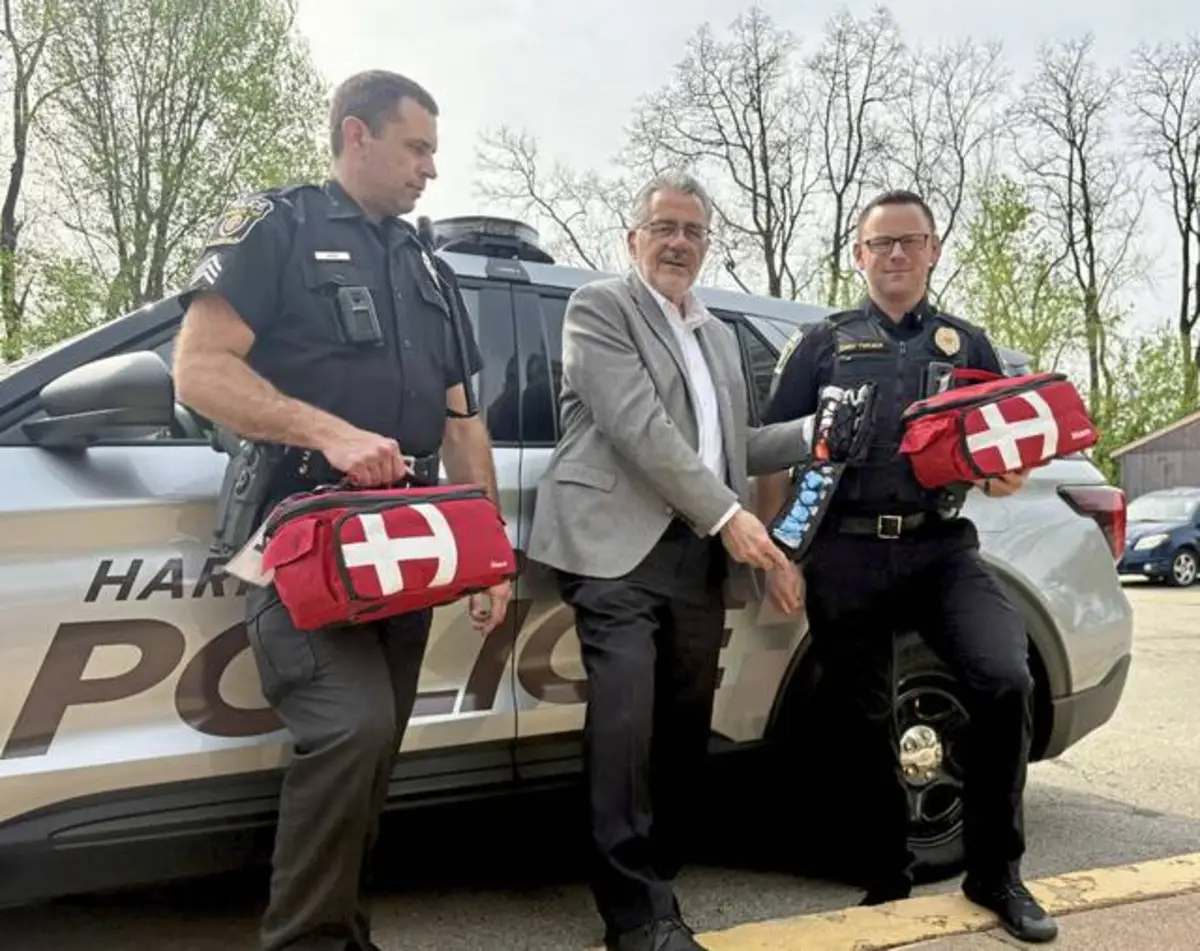
Trauma kits that equip police with essential tools for medical response were barely unpackaged in Harrison before officers put them to use.
“Two days after we got them, we had a man wreck an electric scooter on River Avenue, right in front of the mill,” Chief Brian Turack said.
Officers were able to pack the victim’s wound, a 3-inch leg laceration, and stop the bleeding before EMS arrived at the scene.
Body-worn first aid kits, along with larger bags for mass casualties, were donated to five local police departments — Harrison, Springdale, Allegheny Township, Tarentum and Lower Burrell — by the Allegheny-Kiski Health Foundation in Harrison.
The cost was $25,000, and foundation president John Pastorek is planning a second round.
Because police are often the initial first responders at emergency scenes, the foundation’s trauma kits and mass casualty bags can be crucial.
According to the Federal Emergency Management Agency, police increasingly provide basic life-saving medical care at crashes, explosions, shootings and other incident scenes.
Departments now regularly train and equip officers to deliver immediate interventions, the FEMA website said. They are called on for hemorrhage control, overdose reversal, cardiac support and general trauma.
Springdale police Chief Derek Dayoub said it is a critical component of modern policing.
“The reality is that officers regularly respond to unpredictable and potentially traumatic situations where immediate medical intervention is necessary,” Dayoub said.
The initiative was spurred by the 2023 line-of-duty death of Brackenridge police Chief Justin McIntire, who was shot by an assailant during a manhunt on Third Avenue.
The small kits are packed with more than a dozen supplies to stop blood loss.
Larger bags are meant to be carried in police vehicles and would be used to treat multiple victims in a mass shooting, building collapse, explosion or other large-scale event.
More than 50 of each type of kit have been doled out.
Dayoub said having immediate access to tourniquets, pressure bandages and other hemorrhage control tools can make a critical difference in the moments before EMS arrives.
“The foundation’s generosity demonstrates a genuine concern for those who put themselves in harm’s way each day, and it does not go unnoticed,” he said.
Eureka Community Ambulance Chief Brad James and paramedic Randi Shank helped assemble the prototype mass casualty bag.
“Whether it’s a routine incident or mass event, the whole point is working hand-in-hand with fire, rescue and EMS,” James said.
“The more resources out there, the more tools, the better,” he said. “Not only to help the public but for the officers — if they’re in the hot zone and they need immediate care, they have it on them.”
The Harrison crash on River Avenue illustrates perfectly the need for at-the-ready supplies, Pastorek said.
His goal is to equip every police vehicle in the Alle-Kiski Valley with a bag and to gift each officer with a compact kit for their uniform. Because of costs, distribution is limited to local departments in the Valley.
“We see the effort as fundamental to the foundation’s mission to improve the health and wellness and quality of life for people who live and work here,” he said.
Harrison police were given eight larger bags, one for each patrol car, and enough small kits that every officer can carry one.
“The presence of these trauma kits is essential,” Turack said. “They enhance officer preparedness, improve outcomes for victims and ultimately help save lives.
“God forbid a mass casualty situation happen around here, every little bit will be crucial.”