
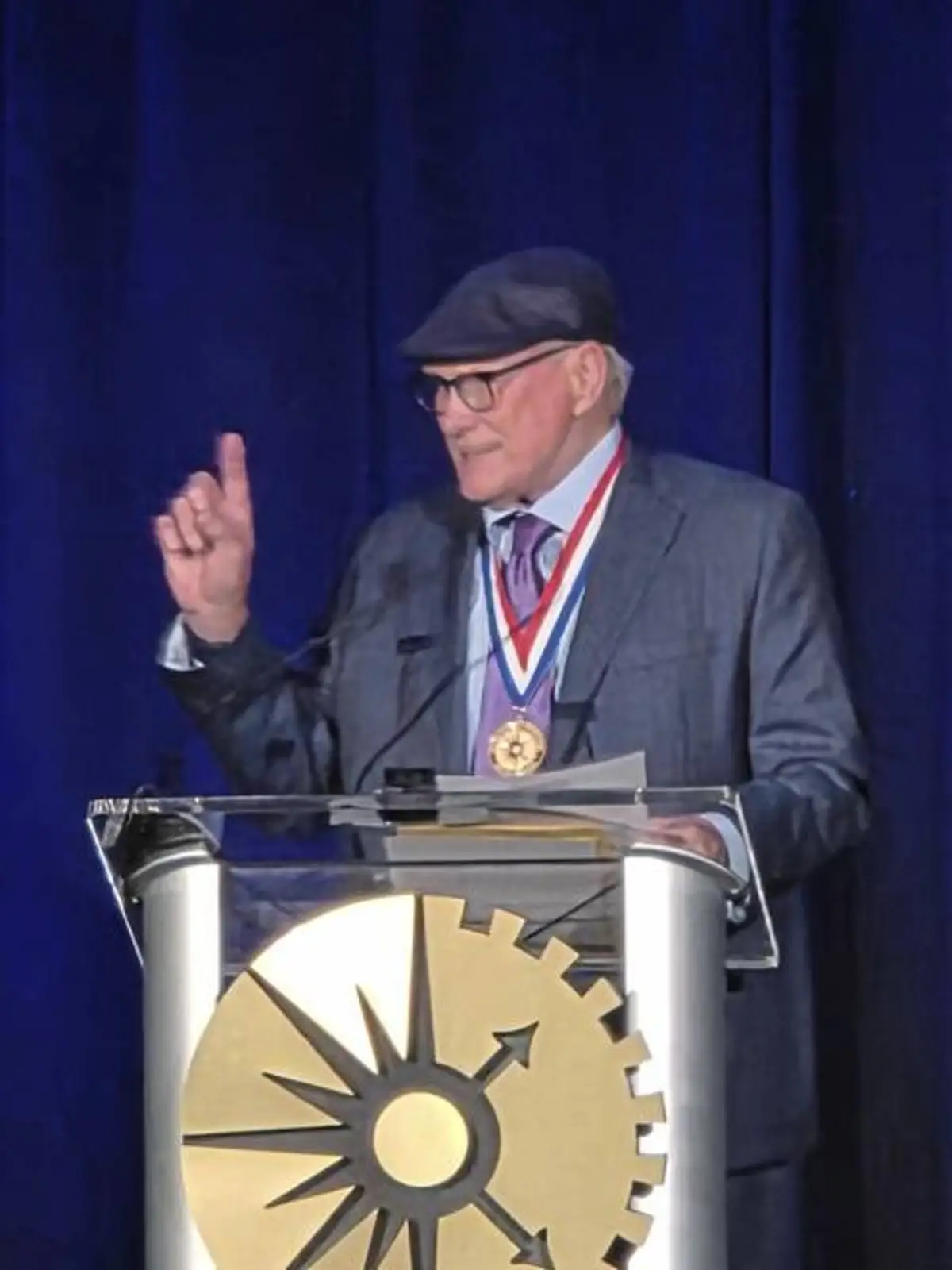
The Senator John Heinz History Center’s 33rd annual History Makers banquet brought an air of reconciliation between a Pittsburgh sports legend and his city, a tease from its most prolific philanthropists of the era, and the closing of a storied career.
Each year, the black-tie fundraiser for the Smithsonian affiliate in the Strip District honors Pittsburghers or those connected who have made “exceptional contributions” to the history of Western Pennsylvania, the U.S. and the world — dubbing them History Makers. Since 1992, the dinner has raised $10.5 million, according to the History Center.
This year, NFL Hall of Fame former Steelers quarterback Terry Bradshaw received the distinction alongside prolific Pittsburgh philanthropists and Kamin Family Foundation founders Daniel G. and Carole L. Kamin; Downtown-based Jewish Healthcare Foundation president and CEO of 30 years, Dr. Karen W. Feinstein; Pulitzer-Prize-winning author and historian Dr. Edda L. Fields-Black; and former U.S. District Judge Robert J. Cindrich.

“These are people who have made an impact nationally, globally and we’re honored to honor them,” said History Center President and CEO Andy Masich. “Their stories go into the archives of the Heinz History Center, which is the memory of Pittsburgh.”
Though Bradshaw was once at odds with the city over Southern stereotyping, clashes with coaches and divvying of credit for four Super Bowl wins — as a room full of Pittsburgh dignitaries witnessed Wednesday night at The Westin Pittsburgh hotel — the Blonde Bomber’s impact on Pittsburgh still resonates.
“I am a nice guy, really a nice guy. I had a hard time with you folks when I came up here. I didn’t understand it,” he said. “When I retired, I left here in a bad mood. I left here not thinking you cared about me or appreciated the work that I did as your quarterback. It was more so about our defense, and Franco’s running, and rightfully so. I wanted someone to say to me, ‘Terry, we really appreciate it.’ But I didn’t get that from my head coach. I didn’t get it from a lot of people. I left here injured.
“It took me a long time to heal, and I have been back in Pittsburgh three times in the last five weeks,” he continued with a smile, noting trips back for the NFL Draft, a Mel Blount Youth Leadership event and Wednesday’s ceremony. “What a great honor this is.”
Prior to the ceremony, Bradshaw reflected on his journey.
“When I first got here, we lost our coal manufacturing — most of it,” remembered Bradshaw. “The city was losing a lot of workers — a hard-nosed, blue-collar town. I experienced that firsthand. If you play hard for and you produce for this city, I mean, you’re solid. And eventually I did that … While I was doing that, I still had my ups and downs along the way.”
“I’m 77. I left here when I was 32. Can you imagine that? … At first I was afraid to come back, I didn’t know how I’d be treated.”
Bradshaw was humbled to enter the collective memory among accomplished names who have given much to the city.
“When you get awards like this, do you really deserve them?” Bradshaw asked. “I’m a sports guy, so I’m very appreciative, a little embarrassed. Because as a sports guy, you don’t think of yourself as a mover and a shaker and a doer and a maker in a community.”
One of those teammates, Hall of Fame cornerback Mel Blount, spoke to what the honor that places him with Fred Rogers and August Wilson might mean for Bradshaw’s continued healing.
“I know Terry appreciates it, because it has taken him a long time to figure out that people in Pittsburgh really do love him,” said Blount. “It’s great for Terry and I think it’s gonna do a whole lot for him, the way he looks at Pittsburgh.”
The Kamins
For years now, the Kamins have been spreading their wealth across the region to the tune of 200 different local, state and national nonprofits a year, Carole Kamin said.
In 2024, the couple made the largest ever contribution of $65 million to the Carnegie Science Center, now renamed in their honor. In February 2025, the pair donated $25 million to the Carnegie Museum of Natural History in Oakland. In June 2025, they donated $11.5 million to the Heinz History Center. A month later, they announced donating $65 million toward UPMC’s Presbyterian hospital tower project and medical research. They also contributed an undisclosed amount to Shadyside’s Family House for traveling patients and their families.
“In terms of the future, we are still not done,” Carole Kamin said ahead of the ceremony.
“By no means,” reinforced her husband Daniel.
They offered no details on who or what might be the next recipient:
“We’re working on it right now,” said Carole with a smile. “We’ll give you some breaking news, maybe a month or so.”

They encouraged everyone to give back.
“I think it’s really important that everybody give a little, it doesn’t have to be a lot, to give annually, just a little bit,” said Carole. “If a lot of people did that, our places that we visit here, our cultural institutions and other things, can continue to be great, and even greater.”
Dr. Edda L. Fields-Black
In 2025, Fields-Black — a professor of history and director of The Humanities Center at CMU — took home the Pulitzer Prize in history for her book “Combee: Harriet Tubman, the Combahee River Raid, and Black Freedom During the Civil War.”
During the Civil War raid, Tubman and her crew piloted two regiments of Black U.S. Army soldiers, the Second South Carolina Volunteers, and their white commanders up coastal South Carolina’s Combahee River in three gunboats. In a matter of hours, they torched eight rice plantations and liberated 730 people.
“I wanted to document Harriet Tubman’s Civil War service from the perspective and in the words of the people who were freed,” she said. “And I wanted to put the reader in the rice fields so that they could try to fathom the daily tragedy in the millions of enslaved people who were forced into labor in these tidal swamps, and I left it all on the field.”

It also led to her discovering her own link to the raid through her third great-grandfather.
“Through uncovering my family history, I began aspiring to translate the tragedy, grief and resilience of enslavement and its afterlives on the page in storytelling, so that I could transmit enslaved people’s stories to readers beyond my graduate students and colleagues in my field and to nonfiction readers to transform descendants of enslaved people’s shame into pride for our freedom-fighting ancestors.”
Dr. Karen Feinstein
For more than 30 years, Karen Feinstein helmed a philanthropic and advocacy organization, the Jewish Healthcare Foundation.
Over the years under her leadership, the foundation would help broach such issues as immunizations, patient safety, maternal health, the AIDS epidemic and the Affordable Care Act. All the while, it funded collaborations and projects and produced media and academic papers.
“I think of history as the story of great people, what they could accomplish collectively, the power of great partnerships,” said Feinstein. “All of us, as history makers, are indebted to our own networks, our roundtables, our brain trusts.”
As of July 1, however, the JHF will have a new leader for the first time. Feinstein announced she would be stepping down from her role as CEO and that executive vice president Daniel Rosen would be promoted to the helm, effective July 1.
“I look back with enormous gratitude and a career that couldn’t be more satisfying,” said Feinstein.

Robert J. Cindrich
The Washington native and former federal judge for the Western District of Pennsylvania (and former federal judicial nominee to the U.S. Court of Appeals for the Third Circuit) was honored for his sense of equality and fairness.
His presenter, Bryant Wesley, chief counsel at UPMC, touted Cindrich’s work in upholding the interests of minorities during his time as Pennsylvania Supreme Court-appointed chairman of the Legislative Reapportionment Commission in 1991, when he guided a redistricting effort.
“The Supreme Court selected him because of his reputation for fairness and constitutional adherence,” said Wesley. “He worked directly with the national and state NAACP and representatives of the Latino community in Philadelphia and across the state to make sure their voices were heard.”
Cindrich’s work was “noted for placing a substantially greater emphasis on minority voting rights than any previous reapportionment in Pennsylvania history,” said Wesley.
Wesley also touched on Cindrich’s ruling during a lawsuit against the city of Pittsburgh that led to one of the first federal decrees calling for extensive police reform over an entire department.
“Thanks, not just for this great honor to me, but for all that this center means to our city and to our region,” said Cindrich. “Thank you for the educational opportunities you provide, not just for our children, but to all of us.”
“There can be no higher calling than that.”
