
A Carrick man who was shot three times by Munhall police while in a holding cell last year is suing in federal court.
Christopher Allie, who remains in Allegheny County Jail pending trial on aggravated assault, strangulation and related charges, said in the complaint filed Thursday that he was shot on Feb. 10, 2025, by Officer Devin Koontz.
Also named as defendants are officers Emily Carrigan and Darnell Coles, as well as the Borough of Munhall.
Messages left for the borough solicitor and borough manager were not immediately returned Thursday evening.
The lawsuit includes claims for excessive force, assault, intentional infliction of emotional distress, denial of medical care, and liability.
Allie, 39, was shot three times just after 12:41 a.m. in the holding cell in the Munhall Police Department.
Police said the shooting occurred after Allie ignored officers’ commands and began fighting with them.
However, the lawsuit alleges that Allie was defending himself after the officers entered the cell aiming what he thought was a gun at him. The lawsuit said that Koontz actually had a Taser ready to deploy.
Allie had been arrested earlier that night for allegedly strangling a woman and threatening to kill her after watching the Feb. 9 Super Bowl together, according to the criminal complaint against him.
Koontz, Carrigan and Coles all responded to the initial incident.
The lawsuit asserts that Koontz took Allie to the Munhall Police Department around 11:51 p.m. in his patrol car and placed him in the holding cell.
Allie claims he was never aggressive, and that some of the conversation with Koontz was “jovial.”
Allie turned over his belt and shoes, and after police checked his winter coat, it was returned to him, the lawsuit said.
Throughout the night, it continued, officers occasionally allowed Allie to use his cell phone.
Around 12:31 a.m., the lawsuit said, Allie attempted to get officers’ attention by knocking on the cell door. When no one responded, the suit claims, he laid on the floor and used his foot to knock on the door.
When that proved unsuccessful, the lawsuit said, at 12:39 a.m., Allie attempted to get officers’ attention by covering the camera in the holding cell with wet toilet paper.
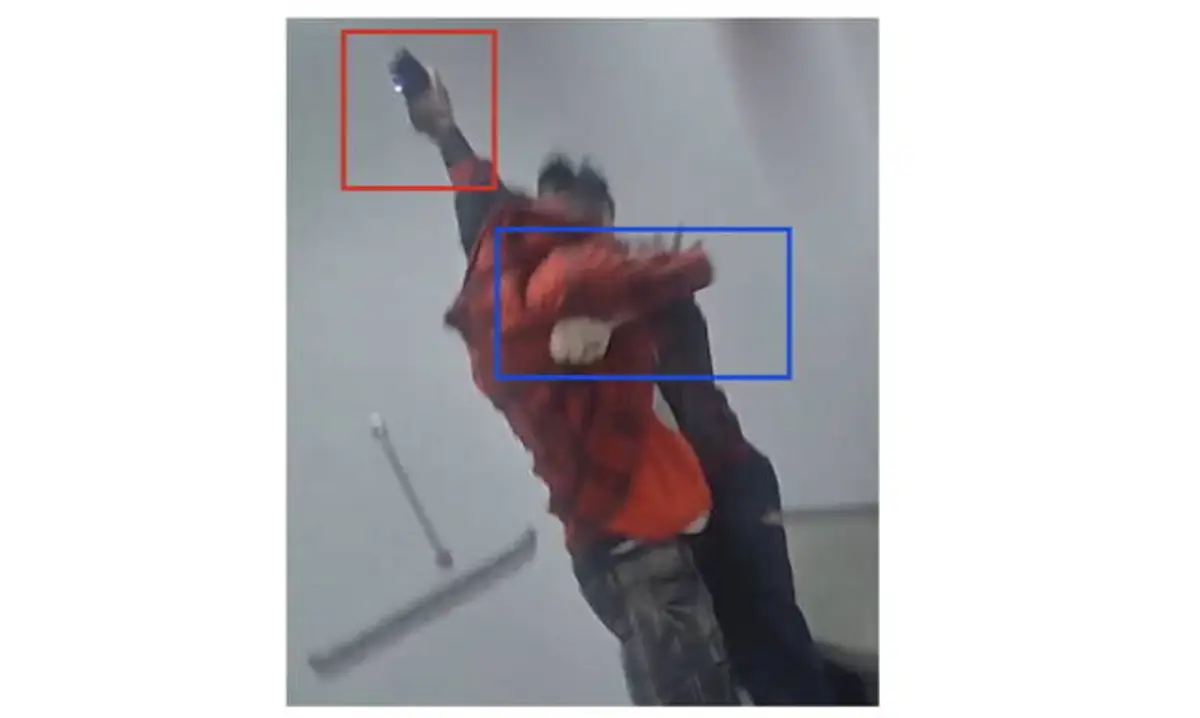
Each of Allie’s claims in the lawsuit is accompanied by still images taken from the surveillance camera inside the holding cell, and later bodycam footage.
At 12:41 a.m., the lawsuit said, Carrigan turned on her bodycam and returned to Allie’s cell with Koontz.
“Even though the cell door had an opening through which prisoners could be handcuffed, either in their front or behind their back, at no time did Koontz or Carrigan attempt to handcuff Allie before they opened the cell door,” the complaint said.
As they entered, Koontz aimed his Taser at Allie’s face, the lawsuit said, and began yelling commands at him.
The Taser, the complaint continued, resembled a semi-automatic pistol.
“Allie reasonably believed that Koontz was pointing a firearm directly in his face,” the lawsuit said. “As a Black man that had just covered up the only known camera that he knew to be recording him in the cell, his reasonable belief that Koontz was aiming his firearm directly at him, and Koontz’s aggressive and agitated tone, Allie was reasonably in fear for his life and he believed that Koontz and Carrigan were taking the opportunity to essentially ‘execute’ him or cause him great bodily harm.”
The lawsuit said Koontz was not wearing his bodycam at the time.
When the officers opened the cell door, Koontz demanded Allie turn around and walk back from the door, which the lawsuit said, he did.
Koontz and Carrigan then grabbed Allie, and Koontz spun him to be face to face with him, it continued.
“Allie immediately saw that Koontz was pointing what he reasonably believed to be a firearm, directly at his center mass and was about to pull the trigger,” the lawsuit said.
Fearful, Allie reached out and pushed Koontz’s arm toward the ceiling while wrapping his other arm around the officer “to prevent Koontz from obtaining the space necessary to bring down and discharge his firearm at Allie,” the complaint said.
Koontz’s Taser then fired at the ceiling, while Carrigan discharged her own Taser, the lawsuit said. However, it was ineffective because of Allie’s winter coat.
The lawsuit alleges that Allie continued to plead with the officers to stop.
But it was then, it said, that Koontz forced Allie onto the cot in the cell, grabbed his firearm from its holster, placed the muzzle against Allie’s rib cage and fired three shots.
Koontz spun off of Allie, backed up and aimed his gun at him, while Allie put his arms in the air, the lawsuit said.
Koontz yelled at Allie, who didn’t realize yet that he’d been shot, to get on the ground, it continued. Then, Koontz dragged Allie across the floor, while Carrigan called for EMS, the lawsuit said.
It asserts that Koontz failed to render any medical aid and instead stood over Allie berating him.
Allie was taken to UPMC Mercy hospital where he immediately underwent surgery, the complaint said. Two of the bullets that struck him remain lodged in his body, the lawsuit said.
He has undergone several surgeries, and one bullet near his spine has fragmented causing Allie extreme nerve pain and numbness.
In addition to alleging excessive force, the lawsuit also asserts that the officers violated department policy by having their firearms with them when they entered the holding cell.
“ABSOLUTELY NO OFFICERS WITH SIDEARMS ARE PERMITTED IN THE DETENTION AREA WHILE PRISONERS ARE BEING HELD OR PROCESSED,” the policy reads, according to the complaint.
It also quotes District Attorney Stephen A. Zappala Jr., who said last month in an interview with WPXI that “the incident should not have taken place.”
In the interview, Zappala said that officers should have handcuffed Allie through the slot in his cell door, and he further questions why the officers had their sidearms on them in the cell.