
BikePGH spokesperson Julie Walsh would be the first to tell you that she and most of her colleagues do, in fact, drive sometimes — despite their organization’s longtime push to swap roads for bike lanes all around Pittsburgh.
Rather than eliminate cars entirely, BikePGH’s true goal is to reduce car dependency for a safer and more accessible city, Walsh said.
Or, in her own words: “Creating more harmony on our streets.”
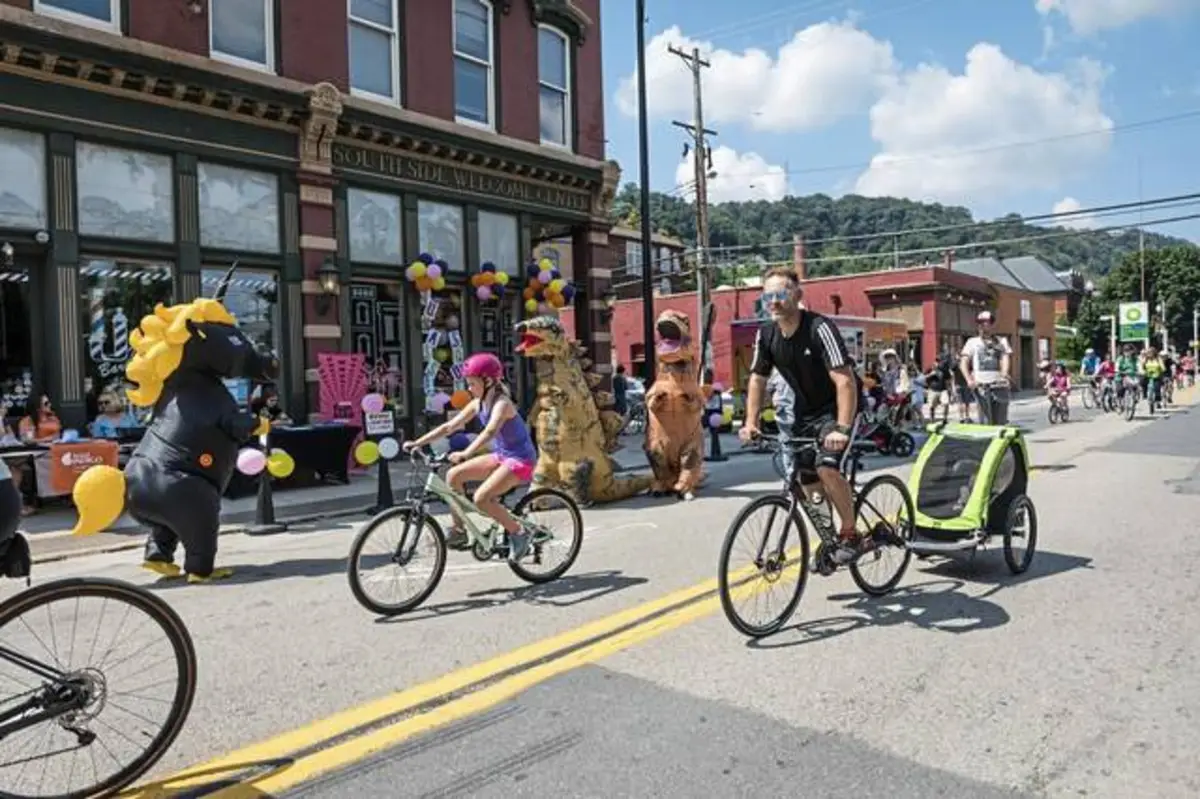
BikePGH’s proof of concept is OpenStreets, a global movement to minimize driving that they brought to Pittsburgh starting in 2015. The organization gets permission to close streets in a certain part the city, often linking two neighborhoods, to let bikers and pedestrians roam. Local vendors are invited to set up booths. Always on a Sunday, starting in the morning, the events last four hours and take place two or three times a year.
BikePGH is hosting OpenStreets this year on June 28 along Forbes Avenue Downtown, the 10th Street Bridge and part of East Carson Street on the South Side, and on July 26 on Smallman Street in the Strip District and a stretch of Butler Street in Lawrenceville. The events run from 10 a.m. to 2 p.m.
OpenStreets is “a perfect example of BikePGH’s mission in action,” and provides a visual example to pair with the organization’s government advocacy, Walsh said.
“Once you get on the street and actually experience it for yourself at an event like OpenStreets, it’s a completely different idea,” she said.
Walsh said that Pittsburghers typically don’t realize how walkable many of the city’s neighborhoods are since they are so used to driving. She pointed out that Downtown and the South Side are only two miles apart, for example.
BikePGH’s events manager, Catlyn Brooke, secured a special events permit from the City of Pittsburgh and worked with the state government, which owns East Carson Street, and the county government, which owns the 10th Street Bridge.
She also looped in the Pittsburgh Parking Authority, Pittsburgh Regional Transit, the Department of Mobility and Infrastructure and emergency services.
“It’s a lot of collaboration between different agencies,” Brooke said.
It’s also a significant expense for a small nonprofit like BikePGH.
Walsh estimated that this year’s events — “a huge production” — cost several hundred thousand dollars, funded by grants, sponsorships and member donations.
“We really do think it’s well worth it — not only to show people what’s possible when we prioritize people on our streets, but also, it’s just a fun event,” she said.
BikePGH likes to mix up its OpenStreets maps every year to reach as many neighborhoods as possible. Brooke took special care to route this year’s events through Market Square, which reopened in April after renovations that reduced car access in favor of pedestrian walkways.
“That just goes hand-in-hand with all the work we’re doing,” she said.
Pedestrians and bikers can enter the event zone at any point. Brooke said OpenStreets regularly draws 10,000 to 15,000 attendees per day, and up to 20,000 if there is nice weather.
OpenStreets does receive some criticism from drivers who are upset that the roads are closed, even though there are several crossing points along the routes monitored by safety officials, Walsh said.
Some critics end up appreciating the “magic” of the events, but BikePGH recognizes that it can’t make everyone happy, she said.
“Cars get to take over our streets every single day,” she said. “We’re giving an opportunity for people to experience their neighborhood, their community [and] their city in a different way.”
BikePGH is pursuing more permanent roadway changes through dialogue with government officials.
Former Pittsburgh Mayor Ed Gainey worked with the organization on policies like Vision Zero — a pledge to eliminate traffic deaths — and Complete Streets, which upgrade existing roads with high-visibility raised crosswalks and refuge islands.
While Mayor Corey O’Connor did not publicly commit to continuing Gainey’s initiatives when he took office in January, Walsh said that he attended BikePGH’s recent “Bike to Work” event and has responded well to their proposals.
“It’s still kind of early days … but from my perspective, the mayor seems pretty cool about this stuff so far,” she said.