
Pittsburgh Mayor Joseph G. Armstrong in the spring of 1916 placed copies of the city’s newspapers, a Bible and Pittsburgh and American flags into a copper box.
He added a copy of the blueprints for the City-County Building and a history of Grant’s Hill, the mound that had once sat where the new nine-story City-County Building was then being constructed on Grant Street in Downtown Pittsburgh.
Newspaper reports from the time show his son, Joseph G. Armstrong Jr., helped him seal the box.
In a ceremony at the City-County Building construction site commemorating Pittsburgh’s 100th anniversary, Armstrong put the copper box into a stone and watched as a 4-by-8 granite slab was placed atop it.
County officials filled a similar box that was placed within the building’s portico, newspapers reported at the time.
Now, Pittsburgh officials are looking for the city’s time capsule.
Armstrong wouldn’t have called it a time capsule when it was placed into the building, said James Hill, who serves as assistant chief of staff to present-day Mayor Corey O’Connor and is leading the search for the long-lost box. That’s a more modern term.
“In those days, they were not meant to be discovered until the building was torn apart,” Hill said.
The city in 1916 was building its third city hall after outgrowing the first two as Pittsburgh experienced rapid population growth. (The city’s first Pittsburgh Municipal Hall opened in 1794 in what is today Market Square.)
City officials in the 1950s unearthed a time capsule that had been built into the second City Hall, whose cornerstone was laid in May 1869, when the Smithfield Street structure was torn down.
That time capsule, which dates to the 1860s, included a drawing of the building; a document identifying when its cornerstone was laid and naming its contractors; documents from the American Institute of Architects; details of the $52,262 contract for brickwork at the building; an article from the March 1869 edition of The Architectural Review and American Builders’ Journal about heating and ventilating the new city hall; a digest of city ordinances; and a Pittsburgh map, among other items.
Officials erecting the present-day city hall in 1916 likely expected it would be torn down within a few decades to make way for an even larger iteration. They assumed the time capsule would be uncovered then, Hill said.
But Pittsburgh’s population growth did not keep that trajectory. Over 100 years later, the city has not outgrown the City-County Building.
Hill, joking Pittsburgh’s government is still there “for the long haul,” is now hoping to find and open the time capsule by next month, to coincide with America’s 250th anniversary.
Though newspaper reports and photographs offer tantalizing details about what’s in the box and approximately where it was placed, finding it is a tricky task.
Some people have erroneously believed the time capsule would be located at one of the building’s corners because it’s stashed in what was called a cornerstone — but Hill pointed out that newspaper reports indicate the box was placed within a granite column of the center arch on the building’s portico.
Hill’s goal is to find and extract the box without damaging the building’s facade.
“Granite is obviously something you obviously don’t want to mess with, especially with a beautiful old building like this,” he said.
Initially, Hill had hoped to access the space through the basement, but that proved too difficult.
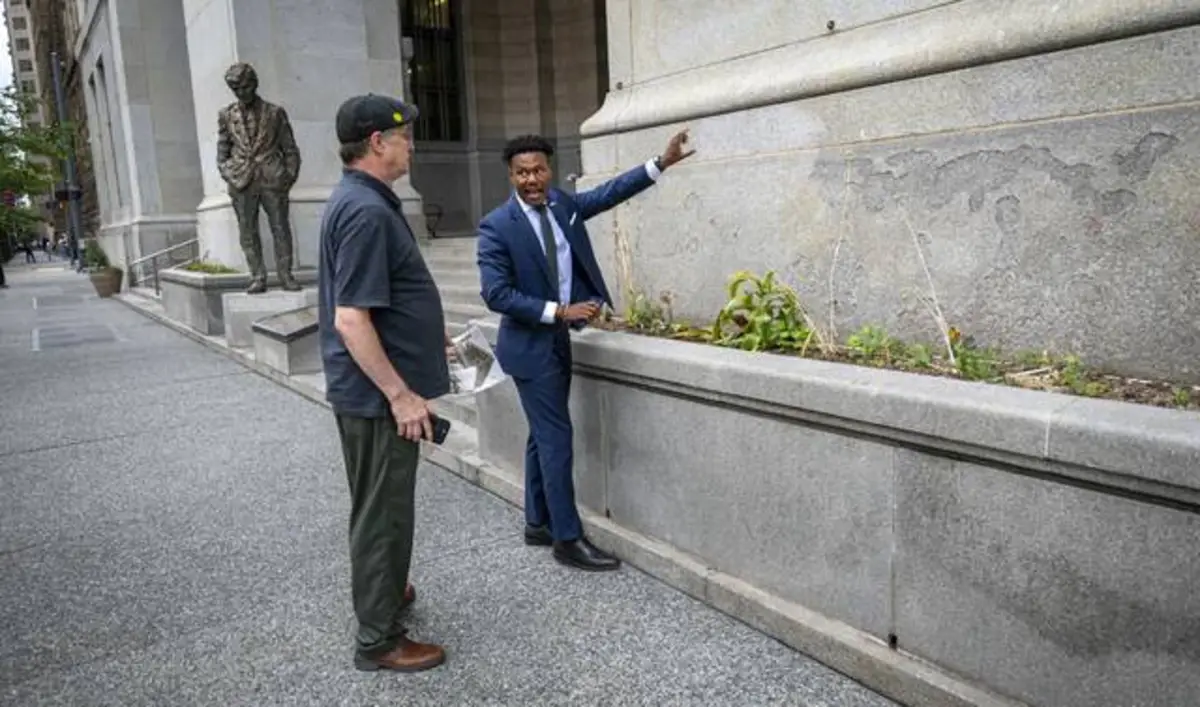
Now, he’s planning to approach the spot through the large planters that were installed at the base of the columns in the 1980s.
Hill said crews hope to snake a camera into the column next week to identify its exact location.
“No one’s laid eyes on it in 110 years,” Hill said.
When Hill and his team spot it, they’ll hammer out a plan for how best to remove it.
Hill hopes he’ll be able to host some sort of event to unveil the box’s contents by Independence Day. While newspaper reports provide information about the contents, Hill wondered aloud whether there could also be any unreported surprises hidden inside.
Though Hill is bullish on finding the box in the area he has pinpointed, he also acknowledged it’s possible that the time capsule could have been moved. Hill said he’s not aware of any construction work that would’ve disrupted that portion of the building since the box was placed.
“You can’t be certain about something nobody’s seen in over 100 years,” he said.