
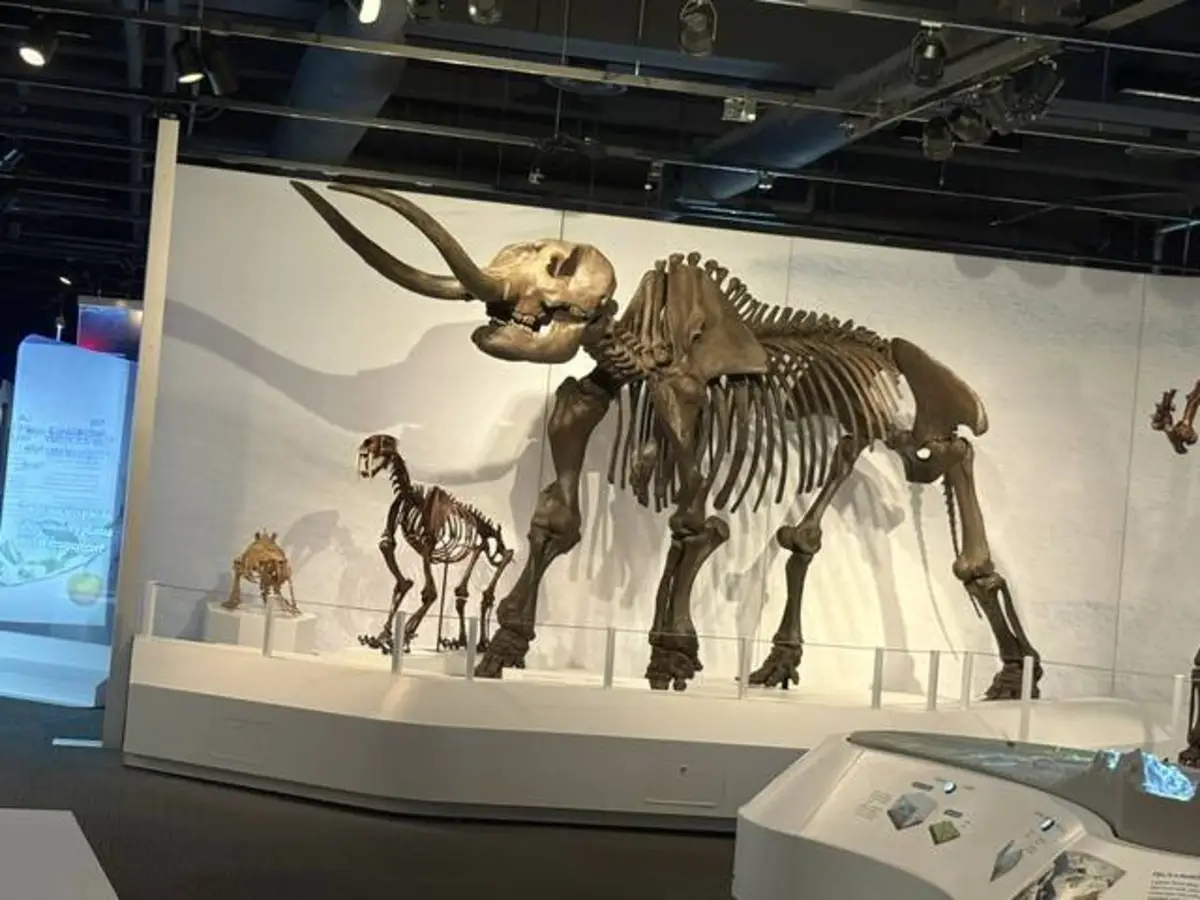
For those despairing about the imminent closure of the Carnegie Museum of Natural History’s “Polar World,” the Senator John Heinz History Center in the Strip District will fill the void.
“Planet Ice: Mysteries of the Ice Ages” opens to the public on Saturday. The exhibit, in partnership with the Canadian Museum of Nature in Ottawa, explores the relationships between humans, animals, plants and climate during the world’s ice ages — including some deep local connections.
Those connections are so deep, in fact, that they go back 19,000 years. David Scofield, director of Meadowcroft Rock Shelter and Historic Village, helped to guide a media tour through the new exhibit on Thursday. He served as co-lead curator for “Planet Ice,” along with Heinz History Center chief historian Ann Madarasz. Meadowcroft has also provided a number of artifacts that can be viewed as part of “Planet Ice.”
Meadowcroft is the oldest site of human habitation in North America and is located in Washington County.
“We’re the ‘people museum’ here in Pittsburgh,” said Andrew Masich, Heinz History Center president and CEO, in introductory remarks on Thursday. “We tell the stories of people and how they have adapted to this place at the three rivers. But that story doesn’t begin with George Washington in 1753.”
The exhibit is immersive and interactive, starting with a game of “polar bear hopscotch” at the entrance.
Contained within the exhibit halls are more than 100 artifacts, models and specimens, from tools used by prehistoric peoples to a jaw-dropping mastodon.
A mammoth tusk found in Pennsylvania and borrowed from the Carnegie Museum of Natural History is on view. Visitors can also see a fragment of a mastodon that was discovered in the 1940s near present-day Bridgeville.
“That’s where this mastodon died 23,000 years ago,” Scofield said. “These animals were right here in our region.”
But there is also an emphasis on the changing climate within the exhibit. The first section is titled “The Power of Ice” and explains the role of water and temperature on Earth.
“People will come to understand how frozen water — ice — and the power it has to shape the world,” Madaraz said.
There’s even an interactive station to design your own snowflake.
The exhibit covers multiple ice ages, reaching back 80,000 years and ending around the end of the most recent glacial period, about 11,700 years ago. While glaciers never reached the city of Pittsburgh, they did stretch down to around Moraine State Park in Butler County, and they shaped the three rivers.
“Planet Ice” also looks at the adaptations that animals and people underwent to survive in these colder periods.
“Thinking about the climate, it affects what clothing you wear, what’s available to eat, how they survive in the landscape. Those are some of the questions that are posed by the exhibition,” Madarasz said.
A wealth of tools — both recreations and archeological artifacts — can be found throughout the exhibit, some of which can be touched. They’re from people from all around the world, and some are local — including the atlatl.
“The atlatl is an intermediate technology between the spear that you could just throw with your hand or thrust and the bow and arrow,” Scofield said. “We’re talking about 19,000 years of human presence in Western Pennsylvania, the atlatl would’ve been the weapon of choice for thousands and thousands of years.”
It’s essentially a stick that launches a lethal dart tipped with a stone, bone or antler point. “Our visitors will get to throw at that short-faced bear staring them down,” Scofield said. “That’s the largest mammalian predator ever in North America; it stood up to 12 feet tall.”
Meadowcroft is holding its annual atlatl competition on June 20.
“If you want to see someone who really knows what they’re doing, come out to Meadowcroft,” Scofield said.
The exhibit also looks at the way that ice shaped the region economically and topographically far back in history in ways that still have an impact today.
“Part of our mission is to get people thinking about the past and how it affects our world today, how it’s relevant,” Madarasz said. “This exhibit does that really well. It’s really going to talk about ice in the world today and what’s going on with climate, and how people can be active agents in shaping the environment. This is a story, of course, in Western Pennsylvania, that we know from Rachel Carson, the great environmentalist.”
From a look at global ocean currents to recreation with ice, the last section brings the exhibit to the present and connects with museum goers. There’s also a station that asks viewers how they would adapt to a changing climate and offers ways that they can become agents of change. They can vote for different strategies in a “snow globe challenge.”
“It’s a way for them to leave the exhibit as civic agents in their own lives and a way for them to take the information that they’ve learned and realize that it’s part of their story, too,” Madarasz said.
“Planet Ice: Mysteries of the Ice Ages” opens Saturday and runs through April 4, 2027, at the Heinz History Center in the Strip District. To learn more, visit heinzhistorycenter.org.