
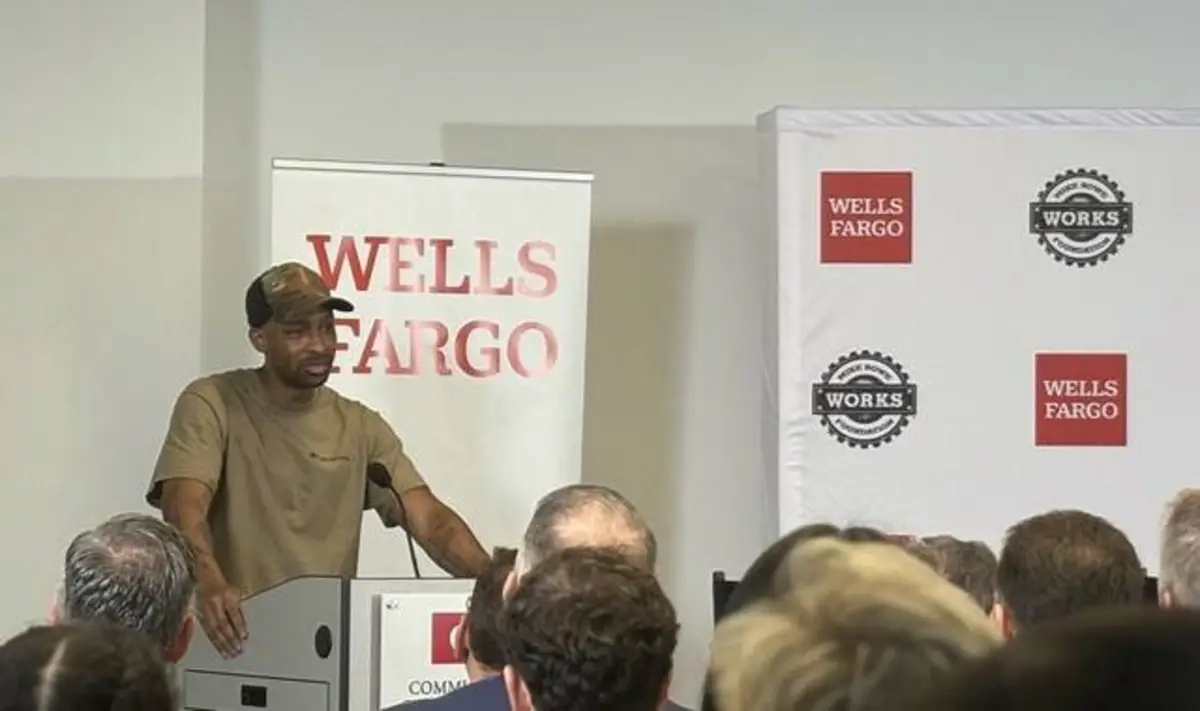
As long as someone is healthy and able to work with their hands, Manny Gomez says, there will always be opportunities in the skilled trades.
After completing service in the Air Force, Gomez decided to earn an Industrial Manufacturing Technician certification from the Community College of Allegheny County in 2022.
He’s since advanced his career from a ground-level worker to a coal side manager at FerroWorks, a Pittsburgh-based industrial manufacturing company that specializes in casting and forging, all while maintaining a family-sustaining wage.
“I wanted to be one of the ones who can get manufacturing back in the United States,” said Gomez, 43, of Hopewell. “There’s a lot of good jobs for people that want it.”
Officials hope his journey can be emulated across the state and nation, as workforce development efforts shift to meet the demands of employers particularly in the energy, manufacturing and industrial sectors.
On Friday, U.S. Sen. Dave McCormick, R-Pennsylvania; Mike Rowe, founder of the mikeroweWORKS Foundation and host of the TV show “Dirty Jobs”; Fernando Rivas, CEO of Corporate and Investment Banking at Wells Fargo; and Scott Mautino, Chief Operating Officer of FerroWorks, toured CCAC’s Center for Education, Innovation and Training, on the North Side.
“We’re in a moment of profound change with technology and AI, and that’s changing the way we work, it’s changing productivity, it’s changing national security,” McCormick said. “It has huge opportunity, and it poses a risk and vulnerabilities, and it depends on what we do. And the part that I think we can all agree on is that having the infrastructure to support that is more important now than ever.”
At the event, Wells Fargo announced a $1 million donation to the mikeroweWORKS Foundation, to support skills training across Pennsylvania. Rowe said his foundation aims to support people seeking future careers in the skilled trades, and aims to debunk the stigma surrounding vocational careers.
Those jobs are in demand, Rowe said. He cited a federal Department of Education statistic where, for every five skilled trade workers who retire, only two replace them.
“The country is grappling with the definition of a good job,” Rowe said. “We’re rethinking it, we’re reimagining it, and it’s long overdue.”
One way employers can encourage young people to consider careers in the trades is to expose them to those jobs, Rowe said. He compared his show, Dirty Jobs — which highlighted essential, but messy, dangerous and physically demanding occupations — to a school field trip.
Mautino said FerroWorks has made efforts to orient prospective or new workers to the field, getting them accustomed to the environment, physicality and work ethic needed to succeed in a trade job. Those expectations were lost when mill jobs became less common in the region, Mautino said.
To complement that, institutions like CCAC help students learn skills like mathematics and safety requirements, Mautino said. Bullock, CCAC’s president, said the college has worked to strengthen partnerships, apprenticeships and industry collaborations to connect students with future employers and raise awareness of skilled trades.
“It’s now connecting that desire, that willingness and that hard work ethic to the educational path in an opportunity,” Mautino said.