
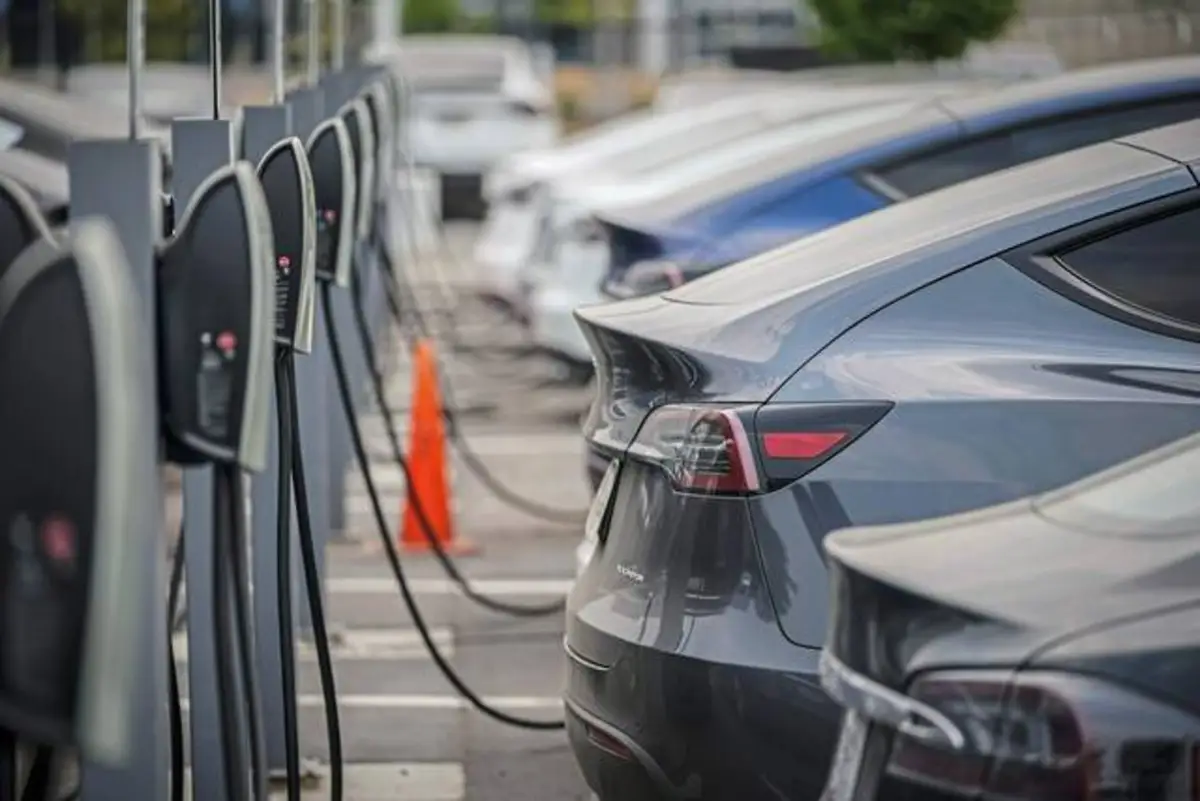
Business owners across Western Pennsylvania can now apply for their own Community Charging ports for electric vehicles following an influx of federal funding.
PennDOT is directing $25 million toward electric vehicle chargers in the region through National Electric Vehicle Infrastructure (NEVI), a Biden administration initiative to construct a nationwide network of EV charging ports.
Pennsylvania now has nearly 40 NEVI-funded charging stations — more than any other state — but they have largely been limited to major highways such as Interstate 79, PennDOT Secretary Mike Carroll said during a press conference Friday at the Cranberry Township Municipal Center.
Now, neighborhoods can have chargers of their own, he said.
“You’ll have charging stations potentially at grocery stores, doctors’ offices, places of worship, really the span of places where community folks thrive,” he said. “This is a real success story and an opportunity to advance the build-out across Western Pennsylvania.”
Cranberry’s Chief Administrative Officer Dan Santoro said the township’s proximity to I-79, U.S. Route 19 and Pennsylvania Route 228 “has long made Cranberry a hub of mobility and connectivity” that will benefit from the chargers.
NEVI will cover up to 80% of design and installation costs for each project, and PennDOT plans to tailor charging infrastructure in each community based on its needs, Carroll said.
Locations in a densely populated community like Cranberry would qualify for a “more robust” setup for charging stations, compared to something “a little more modest” in rural areas, he said.
“The math is the same – 80% [funded] – but the number of ports would be dependent upon the application and the expected usage,” he said.
Charging speeds may vary by location, according to PennDOT’s alternative fuels and infrastructure coordinator, Colton Brown. The agency had prioritized “very fast charging speeds” at its stations along the interstate, he said.
Carroll said PennDOT expects the average grant to cost around $500,000, and Brown added that the final figure of new charging projects in the region will be “definitely somewhere between dozens and hundreds.”
Although the Trump Administration has de-emphasized EV projects, Carroll said that the number of electric vehicle owners in Pennsylvania continues to grow, even if the rate of new purchases has slowed. There were more than 85,000 electric vehicles and 475,000 hybrid vehicles registered in Pennsylvania as of 2024.
“There will be more tomorrow than there are today,” Carroll said.
Western Pennsylvania’s funds are part of a broad statewide funding spree. PennDOT has allocated a total of $100 million to EV Community Charging, split evenly across the eastern, southeastern, central and western regions of the state.
Those interested in community charging ports have a Nov. 20 deadline to submit their proposals using an online form. PennDOT expects to announce funding awards in January and February, but the timeline could change.