
It’s shaping up to be a summer of optimism for Pittsburgh’s resurgent Downtown and South Side — but also a season of concern.
Market Square wrapped up a $15 million upgrade in April just in time for the 2026 NFL Draft. South Side’s Oliver Bath House, the city’s only indoor public pool, reopened after years of renovation.
Arts Landing, Pittsburgh’s new Downtown park, hosted its grand opening last week as millions of dollars in public and private investment poured in to reinvigorate the Golden Triangle. And the South Side, buoyed by new businesses, has worked hard to burnish its image along the East Carson Street corridor.
It all sounds like great news for the theatergoers, tourists, foodies and late-night revelers who flock to two of Pittsburgh’s biggest entertainment meccas.
But a recent spate of Downtown violence — including a stabbing, a shooting and a brutal, midday attack at a 7-Eleven — and jitters over a repeat of last summer’s alcohol-fueled delinquency outside East Carson Street’s bars, underscore a challenge facing city leaders: how to convince residents and visitors that Pittsburgh’s most high-profile destinations are secure.
“Right now, it’s like a new day in Pittsburgh. We’ve (come) a long way toward restoring the reputation of the city as safe,” said Elizabeth Pittinger, longtime executive director of the Pittsburgh Citizen Police Review Board. “But I’m sure we’ll be tested this summer.”
Bar owner Michael “Archie” Manning fears both neighborhoods’ crime headaches are souring customers on returning to old haunts.
“I’m worried about the summer, it’s been slow down here,” Manning, 62, of Ross, who owns Archie’s bar on East Carson, said this week. “I don’t know if the neighborhood’s reputation is catching up with us, the negative attention we’ve received.”
Manning has sensed a shift.
“The North Shore is now the destination, let’s be honest,” he said. “And I think people go because they feel safe there.”
For Downtown champions like Jeremy Waldrup, president and CEO of Pittsburgh Downtown Partnership, juveniles stand at the center of the problem.
“Like many urban centers across the country, Downtown Pittsburgh has been navigating a serious challenge as an increase in unsupervised teen gatherings has, at times, become unsafe,” Waldrup wrote in a May 28 email to residents and business owners.
“Large groups, fights and chaotic incidents have created situations that put young people and the broader public at risk,” Waldrup added. “We know public spaces work best when people feel safe using them. Our focus now is making sure Downtown Pittsburgh remains a safe, welcoming place for everyone.”
How that will happen, though, is unclear.
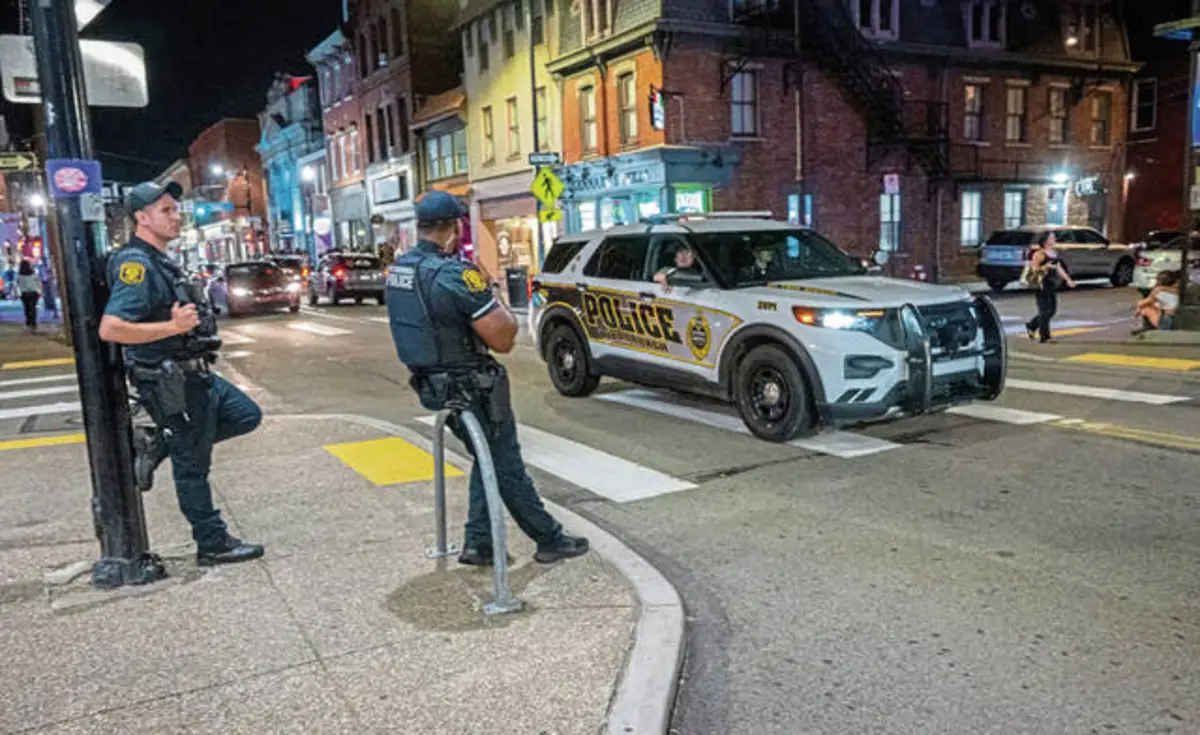
Pittsburgh’s police chief and public safety director declined to be interviewed for this story. And while a spokeswoman said the police bureau has a summer plan to increase staffing in Downtown and South Side, law enforcement officials won’t discuss it.
Top brass “have been working closely with both South Side and Downtown stakeholders to address safety concerns during the summer months,” Cara Cruz, a police spokeswoman, said this week.
She did not elaborate.
Summer in the city
In recent years, crime has heated up during the summer months in Downtown and South Side. Already there are indications that same trend is likely to happen this year.
Reported crime through June 8 jumped nearly 35% in the Central Business District over the same period last year. Aggravated assaults there are nearly double what they were at this time in 2025.
South Side hasn’t fared much better. Aggravated assaults surged 25% year over year. Burglaries rose. So did sex offenses and car thefts.
Longtime South Sider Mark Rauterkus said Pittsburgh simply doesn’t offer enough programming for its young residents.
“When you don’t give kids something to do, to aspire to, to hope for, they’re going to turn to negative behavior,” said Rauterkus, 67, a swimming coach and web manager who’s launched unsuccessful bids for Pittsburgh mayor, city controller and state senator.
Rauterkus is hardly the first person to suggest that keeping teens and young adults busy keeps them out of trouble.
Former Pittsburgh Mayor Ed Gainey linked drops in murder rates during his tenure to expanding hours at city recreational centers. City leaders in March touted programming when they reopened Oliver Bath House.
Mayor Corey O’Connor, Gainey’s successor, says police will respond to summer spikes in crime the same way they always do.
“The trends are that you tend to see spikes in crime in the summer,” O’Connor told TribLive Thursday. “But we’re going to keep patrolling, keep responding to calls and be as proactive as best we can.”
Rauterkus stressed city leaders need to act with more urgency than that.
“That is just a snowflake on the tip of an iceberg of what we need to do,” Rauterkus said. “And it’s clear our political will is not to do this.”
Violent incidents
The attack last month in the Cultural District happened quickly.
A Downtown resident told TribLive he saw a group of teens on Memorial Day weekend trying to steal drinks from a 7-Eleven in the neighborhood. They were stuffing pop into their pockets. He hailed a store clerk.
The next thing he knew, he was chased from the shop and collapsed on Penn Avenue, just outside Heinz Hall. He recalls a torrent of fists and kicks.
“It got very dark,” said the man, 40, who asked to remain anonymous. “But then I started feeling things hitting my head, maybe a dozen times.”
The man, who moved Downtown several years ago, said he looked up before trying to run away: no police officers in sight, no good Samaritans offering help.
On a nearby corner, he said, a pedestrian was checking his cellphone and sipping coffee.
“These guys are punching me all over — and he just went back to his phone,” the man said earlier this month. “But this is a good neighborhood. … I haven’t really felt in danger until these last few weeks.”
The man suffered minor injuries and was not hospitalized. Police have announced no arrests in the attack.
The incident was not isolated.
In March, 40 kids brawled in Market Square. Police responded with pepper spray.
In April, hours before the NFL Draft kicked off, a teen was stabbed repeatedly in front of a Downtown police substation a block off the historic square. Police later charged a 15-year-old girl as an adult with attempted homicide.
In May, a fatal shooting turned Terryll Little, 19, of Duquesne into the neighborhood’s first homicide victim of 2026.
Showing up ‘with love’
Some believe it’s lazy to scapegoat teenagers as the sole driver of city crime.
Von Madden — the founder of intervention group AIM, which stands for “Achieving goals, Inspiring change and Motivating students” — has been interacting with at-risk kids Downtown seven days a week, with few exceptions, since 2022.
“If you just look at the surface, it’s kids having a fight,” Madden said. “But we know the truth. It’s also adults causing a lot of problems down there.”
AIM responds with brief “coaching sessions,” some of which run just 30 seconds, Madden said. Roughly a dozen staffers and volunteers interrupt potential clashes and promote intervention. The group has partnered with the city in the past. Long-term mentorship remains at the core of their mission.
“No matter what a kid does, we show up and we show up with love,” Madden said. “It’s like a MAC machine. If you don’t deposit anything, you can’t take anything out.”
Last weekend, Madden and fellow AIM leader Jason Rivers physically stepped into a scrum of teens about to brawl at a bus stop near Market Square. With no police officers in sight, Rivers moved between two girls in a shouting match, encouraging cooler heads to prevail, then accompanied one girl out of Downtown.
The pair stopped the potential clash without raising their voices.
Navigating juvenile crime
It’s hard to say how much of Downtown crime is caused by juveniles. Pittsburgh police don’t report the age of suspects or victims in their public-facing databases.
But national figures show young people account for an increasingly small part of American crime arrests.
A Council on Criminal Justice report showed juveniles made up 19% of all arrests in the nation in 1980. The number has lingered around 7% since 2018.
Restricting teens in Market Square, especially through a recent temporary chaperone policy, has led to some positive results, one Downtown business owner said.
“So far, so good,” said Sasha Machel, owner of Medi’s on Market, a Market Square eatery. “I think that the chaperone policy has really helped.”
While Machel notes “lunch is my crowd,” she recently expanded service into dinner on Friday and Saturday nights. She did so cautiously, citing the plaza’s sometimes-chaotic activity and a fear potential diners might be made uneasy.
“It’s just the wild, wild west,” Machel told TribLive in early May.
But traffic during Medi’s on Market’s weekend dinners has been steady, she said. There have been few problems.
Issues dealing with juveniles since the pandemic, however, are not isolated to Pittsburgh, she said.
“I think this is a big problem we have to address in this country,” Machel said. “This isn’t just a Pittsburgh problem.”
In cities like Detroit and Washington, D.C., “teen takeovers” — large gatherings of teens and young adults organized via social media — have popped up in business districts, parks and downtowns, The New York Times recently reported.
Police in Chicago have started monitoring social media for what they call “teen trend” announcements, and receive tips from parents, community organizers and school officials when a takeover is posted, the Times reported.
South Side life
Crowds on the South Side are expected to swell with summer. If past patterns hold true, so will crime rates.
Crime last year climbed during the hottest months in South Side Flats, where about 20 bars are clustered around five blocks of East Carson Street. Reported crime in July last year was roughly double what it was in February.
Turmoil in the entertainment district reigned for much of last summer. Crowds became unruly after bars shuttered each night. Around Independence Day, shots were fired and revelers threw fireworks at officers.
Some say the tide is turning in South Side.
Last month, Councilman Bob Charland, whose district includes the neighborhood, suggested establishing an improvement district along East Carson Street to attract investment and reshape the corridor beyond its reputation as a troubled nightlife destination.
Businesses are responding, Charland said. In March 2025, nearly a quarter of the business district’s storefronts were vacant. That rate dipped last month to 16%.
This summer, officials plan to use economic development money from Harrisburg to close parts of East Carson Street, screening for guns and keeping those under age 21 out of South Side bars.
“I hope that we will continue to see a reduction of violence,” state Rep. Jessica Benham, D-Pittsburgh, whose district includes South Side, told TribLive this week. “There is still room for improvement.”