
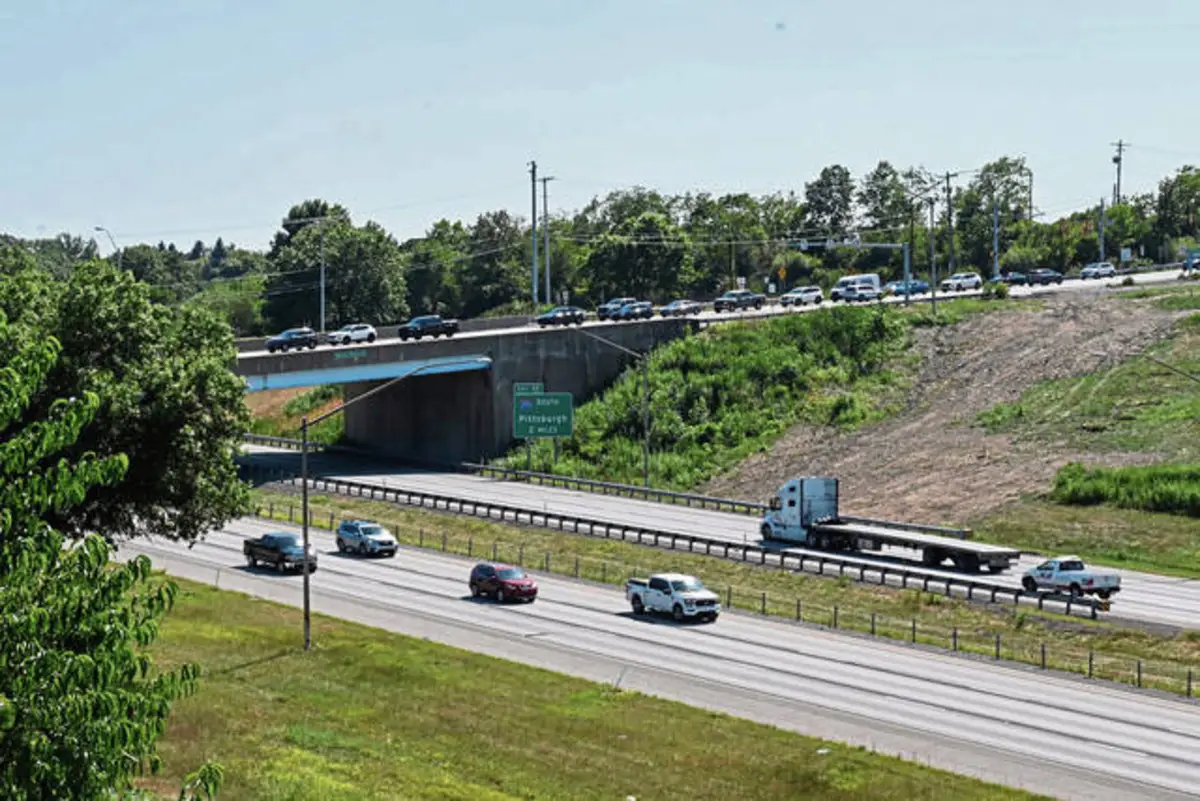
For Franklin Park residents living near the Interstate 79 and Interstate 279 corridors, a highway noise study will have to wait.
This was part of the discussion at a recent Franklin Park regular meeting, where several residents addressed council regarding what they say is noise pollution from the highways.
“Many of us have been struggling with the increase of highway noise that has grown steadily worse over the past seven years. As the development continues in Cranberry, Zelienople and surrounding areas, the traffic volume has risen dramatically and the noise that goes with it,” said Annette Brady, who lives in Hunter’s Point, adding she was speaking for “everyone who lives on I-79 North near the Wexford Exit.”
The noise has affected sleep, stress levels and possibly home values, she said at the May 20 meeting.
Council President Uday Palled also lives near the highways.
“A lot of people have brought this concern,” Palled said. “We hear the noise. We do hear the concerns. We share the concern.”
The borough investigated ways to fund a noise study over the years, including a state grant opportunity in 2023 and 2024 that required a match of approximately 60% to 70% of $1 million, Palled said.
This is cost-prohibitive for the borough, which is limited in surplus funds, according to council.
“We literally have no reserves. We are starting from scratch,” Palled said.
Borough Manager Zachary Filous said it was his understanding that any potential sound barrier or highway noise walls likely would be constructed if the highways were widened to three lanes, which could happen if areas north continue to develop, per his conversations with PennDOT.
At some point, as the communities continue to grow and population shifts north and Route 28 and I-79 merge, three lanes could be a likely scenario, Filous said.
No plans on that have been announced.
Not only is it too expensive for the municipality, but the borough does not have the right of way to conduct any studies, Filous said.
This project was placed on a sort of state wishlist, according to Palled, who explained each congressman has a list of potential projects for a district. In the meantime, borough leaders are working with state Rep. Arvind Venkat, D-McCandless, and state Sen. Devlin Robinson, R-Bridgeville.
Susan Stepchuk is president of the Hunter’s Point homeowners association. She and others in the area started pursuing efforts to address the noise three years ago. But they haven’t been updated on the situation.
“Now, I have a better understanding why nothing happened with that and why I haven’t heard anything in three years,” she said.
“I just appreciate anything you can do. There are a lot of us, not just that neighborhood. We would appreciate any updates that you can give us in the future. It is very important to the health and welfare and property values,” she said.
One resident commented that the borough funded a noise study regarding noise of the former pickleball court at Old Orchard Park along Rochester Road.
The borough was able to do it because that study was “not a budget buster,” costing an estimated $4,000, said Councilman Brian Malkin.
He added he and others on council sympathized with residents on the matter and wished there were more funds to pursue the highway noise study.
While members of local government have addressed the constraints of funding a noise study in public sessions, Malkin acknowledged they could have done a better job on reporting the outcome to residents.
A presentation was held in the fall in Franklin Park, which included discussions of planting trees to mitigate noise levels, Palled said.
For PennDOT to consider a sound barrier along an existing highway, under federal regulations and state guidance, proposed projects must qualify as a Type I project, according to Nicole Haney, a spokesperson for PennDOT, referencing the Pennsylvania Department of Transportation Project Level Highway Traffic Noise Handbook Publication No. 24.
A Type I project is “typically a significant highway project that increases capacity,” she said.
She lists several criteria, including, but not limited to, the construction of a highway on a new location or certain physical alterations of an existing highway, additions of through-traffic lanes, auxiliary lanes or additions and modifications of interchange lanes, and more.
Projects with the potential to alter the acoustical environment are analyzed for noise impacts and abatements are considered, according to a PennDOT informational page “Sound Decisions About Highway Noise Abatement,” which can be found at pa.gov.
For a wall to be reasonable, it must be cost-effective. And maintenance, constructability, drainage and utility impacts, as well as the desires of the affected residents, must be considered. PennDOT only uses noise walls that have been approved through a rigorous product evaluation process to ensure safety, integrity, longevity and preservation of aesthetics, per its website.
Located in that area is the $46.5 million 1-79, Route 910 Wexford Interchange project, located in Franklin Park and Marshall, which includes new construction of a full offset single-point urban interchange at the I-79/Route 910 Wexford Interchange.
The project is anticipated to continue through the 2027 construction season.
Traffic noise
Speed, number of vehicles and type of vehicle all impact noise levels, according to PennDOT’s “Sound Decisions About Highway Noise Abatement” webpage at pa.gov.
• Speed: Traffic at 65 mph sounds twice as loud as traffic at 30 mph.
• Traffic volume: 2,000 vehicles per hour sound twice as loud as 200 vehicles per hour.
• Trucks: One truck at 55 mph sounds as loud as 28 cars at 55 mph.