
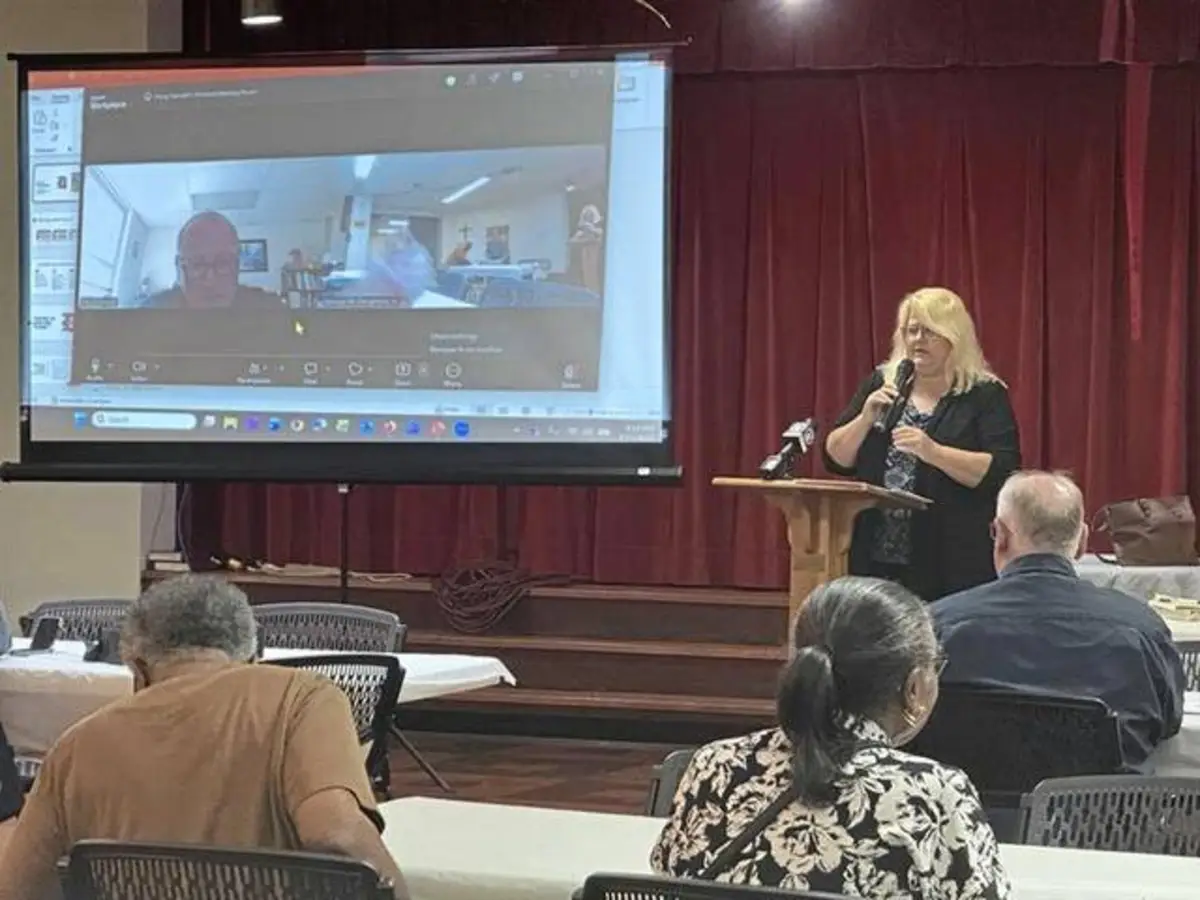
Questions about financial oversight, government accountability and the elimination of Duquesne’s city controller position dominated a public hearing Monday on the city’s proposed home rule charter.
The Duquesne Government Study Commission unveiled the first draft of the charter, which would serve as the city’s governing document and reshape how municipal government operates if approved by voters.
More than a dozen residents gathered at Christ Lutheran Church to hear details of the proposal, which is designed to increase efficiency, streamline government operations and provide greater flexibility for city officials. The charter would eliminate the long-vacant controller position, allow for changes to the city’s tax structure through future council action and establish a governing framework tailored specifically to Duquesne.
“We reviewed current laws of the third-class city and explored potential improvements. That’s when we started to draft the charter that best fits the current and what we feel are our future needs for our city,” said Kirsten Pastrick, chair of the Duquesne Government Study Commission.
Much of the discussion centered on the possibility that the charter would allow the city to increase an earned income tax. Commission members emphasized that the Home Rule Charter would not automatically increase the tax. Instead, it would give City Council the authority to consider and vote on future changes if additional revenue is needed.
Allegheny County Councilman Aaron Adams, D-Duquesne, said that if additional revenue was needed and the earned income tax was not available, officials would likely have to consider raising property taxes or cutting municipal services.
“If I was on the City of Duquesne Council, like I previously was, and this was not voted in and the money would not be coming in, I’d probably be advocating for a property tax increase, or we’d be making significant cuts in the community,” Adams said.
He said those cuts could affect departments such as public works, water, police or fire services.
The proposal comes as Duquesne, located along the Monongahela River just below Kennywood, continues to recover from decades of financial hardship.
The city was designated a financially distressed municipality under Pennsylvania’s Act 47 program from 1991 until 2023. That status that allowed it to collect a higher earned income tax rate while operating under a state-approved recovery plan.
Duquesne City Manager Douglas Sample told TribLive on Friday that the municipality’s current earned income tax rate is 1%, split equally between the city and school district. While under Act 47, the city received 1% and the school district received 0.5%.
Sample said the proposal would not automatically raise taxes but would provide city officials with another revenue option should future financial needs arise.
“It is hard when you come out of Act 47 because you lose that money right away as soon as you’re out,” Pastrick said.
Sample pointed to a recent police contract increase that cost the city about $280,000 annually. He said there is limited room to generate additional revenue through real estate taxes.
“The earned income tax gives you the availability to get more revenue where the real estate is flat,” Sample said, warning that without additional revenue options the city could struggle to maintain services and meet future financial obligations.
Residents also questioned whether the charter would maintain Duquesne’s current governing structure rather than adopt a different model. Pastrick said the commission determined the city’s size and population did not justify major changes.
“We thought that four council members and a mayor was still a good fit for us,” Pastrick said.
Under the proposed charter, the mayor would continue to serve as a voting member of council but would not have veto power. Council members would continue to be elected at large rather than by ward.
The City of Duquesne’s population is estimated at 5,020, according to the U.S. Census Bureau.
During public comment, only one resident spoke.
“I want to thank the committee for all the time they spent doing this, and I am going to vote yes, because I think this will help the city,” said Judy Cvejkus, 68, of Duquesne.
While residents raised several questions throughout the hearing, most focused on how city officials planned to educate voters about the proposal rather than voicing opposition to the charter itself.
During Monday’s meeting, commission members stressed that home rule is not limited to communities facing financial challenges. They said municipalities often adopt home rule to gain greater local control over governance.
Duquesne is one of four cities in Allegheny County, along with Pittsburgh, McKeesport and Clairton. McKeesport and Clairton already operate under home rule charters. Other municipalities that have adopted home rule include Bethel Park, Bradford Woods, Green Tree, McCandless, Monroeville and Mt. Lebanon, Pastrick said.
Duquesne Mayor R. Scott Adams said he reached out to Clairton to hear about their home rule charter. He said the more he heard about the charter, the more he felt it would benefit the city.
“We don’t want to increase our real estate for our older population who are on fixed income, that’s the absolute last thing we want to do. So, what it does is gives us the opportunity to increase revenue by the people who actually are working, so the people that are earning a wage,” he said.
If approved by voters in the Nov. 3 general election, the Home Rule Charter would replace the city’s current governing structure with a framework tailored specifically to Duquesne’s needs.