
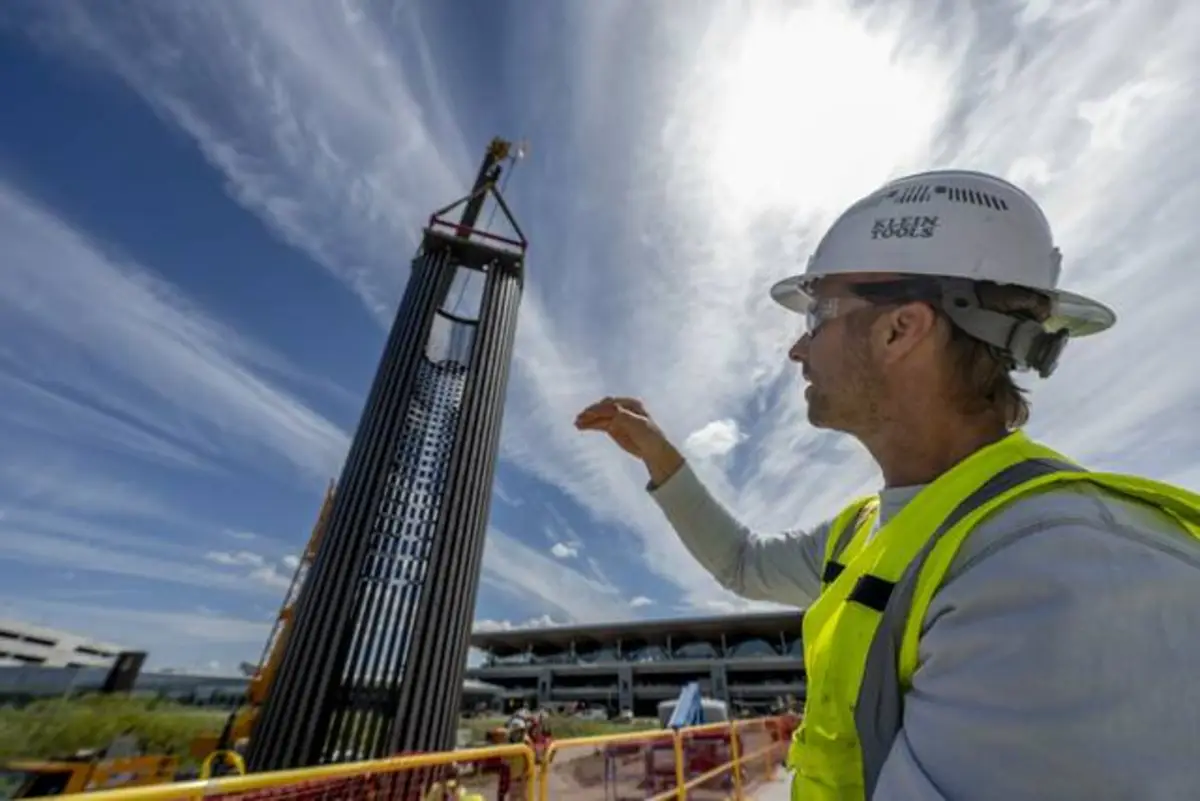
Artist Patrick Marold adjusted his hard hat in Pittsburgh International’s parking lot as he watched his latest creation — one of a trio of massive steel columns in front of the new terminal — rise into the sky.
Marold has plenty of experience designing art for airports. His abstract Pittsburgh piece, “Open Columns,” features columns 40, 30 and 25 feet tall and will soon join similar displays at Denver International, Fort Lauderdale-Hollywood International and Dallas Fort Worth International.
Normally, Marold would have plenty of advice and notes for the workers entrusted with bringing his art to life. Given Pittsburgh’s reputation for construction, though, he was happy to defer to their expertise.
“They know what they’re doing — they build bridges,” he said on Tuesday.
The three sculptures are, fittingly, a monument to Pittsburgh’s grit.
They’re each made of thousands of pounds of Corten steel — also known as weathering steel — a popular construction material in the region for over a century that also supports icons like the U.S. Steel Tower Downtown.
When Corten steel rusts on the outside, it forms a protective layer, Marold said, with the added benefit of making the three columns look older than the terminal complex and “rooted in the landscape.”
The rusting process will only take around a year in Pittsburgh, compared to the five it may have taken in Marold’s home state of Colorado.
“You guys get quite a bit of moisture,” he said.
The inside of each column is made from polished stainless steel to provide a contrasting visual stimulus. If you enter a column’s hollow base and look up, the sky reflects onto the steel, appearing as if it is surrounding you.
Marold, an air travel enthusiast and self-professed “window seat guy,” said he wanted to give passengers that same feeling of wonder with his sculptures that he gets every time his plane takes off.
Of course, the public will first need to realize that the sculptures are meant to be interactive. The cylinders will eventually have paths leading up to them, but Marold still expected children to be the first to discover the hidden reflective feature on the inside – probably while their parents were barking at them to come out, he joked.
But eventually, the columns’ photogenic nature will spread through social media, Marold said.
“The selfies will start happening, and people will be like, ‘Oh, that’s where that one person took that shot,’” he said.
Each of Marold’s airport pieces has some kind of relationship with the sky, but no two are the same shape, nor do they create the same effects.
For example, the Denver sculpture is oriented towards the horizon, while the Dallas sculpture is based on how plane contrails can be manipulated by the wind, Marold said.
Marold began working on Pittsburgh’s “Open Columns” more than six years ago and withstood the terminal’s painstaking construction process. His columns will only take around a week to install, but he had to wait for workers to finish the terminal’s so-called “Green Spine” of vegetation and pour concrete bases for them.
“Open Columns” completes Pittsburgh International’s extensive collection of art for the new terminal, contributed by 15 artists mostly from Western Pennsylvania.
Keny Marshall, Pittsburgh International’s arts and culture manager, said “Open Columns” was a prime example of the terminal’s “NaTeCo” design philosophy, emphasizing nature, technology and community.
“Patrick bringing in both the history of the region with the Corten steel and then bringing in this new technology with the mirrored stainless inside — that allows people to be in this reflective space, but also enjoy the environment of Western Pennsylvania,” he said.
Marold thought it was appropriate that his columns were so close to his good friend Adam Kuby’s “Cross Currents,” a series of concrete engravings adorning the terminal garage and the first piece to be installed over a year ago.
Patience is a core tenet of creating public art, Marold said.
“These projects are so complex that there are huge lag times that we can’t do anything about,” he said.
“It’s just the way it all comes together.”