
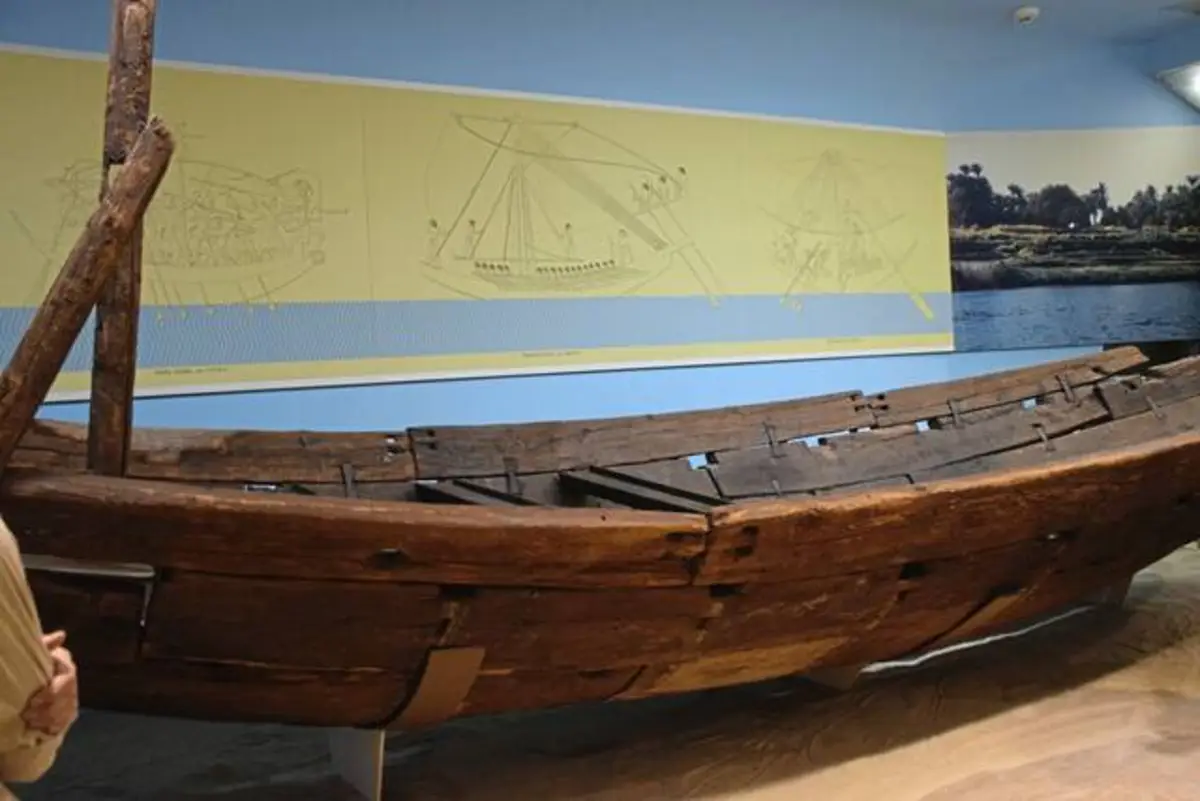
As the Carnegie Museum of Natural History’s “Polar World” exhibit melts away after 40 years on view, a 4,000-year-old boat that once carried royalty from one of the world’s most influential ancient civilizations on their final voyages will cruise in on a river of change.
On May 1, 2027, the Oakland museum will open its first new long-term exhibit in 20 years, “Egypt on the Nile,” to be housed in more than 6,600 square feet of third-floor space once home to “Polar World.”
The interactive exhibit will draw on 400 artifacts, tools and hand-crafted belongings to illustrate the interwoven connections between the natural world of the Nile River-based civilization and its pioneering culture.
The items — dating back as far as the end of the Paleolithic period (10,000 years ago) and as recent as the Byzantine Period ending 700 C.E. — were acquired by the museum from its founding in 1896 through the early 20th century. The largest portion arrived at the museum through the Egypt Exploration Society.
“The significance of the river to life in the Nile Valley is a message that connects deeply to Pittsburgh, a city proudly defined by its three local rivers,” said Lisa Haney, curator of “Egypt on the Nile.” “It’s our hope that, by approaching ancient Egypt from new perspectives, the exhibition will provide visitors with a richer understanding of the past and an appreciation for the eternal connection between nature and culture.”
The exhibit features three themes: settlement of the Nile River Valley, life and nature, and the Hereafter. In addition, the exhibit will also feature an immersive and full-scale recreation of a portion of the tomb of an ancient Egyptian scribe and field overseer named Menna, complete with hand-activated stories within its wall images. There will also be a section on the development and use of the world’s first manmade pigment, Egyptian blue.
Flora and fauna paleontology, as well as other hands-on activities and immersive media experiences, will be incorporated into the exhibit.
“I think it just offers a kind of different perspective to make connections, think about people from different perspectives and also to showcase a lot of the innovations that occurred in ancient Egypt,” said Haney. “You probably don’t think about making pottery as something that’s invented, but these are some of the first groups of people that are firing pottery. These are people that are inventing their own way of communicating and writing for the very first time that anyone is ever doing that, who are inventing so many different technologies and techniques that we still use today.”
One of the exhibit’s centerpiece artifacts is a 4,000-year-old boat, believed to have belonged to 12th Dynasty pharaoh Senwosret III (who reigned from 1878-1839 B.C.E.) was excavated in the 1890s from one of his two funerary complexes by French archaeologist Jacques de Morgan.
It is believed to have carried “a number of queens and royal princesses” as part of their funerary proceedings, according to Haney, who said it is one of only four of its kind in the world.
It will appear as part of the exhibition’s “Nature and Life” section.
Then there’s the “Hereafter” section.
“As visitors journey through this area of the exhibition, we hope that they will come to understand that the Hereafter was considered a reflection of life on earth,” said Haney. “That they will appreciate the significance of the landscape of Egypt itself and beliefs around the Hereafter, that they will reflect on objects that represent the lives of once-living people, and that they will be able to see and smell the scents of the mummification process and examine connections between ancient practices and beliefs and modern ones.”
Though it has been in the museum’s care for 122 years, upon the new exhibit’s opening, the boat will be viewable from all angles for the first time since the 1950s.
“One side focuses on river life. It looks at the boat’s construction and examines the significance of the river itself in daily life from farming to fishing to trade to the cyclical nature and fluctuations in the seasonality of the river,” said Haney. “The other side focuses on how the boat was used, why it was found where it was and its excavation.
“We’ll also trace the boat’s journey all the way to Pittsburgh, where we’ve been doing a lot of cutting-edge science to further explore the boat and learn as much about it as we possibly can.”
Just a month ago, the boat was used in a dendrochronology study that examined tree rings in the wood it is crafted from to study climate history.
“We recently had all the planks scanned as well for some scholars that we’re working with who study boat construction in ancient Egypt,” added Haney. “And so its journey will be actively continuing even after it’s installed in the exhibition.”
But perhaps more so than research, its purpose will be one of inspiration.
“There’s only a very small number of life-size watercraft, or really any other things of this magnitude, anywhere in the world that are on view,” said Haney. “So it’s really special to be in the presence of something that’s both that large, because it just sort of draws you in, but also, that’s a very direct connection for anyone who’s been out on a boat.”
It’s all part of the museum’s mission.
“I hope that people understand that we learned new things about Egypt in the last 20 years,” said Sarah Crawford, senior director of museum experience. “Which hopefully should signal to young or older people who could be that next generation that studies ancient Egypt and learns more and then comes back and updates the next iteration of this exhibit, that there’s a reason to stay engaged.”
According to Crawford, the exhibit was first conceptualized back in 2015 and has since received several grants from the National Endowment for the Humanities. The goal with long-term exhibits, she said, is to have them on display for 20 years.