
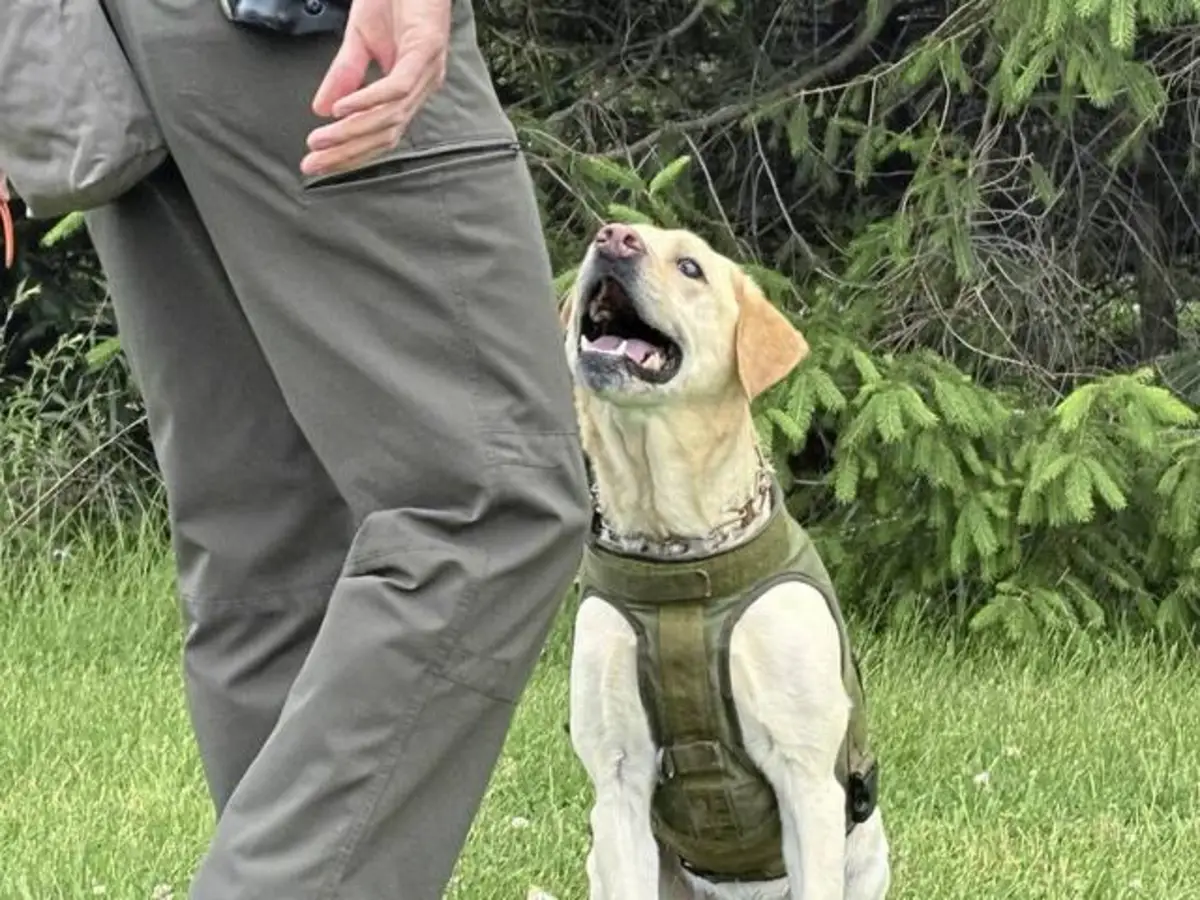
To the untrained eye, it probably looked like Ayla the yellow Labrador retriever was simply excited and running around in a field behind the Pennsylvania Game Commission’s offices in Fairfield.
But both Ayla and her handler, Shawn Barron, have hundreds of hours of training under their collar and belt, respectively. Ayla’s seemingly frantic back-and-forth motion is her way of narrowing down the scent cone she is picking up with her nose, slowly homing in on what Barron has asked her to find: a small spent shell casing placed randomly in the grass.
It could take a game warden hours of searching before noticing the small glint of sunlight off the casing, which is otherwise nearly invisible. But 6-year-old Ayla takes barely a minute to find it, signaling by lying down on the ground with the shell casing situated almost precisely between her paws.
Barron and Ayla will return to the offices next month as part of the commission’s annual Junior Game Warden camps for children ages 12 to 15. The camps take place across the state and offer a full day of learning about what Pennsylvania’s game wardens do, how they investigate crimes and how they protect the region’s wildlife.
“We start the camp day off with a little bit of physical fitness, although we don’t put them through the full hour that we do in training,” said Lt. Andy Harvey, a state game warden and the commission’s information and education supervisor. “Then we split them into four groups and everyone does two stations in the morning and two in the afternoon.”
The stations touch on all aspects of a game warden’s job, from a forensics station where campers will search for clues in a deer poaching case to a tracking station where they will learn how to look for recent signs of both human and animal movement.
“A lot of people think we only do wildlife tracking, but we train in the same aspects of law enforcement as your typical police officer,” Harvey said. “It’s actually a lot of human tracking. We have a specific unit, our tracking team, that gets called for a variety of things, whether it’s searching for a missing person, searching for a criminal that’s fled — all wardens are trained on tracking to some extent, but the tracking team does specialized training.”
Campers will use the commission’s sand pit to study footprints and determine things like direction of travel or if a person was walking or running.
A third station will touch on outdoor survival tips such as recognizing edible — and more importantly, poisonous — plants and making a fire without a lighter.
“We usually have a neat race where we give each group a piece of twine, and they have to start a fire to see who can burn the twine first,” Harvey said.
The final station touches on wildlife capture. Campers are shown how nonviolent trapping methods such as tranquilizing and turkey nets are used, and they can practice shooting the dart guns wardens use to tranquilize animals.
After Barron does his demonstration with Ayla, it’s time for the part Harvey said is usually the campers’ favorite. Wardens bring out a bear they have trapped to study, tranquilize it and bring it out of the trap so campers can observe the various data wardens collect.
“And they usually can take a photo next to the bear, which not many people get a chance to do,” Harvey said.
The Southwest Regional Office will host its Junior Warden Camp from 8 a.m. to 3 p.m. July 23 at the office, 4820 Route 711, Fairfield. The only other camp taking place on the western side of the state is June 27 from 8 a.m. to 4 p.m. at the Butler City Hunting & Fishing Club on Grant Avenue in East Butler.
Registration can be completed online. Each camp is limited to 40 participants.
For more information, or to register, visit pa.gov/agencies/pgc and enter “Junior Warden Camp” in the search box.