
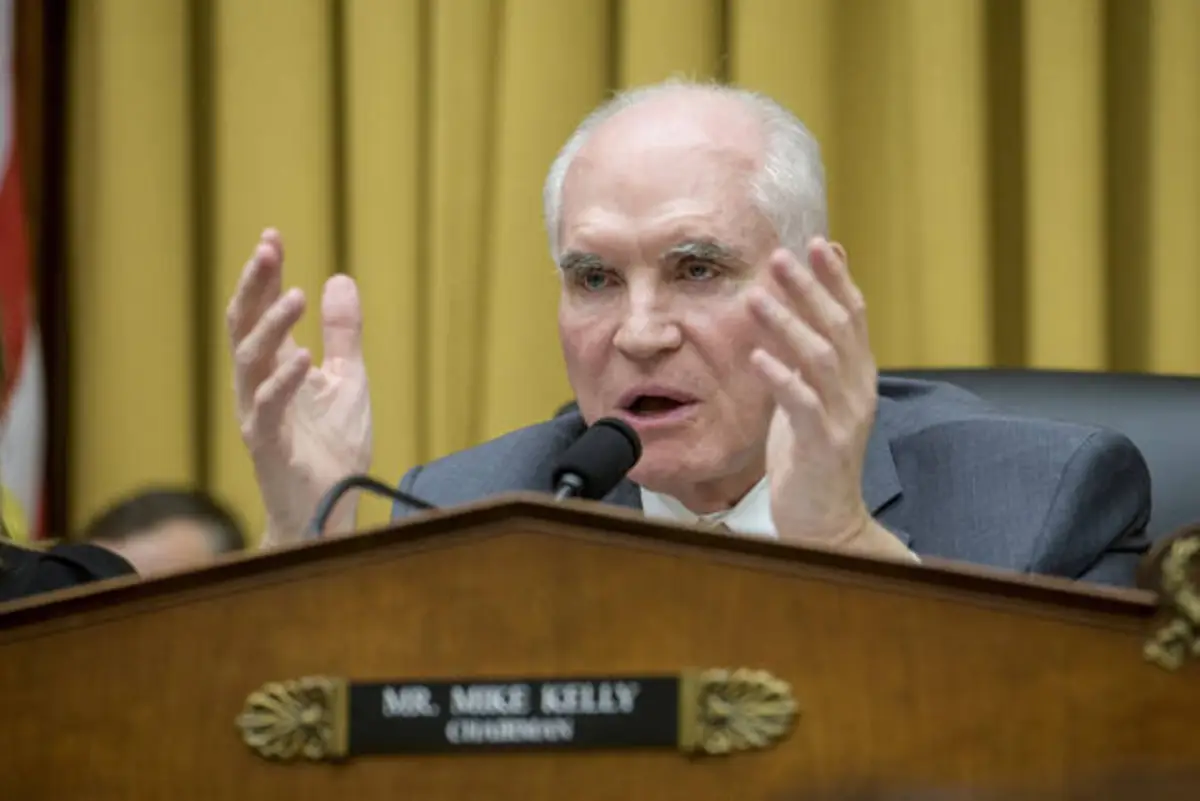
As a member of the powerful House Ways and Means Committee, U.S. Rep. Mike Kelly could soon find himself on the front lines of grappling with a projected shortfall facing the nation’s Social Security retirement program.
Ways and Means, the chief tax-writing committee in the U.S. House, has jurisdiction over the Social Security program. Kelly, an eight-term Republican from Butler, is one of the committee’s 27 members.
Social Security trustees announced last week that if no changes are made to the program, its retirement trust fund could run out of money by 2032 — resulting in a 22% reduction in payments for those receiving retirement benefits. The trust fund has been used to cover the shortfall between the cost of payments and program revenues, which come mostly from payroll taxes.
“For us to do nothing would be the greatest sin of all,” Kelly said in an interview with TribLive.
What to do is less clear.
“It’s going to be a difficult problem to fix. This isn’t just a math problem. It’s also a political problem because the fix is not going to be pleasant,” Kelly said.
A survey released last year by the National Academy of Social Insurance, AARP, the National Institute for Social Security and the U.S. Chamber of Commerce showed that Americans broadly support raising revenues for Social Security, not reducing benefits.
The groups said 55% of respondents were in favor of making changes to ensure benefits are not reduced, even if it meant raising taxes on all or some Americans, while another 30% said benefits should be increased even if lawmakers raised taxes on all or some Americans.
Among potential changes, 68% of respondents said they were in favor of eliminating the payroll tax cap (currently, workers are not taxed on earnings above $184,500); 57% were in favor of gradually increasing the payroll tax for workers and employers; and 52% were in favor of rerouting other government funding to continue paying full retirement benefits. Another 23% favored rerouting other government funding as long as it was repaid in the future.
A minority of respondents favored steps like raising the retirement age (37%), changing how cost-of-living adjustment increases are calculated to slow the growth of payments (38%) and reducing benefits for people with significant income outside of Social Security (41%).
“We can do a number of different things. It’s all going to come down to deductions and what we’re able to draw down,” Kelly said, referring to potential changes to the payroll tax and the cap on those taxes.
“My worry,” he said of potential tax increases, “is that the net of people’s pay has really been stretched and inflation has made it even more difficult. I don’t think there’s anything we don’t tax people on now.”
U.S. Rep. Chris Deluzio, D-Fox Chapel, said allowing the retirement trust fund to become insolvent would be “a choice — one I disagree with.”
“Right now, billionaires like Elon Musk pay the same amount into Social Security as someone who makes $185,000. Let’s fix this Social Security tax cap and bring fiscal stability to Social Security,” Deluzio said in a statement. “The ultra-rich already pay lower taxes on their investment gains than people who earn a paycheck — they should be paying their share of taxes into Social Security.”
U.S. Reps. Guy Reschenthaler, R-Peters, and Summer Lee, D-Swissvale, did not respond to a request for comment.
While it won’t address Social Security’s potential shortfall, Kelly advised people to take a close look at their financial situation.
“Look at where you are (financially) and where you will need to be. Are you still going to need the big house that you had when the kids were living with you? Do you need two cars or can you get by with one? I’m not trying to be Debbie Downer here, but the best thing that can happen to anybody is to realize early on what’s coming and be prepared,” Kelly said.
He said those with questions should reach out to a financial adviser or groups like AARP that offer Social Security-related resources.
Brad Colvin, a Pittsburgh-based financial adviser with Baird, acknowledged there are a “ton of worries” about Social Security, but he believes Congress will address the projected shortfall.
It would be political suicide not to, he said.
“I think there are a lot of very minor levers that can be pulled to address this,” Colvin said.
Still, Colvin said: “You need to work with a financial professional and take inventory of your assets. You should include Social Security in that formula. The bigger risk is to not include it. If you exclude it entirely, your magic number to retire might be at 68 instead of 62.”
R. Brian Werner, managing member and chief financial officer for Winthrop Partners in Pittsburgh, said there hasn’t been much of a response to the latest projections on the retirement trust fund’s potential insolvency.
“Despite all the headlines about the Social Security trust fund, we’re not hearing widespread fear or panic from our clients. I see most retirees still expecting Congress to address the issue in some form before any significant benefit reductions occur,” Werner said in an email.
A CivicScience survey embedded in a TribLive story about the issue showed 37% of respondents were not at all confident that Social Security would provide full benefits in the future, while another 26% were not very confident. About 15% said they were very confident that full benefits would be provided in the future, 18% were somewhat confident and 4% were unsure. Nearly 900 people participated in the survey.
“What we are seeing, however, is that concerns about Social Security’s long-term finances are influencing some retirement decisions,” Werner said. “Some people choose to claim benefits earlier than our analysis would suggest because their mindset is, ‘I paid into it, and I’d rather take it while it’s there.’ Many retirees are also more comfortable receiving a Social Security check than drawing from their investment portfolio, even when delaying benefits may make more financial sense.”
In a perfect world, Werner said, “Social Security should be one component of a broader retirement income strategy, not the sole pillar supporting retirement.”
For many people, that’s not the case.
Nearly three-quarters of seniors rely on Social Security for more than half of their income, while 39% depend on it for all of their incomes, according to a survey by the Alexandria, Va.-based Senior Citizens League.