
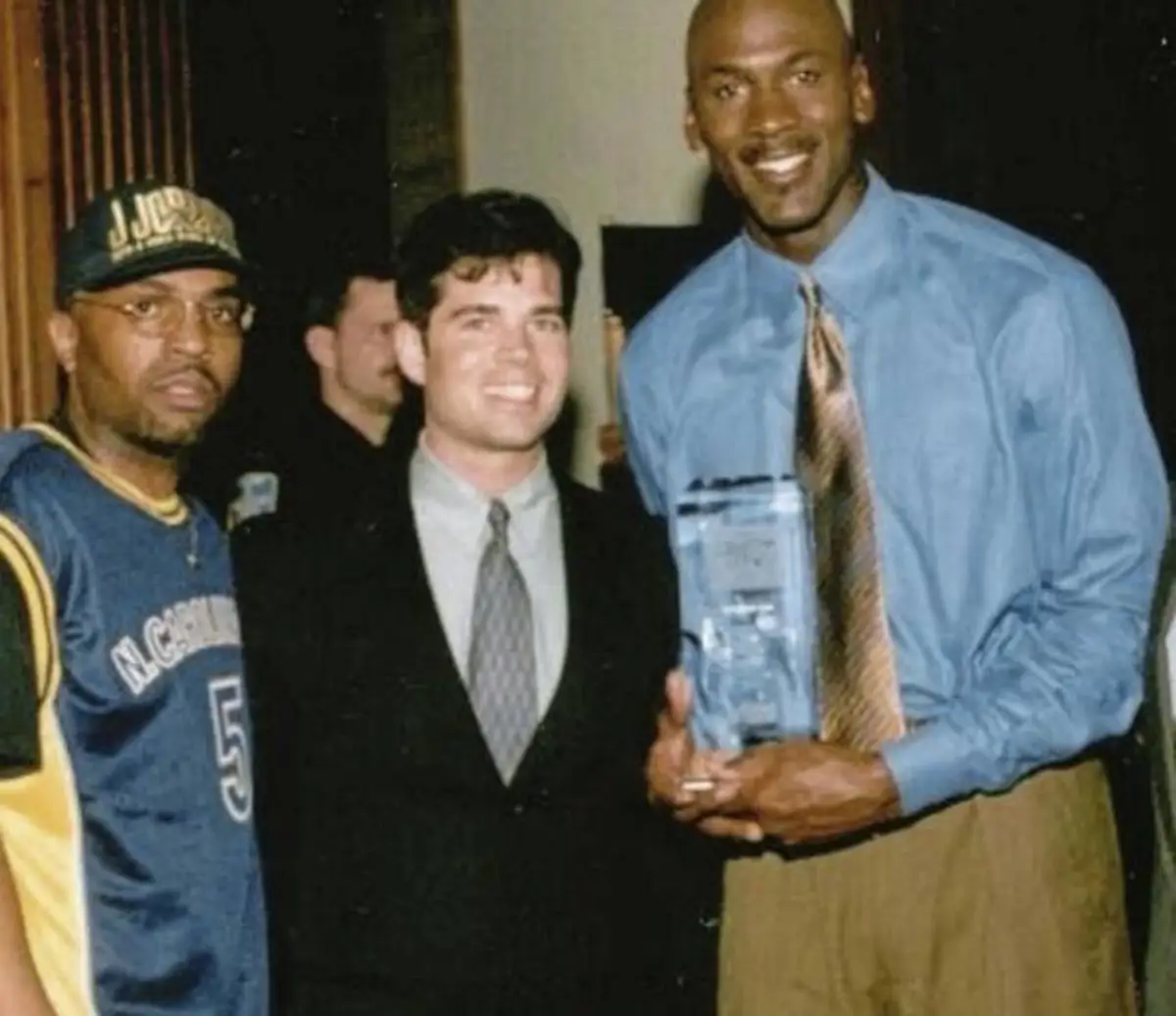
Erin Patton worked for Nike when he authored a business plan for one of the most influential names in sports marketing history: the Jordan Brand.
At 28, he stood on a stage in New York City with Michael Jordan, Ahmad Rashad and shoe designer Tinker Hatfield for the brand’s unveiling in 1997.
“It was surreal,” he said. “It was the closest thing I had ever felt to playing a pivotal role on a championship team.”
Patton also disrupted conventional thinking inside Nike. As a marketing director, he proposed introducing Jordan products at neighborhood barbershops in Los Angeles, recognizing them as comfortable hubs to spread culture and trends.
“That radical idea got us on the front page of The Wall Street Journal,” Patton recalled. “MJ agreed with me. He recognized me as a consumer. He understood why it was relevant.”
He’d eventually leave a successful marketing career behind and attend seminary to become a pastoral counselor, but we’ll come back to that.
I knew Patton as a kid from Homewood at Peabody High School, when he sat next to me in Russian class in the mid-1980s. I never knew how he arrived there through the help of a single parent advocating for him. I certainly didn’t know where he was headed.
The story about how he got to Peabody is fascinating on its own.
Patton’s mother had concerns about his safety and behavior attending Westinghouse High, which stood about a block from his house. She learned that Peabody offered courses in Russian language, while Westinghouse didn’t. A transfer to Peabody was orchestrated.
“That one decision by my mother to challenge the status quo and say, ‘You know what, I don’t want my son going to Westinghouse,’ changed everything,” he said. “I wasn’t looking for trouble, but my mom didn’t want me to find it.”
I still remember his Russian name in class — we all had them — “Victor.” He also started working on the school newspaper and became its editor.
A couple years later, he was off to Northwestern University on a scholarship to its prestigious Medill School of Journalism. He played basketball for a year and became team manager for Northwestern’s football team.
He interned as a reporter at The Pittsburgh Press and The Virginian-Pilot in Norfolk.
Then he took a marketing class at Northwestern, and everything shifted. An interest in public relations, marketing and brand-building took over. He joined Edelman, a public relations and marketing firm in Chicago, before a disappointing job interview put him at a crossroads. After failing to land a communications job at Kellogg’s in Battle Creek, Mich., he found himself wondering what came next.
“No more than two weeks later, I got a call from a headhunter about Nike.”
Of course, he jumped at the chance.
Just do it
For the sports-obsessed kid from Pittsburgh, walking into Nike headquarters in Beaverton, Ore., felt like nirvana. World-class athletes such as Reggie Miller, Vlade Divac and Carl Lewis were regular sights.
Patton joined the company in 1995 as a public relations manager, overseeing publicity for basketball and NFL products.
His job was to generate publicity for new Nike shoes. The company was drawn to him because he blended his passion for hip-hop culture with consumer marketing.
He recognized that many customers weren’t only buying Jordans to play basketball. The shoes conveyed an identity.
“People bought Jordans to go to the movies and go to Monroeville Mall,” he said with a nod to Greater Pittsburgh.
Patton was on hand in Chicago when Jordan filmed one of his famous commercials. The commercial featured Jordan soaring through the air in Air Jordan XI sneakers, slamming a dunk on a 100-foot hoop and then hanging from the rim. Looking nervously toward the ground before glancing at the camera, Jordan seemed to wonder: How was he going to get down?
He developed a rapport with Jordan, visiting his house, checking out his Ferrari and discussing marketing strategies. He earned the title of global director for the Jordan brand.
During another commercial shoot with Jordan and Stevie Wonder, the singer asked Patton to call his mother. Stevie Wonder then got on the phone with her.
“He told her what a great mother she is and what a fabulous job she did,” Patton recalled. “I felt such a sense of accomplishment.”
How did the city of Pittsburgh not know about Patton’s accomplishments?
“I’m not one to toot my own horn,” he told me.
He was at the apex of a marketing career, rubbing elbows with the crème de la crème of athletes. Still, something was missing.
Patton grew up poor with a single mom. He and his two brothers would take the bus to neighborhoods like Squirrel Hill to shovel snow in the winter for money.
He knew what it meant to struggle. And something always nagged him about the high price of Jordan sneakers. Kids were literally killing other kids over a pair of Jordans.
“I was on ‘Nightline,’ on the hot seat trying to explain it,” he said. “I was trying to rationalize it.”
A calling
He would leave Nike and start his own agency, The Mastermind Group.
Soon he was working with clothing chain Steve & Barry’s to create the affordable Starbury sneaker line with former NBA player Stephon Marbury. The project carried special meaning. Having spent years promoting $150 sneakers, Patton never forgot family members back home who asked why shoes couldn’t be made more affordable.
Starbury shoes cost $15.
He cried with Marbury when the shoes were released, thinking back to his humble childhood.
Another change was coming.
Following professional success, personal struggles and a difficult divorce, Patton, a father of three, found himself searching for purpose beyond business. He was walking past a seminary in Dallas, where he lived at the time.
“The Lord said, ‘Stop,’ ” Patton said.
He would later enroll in seminary, pursuing a master of divinity degree from Fuller Theological Seminary’s School of Mission and Theology in Pasadena, Calif. He earned degrees in counseling and ministry.
For years, he focused on building brands and grassroots marketing campaigns. But he said he eventually felt called to a different purpose.
“When I left my marketing career, I realize now it was part of the plan,” he said. “And God had a bigger one and a better one for me. I honestly felt like I had achieved the pinnacle of success in that area. I didn’t want to merely replicate, or duplicate, I wanted to innovate.”
That calling led him toward counseling and trauma recovery.
He founded New Birth Institute, a mobile therapeutic unit that brings counseling, ministry and support services into communities, schools and neighborhoods where people might otherwise struggle to access care.
His path was shaped, in part, by his own experiences. He described growing up amid family dysfunction, including alcoholism on his father’s side of the family and what he called a spirit of rejection on his mother’s side.
“I came from a traumatized environment,” he said. “I came from generational trauma.”
Those experiences helped guide his journey. Drawn to both teaching and counseling, he ultimately chose a path as a pastoral counselor, combining ministry with trauma care.
“Now, when I go to sleep and I wake up, I am my brother’s keeper,” he said.
Based in the Washington, D.C., area, Patton frequently visits Pittsburgh to counsel people.
Now he hopes to help others heal from the kinds of struggles he knows firsthand.
“I love where I’m from,” he said. “We learned how to do more with less. If I don’t outsmart you, I’ll outwork you.”
He also credits mentors along the way, including a church volunteer named Dan Meyers, who regularly drove children from Homewood to Bible study and basketball games. Years later, Meyers drove Patton to Northwestern and walked him across campus.
“Dan knew if he could get this young Black kid out of Homewood and into the top journalism school in the country, he could make it,” Patton said. “Success and failure are both premeditated. They begin with belief, faith and a clear vision of what you want to achieve.”
That lesson remains central to Patton’s message today.