
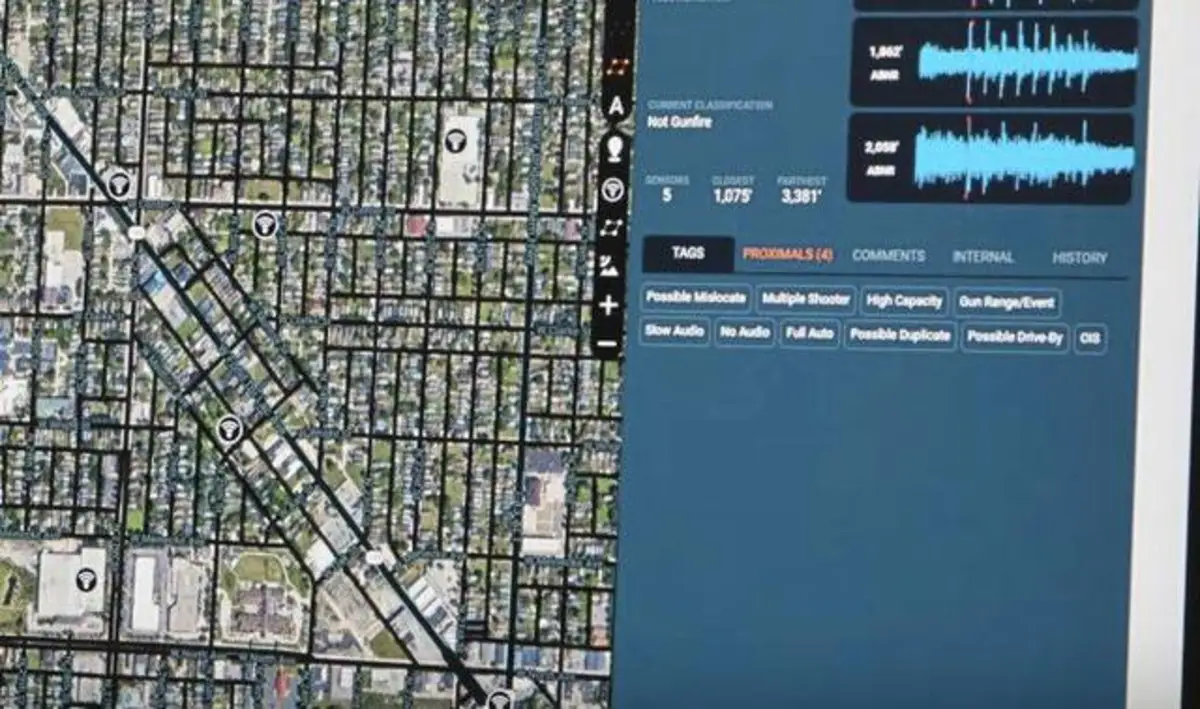
The Pennsylvania Supreme Court’s recent ruling in Commonwealth v. Foster affirmed last month gunshot detection technology (GDT), in this case a ShotSpotter alert, combined with other articulable factors, can constitute reasonable suspicion consistent with the Fourth Amendment.
Subsequent reporting on this decision omitted important context and key findings on ShotSpotter’s efficacy. Understanding those studies in full is essential to giving readers an accurate picture of the technology.
Consider the Kansas City research critics cite. Some voices are choosing to run with the narrative ShotSpotter alerts had “little impact on evidence collection in Kansas City.” But that same research found ShotSpotter detected gunfire a median of 93 seconds before the first 911 call, pinpointed incidents far more precisely than a caller describing an address and got officers to those scenes faster, where they spent more time gathering evidence. These are real operational benefits for law enforcement and the community that are missed by many anti-GDT advocates.
Critics also frequently cite a study from the Journal of Urban Health, but it carries a limitation worth understanding. The study analyzed data from 68 metropolitan counties and found “ShotSpotter technology has no significant impact on firearm-related homicides or arrest outcomes.” Yet it measured firearm outcomes across entire metropolitan counties, even though ShotSpotter is deployed in small target areas — often just a few square miles — within those counties. Kansas City’s coverage area, for example, spans roughly 3½ square miles, representing less than 1% of Jackson County, Mo.’s roughly 616-square-mile footprint. A countywide measure cannot isolate what the technology does inside the neighborhoods where it actually operates, which is precisely the question that matters.
In addition, ShotSpotter’s ability to detect gunfire incidents also has come into question: “SoundThinking boasts that ShotSpotter is 97% accurate at detecting gunfire. But information — or any third-party evaluation of those claims — is hard to find.” Well, an independent audit by Edgeworth Economics confirmed a 97% aggregate accuracy rate with a false positive rate of just 0.36%. A study in the Journal of Trauma and Acute Care Surgery found ShotSpotter shortened police response and prehospital time for gunshot victims. And a 2025 study in Crime Science found that, “overall, the evidence indicates that GDT broadens police awareness of gun violence, modestly enhances firearm interdiction, and accelerates gun recovery in otherwise under-reported cases, offering practical benefits at the patrol level … .”
We have never made the claim GDT can unilaterally solve the multivariate factors of gun violence. What the technology does, and does well, is alert police and first responders to the more than 80% of criminal gunfire that never gets called into 911. With this awareness, first responders can get to the scene quickly, facilitate evidence recovery and render aid if needed to any victims. Another important benefit: It builds trust with the communities most directly impacted by gun violence, which overwhelmingly support the technology.
An August 2025 City of Pittsburgh (Department of Public Safety) review found “ShotSpotter significantly increases the PBP’s (Pittsburgh’s Police Bureau) capacity for responding to gun-related incidents when compared to standard 911 calls. On average, both the report-to-dispatch and report-to-en route times were approximately 63% faster with ShotSpotter.”
No single technology can solve gun violence, but that does not mean we have to work toward a safer community with two hands tied behind our backs. ShotSpotter empowers first responders, and together, we work toward the overall goal of safer communities in Pittsburgh and beyond.
Ralph Clark is president and CEO of SoundThinking.