
Murrysville prides itself on its natural beauty. The town is full of wooded areas with streams carrying stormwater down to Turtle Creek.
Many of those waterways, however, carry the region’s mining history in their currents. Parts of Turtle Creek occasionally have a cloudy sheen or appear an unnaturally bright blue, the product of aluminum dissolved in the water. An abandoned mine in the Lyons Run Watershed dumps dirty orange water with iron and sulfur dissolved in it. In both cases, those stretches of waterway are largely devoid of typical aquatic life.
Groups and individuals in the municipality, however, are actively addressing the water quality and conducting research into the bacteria that is able to survive in an environment where most animals cannot.
At the Murrysville Area Watershed Association, program manager Melissa Church and others are seeing the rewards of a passive remediation system installed in early 2025 at the source of acid-mine pollution along Lyons Run. Mine water passes through a series of ponds lined with limestone, which helps precipitate metals such as aluminum and iron, cleaning the water before returning it to the stream.
“We do monthly monitoring and quarterly analysis of the whole system,” Church said. “We’re collecting water coming out of the mines in three places. The raw mine water is coming in with a pH level of 2.4 in one spot and at 2.67 in the two others. That’s very acidic.”
Once the water passes through the treatment ponds, it exits the system with a pH of 6.8, just shy of a neutral rating of 7.
“That’s really what we want to see,” Church said. “We’re also doing some overall flow monitoring, so we can determine how much water, total, is moving through the system. That will allow us to calculate what percentage of metals are being removed, and how many pounds, on a daily basis.”
Now that the passive pond system is installed, the association is “regreening” the area, planting native tree species to fill in the areas that were cleared for the system’s construction. It is also looking ahead to the next project, working with the DEP to seek funding for an active treatment plant, which would use lime slurry to remove sulfur and aluminum runoff from mine water, which would then be pumped into a public pond where game fish are raised and stocked.
The watershed association has secured an easement from Export officials to use a portion of property off Borland Farm Road and is preparing a request-for-proposals to solicit potential designs for the project, expected to cost between $5 million and $10 million.
“We’re taking a phased approach,” Church said. “Right now we’re using the grant we received for the development and design. We have an idea of what the construction cost will be, and we’re working on a long-term funding plan. But our focus is doing grant-funded research on the watershed and really find out what type of plant we’ll need and what its functions will need to be.”
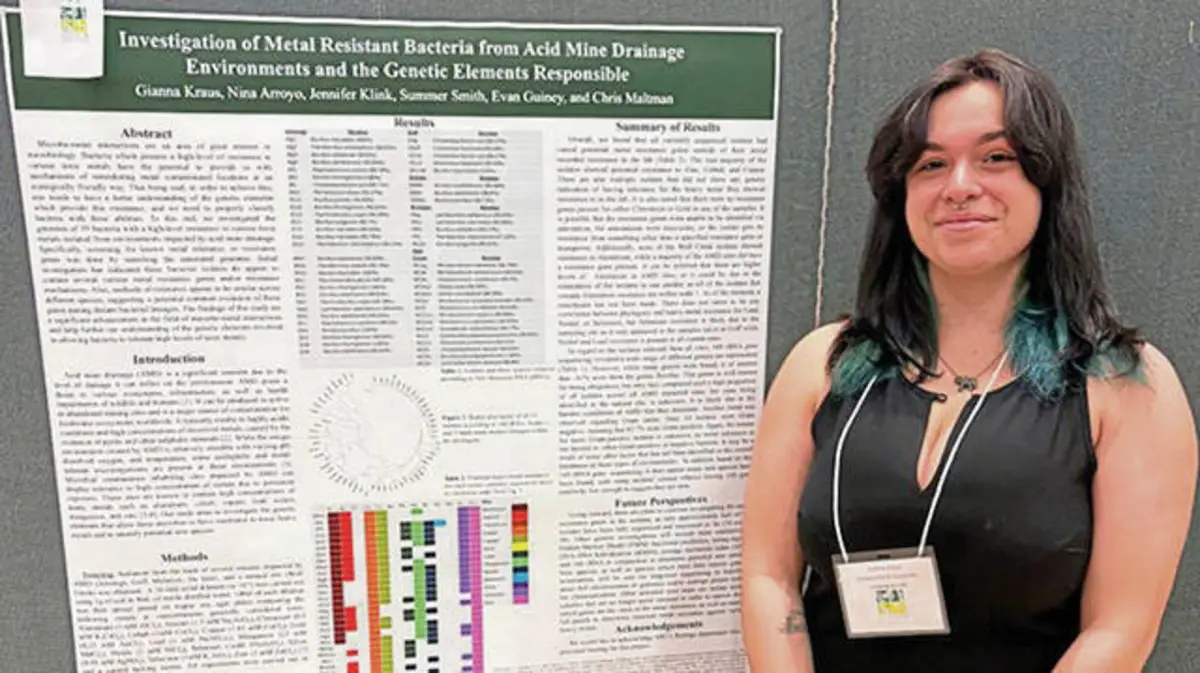
Murrysville native Gianna Kraus, 20, knows plenty about acid-mine water research: She’s working with the microbiology department at Slippery Rock University, where she is a senior, to study the bacteria present in acid-mine drainage.
“The microbiology department wanted someone working on genetics to join their research, doing genetic analysis on bacteria isolates,” Kraus said.
Kraus compared the bacteria present in soil at acid-mine drainage sites to bacteria found in clean soil and discovered it has a significantly higher-than-normal resistance to metal.
“There’s a standard amount of metal that bacteria are able to tolerate,” Kraus said. “They placed bacteria on plates with a high concentration of these toxic metals, and they were still able to grow.”
Kraus and other researchers want to know how and why.
“There are some bacteria that can help break down these heavy metals, and it kind of stabilizes the surrounding soil so that eventually plants can grow in it,” she said. “Some of these microscopic bacteria actually create little pockets in their cells that are just pure heavy metals.”
With her interest in genetics, Kraus said she would like to continue growing the bacterial isolates to discover mutations that don’t exhibit this newfound heavy-metal resistance.
“I want to break down their genomes and do a study between the mutants and the regular isolates, and determine which genes are having an impact on heavy-metal resistance,” she said.
Church said she’s not sure what Kraus’ research might mean for the work the watershed is doing, but the notion of a bacteria that can feed off the heavy metals in acid-mine drainage sounded like good news to her.
“There’s also a lot of talk about what can be done with the metal that’s precipitated out of the water,” she said. “In some cases, people have sold the iron as pigment dye powder. There’s been some talk about possibly harvesting rare-earth elements from mine drainage as well, but the economy-of-scale for it is not really there right now. Our No. 1 goal is removing as much bad stuff as possible and improving the health of the watershed, and we’re seeing that through our testing.”
For more on the association’s work, see TheMAWA.org.