
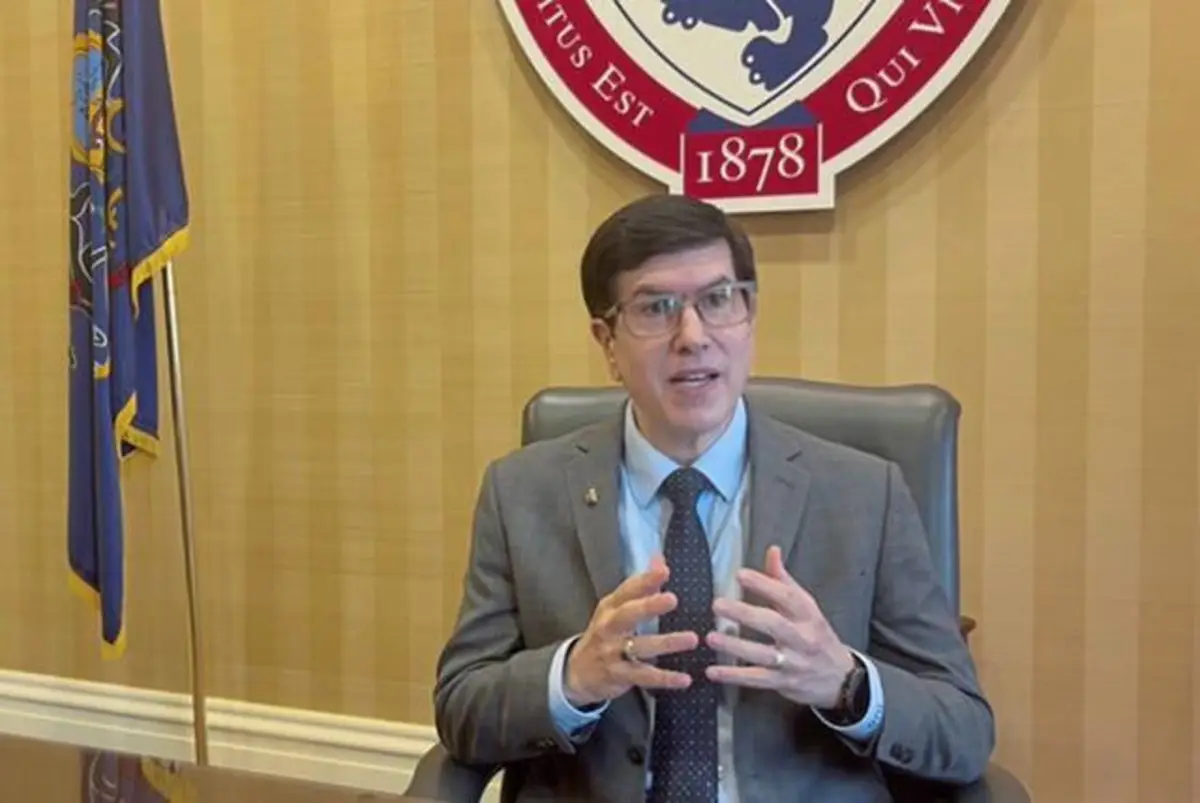
Incoming Duquesne University President David Dausey says the higher education sector is experiencing an “identity crisis” through a shrinking college-age population, an increasing skepticism of the value of a college degree and rapid evolution of technology.
But his university in Pittsburgh’s Uptown neighborhood is equipped to meet the moment.
“The challenges we face as a comprehensive, Catholic university … is what you’re seeing at a national level,” Dausey said in an exclusive interview with TribLive. “We have to continue to deepen our distinctiveness and make sure that we are identifying our value proposition for the community, for the students.
“We need to do so with purpose and also with speed, and recognizing that the world is changing: higher education is changing, things are evolving quickly, and we need to quickly evolve as well.”
Dausey was promoted to President in November after serving as Duquesne’s provost since 2018. He officially starts as president on Wednesday, succeeding Ken Gormley.
Dausey said a priority is to build and enrich Duquesne’s academic distinction.
“We are a university that believes in helping students achieve bigger goals, but we’re also a university that grounds students in something bigger than themselves, that helps them to discover their purpose and live a life of purpose,” Dausey said.
Higher education is at the confluence of many challenges.
Nationally, colleges and universities collectively experienced a 15% decline in enrollment between 2010 and 2021, reported the National Center for Education Statistics.
Pennsylvania is one of the least affordable states to pursue higher education.
And there’s increasing doubt about college: a September Gallup poll found two-thirds of Americans rated a college education as only “fairly important” or “not too important.”
Dausey knows this.
Growing up in Jefferson Hills, he had planned to work in steel mills before deciding to pursue his education starting at CCAC’s South campus in West Mifflin.
He is a first-generation college student and later earned a bachelor’s degree in psychology from Mercyhurst University, master’s and doctoral degrees in epidemiology from Yale University and a second doctoral degree in higher education management from the University of Pennsylvania.
“We are addressing the skepticism about higher education by proving our value–add,” Dausey said. “We do more than just give students a piece of paper offering them a credential. We help them to discover a life of purpose, we help them to discover how they can meaningfully contribute to the world, and how they can contribute to their communities, and we feel that that is a game changer.”
Duquesne addresses the demographic issue, Dausey said, by offering “demographically-resilient programming.” The university offers programs that are in high-demand and meet employment and community needs.
Case in point: Duquesne opened a College of Osteopathic Medicine in January 2024, will launch a real-estate business major this fall, and plans a new health sciences building slated to open Fall 2028.
“Duquesne’s key strengths lie in our ability to really meet students where they are, to help them build authentic relationships with others and to really ground them in a life of purpose, integrity and meaning surrounded by ethics,” he said.
“…It doesn’t matter if you’re a business major, a nursing major, you’re going into pharmacy, going into engineering, the core of all of that is integrity, service and ethics.”
Over the past months, Dausey went on a “listening tour” to collect feedback and comments from both people on-campus and in the community. He identified a desire to collaborate with others.
“We want to continue to be a flagship of community engagement,” he said. “The ways that we will do that is through deepening our ties in the community.”
The university is “in an ascendency,” Dausey said.
“We really have been, in the last decade, on a trailblazing mission to change not only the way that we approach education but the distinctiveness of that approach, and why our education is different,” he said.
“We’ve sharpened those points: what is different about a Duquesne education than other educations that you get, even within the city of Pittsburgh? We think that we offer something here that is distinct and unique, and that meets students’ needs; but more importantly meets societal needs, and meets the needs of our moment.”