
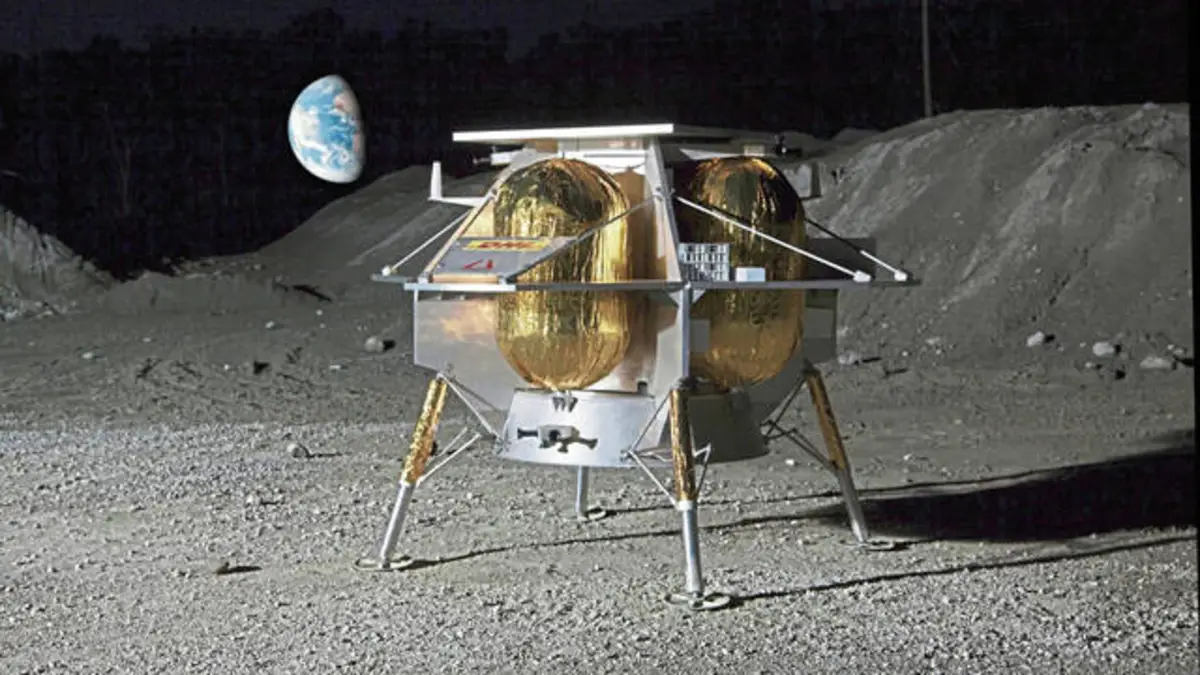
Pittsburgh-based Astrobotic was awarded two NASA contracts to deliver payloads to the moon, the company announced Tuesday.
The efforts are part of the Commercial Lunar Payload Services initiative, which supports NASA’s Moon Base. The missions are expected to fly two Peregrine lunar landers to the moon by the end of 2028.
The two contracts total $297.9 million, according to a NASA news release.
“Each mission has moved us closer to routine lunar access,” Astrobotic CEO John Thornton said in a news release. “The experience gained from our first two lander programs has matured both our team and our technologies, and we look forward to applying those lessons to Peregrine-2 and Peregrine-3 as we continue supporting NASA in building America’s Moon Base.”
Astrobotic’s inaugural Peregrine lunar lander launched into space in January 2024, with the goal of a soft landing on the moon. It quickly became clear the lander wouldn’t reach the lunar surface when a critical malfunction in the propulsion system led to fuel loss.
The lander was ultimately allowed to burn up reentering Earth’s atmosphere.
The two new missions Astrobotic announced this week will attempt to deliver three NASA-sponsored payloads to a landing site near the Gruithuisen Domes, a volcanic formation on the moon’s near side.
The delivery is set to include NASA’s Linear Energy Transfer Spectrometer, or LETS, which will monitor lunar radiation. Data collected by LETS will help officials understand potential radiation exposure for astronauts living or working on the moon.
The Astrobotic lander also is expected to carry Stereo Cameras for Lunar Plume Surface Studies, or SCALPSS, a camera system mounted beneath the spacecraft that will observe how engine exhaust interacts with the lunar service. The information can help engineers improve safety for future landings.
On the top of the lander, NASA’s Retroreflecter Array will reflect laser signals to support precision navigation on the moon, Astrobotic said.
Each Peregrine lander also will have capacity for commercial, government, academic and international customers, the company added.
After the pair of Peregrines land, each is expected to provide power, communications and command services for the payloads.
“These Moon Base task order awards are a clear signal of the U.S. investing in a permanent lunar presence,” said Matt Kuta, president of Voyager Technologies, which is acquiring Astrobotic.
NASA also awarded a $144.2 million contract to Cedar Park, Texas-based Firefly Aerospace and a $148.3 million deal for Houston, Texas-based Intuitive Machines.
“We’re building a proving ground for Moon Base operations,” said Ryan Stephan, NASA’s Moon Base acting director of cargo landers. “Accelerating our Moon mission ordering cadence and launch opportunities enable us to move quickly to learn, iterate and improve.”