
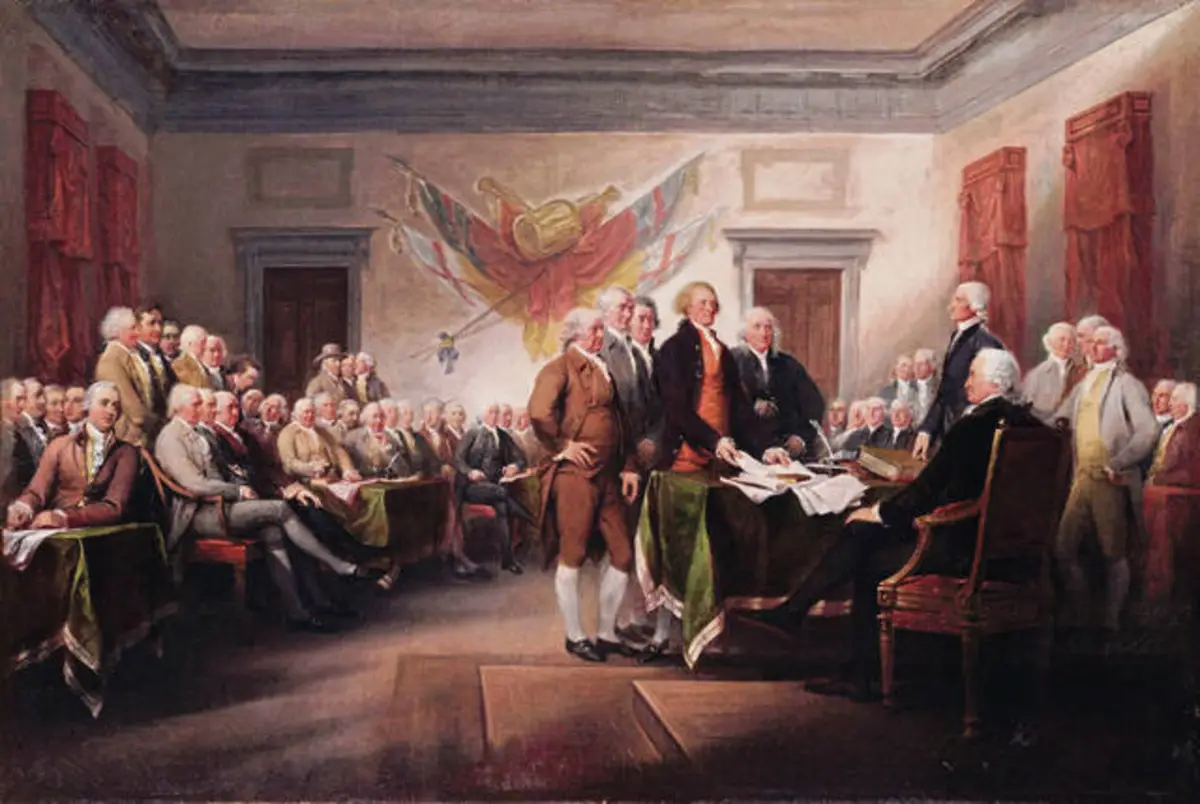
There will be parades, picnics, fireworks and fanfare Saturday to celebrate the 250th anniversary of the July 4th holiday.
But what actually happened on July 4, 1776?
It’s not the date when the Continental Congress voted to break free from Great Britain. It’s not the day the founding fathers signed their names to the Declaration of Independence.
The process of formally declaring independence started nearly a month earlier, on June 7, 1776. Richard Henry Lee, a delegate representing Virginia in the Second Continental Congress, introduced a resolution “that these united colonies are and of right ought to be free and independent states.”
His resolution called for a declaration of independence, the formation of foreign alliances and a plan for how the 13 colonies would operate as a confederation.
Many delegates wanted to confer with people they represented before voting on something as monumental as breaking free from Great Britain, so they delayed calling a vote on Lee’s resolution.
In the meantime, Congress appointed a committee to draft a declaration of independence. The committee was made up of John Adams, Benjamin Franklin, Robert R. Livingston, Roger Sherman and Thomas Jefferson, who authored the document.
Starting on June 11, Jefferson began crafting the declaration in a Philadelphia boardinghouse. Jefferson said the document was inspired by philosophers like Aristotle, Cicero and John Locke.
“Neither aiming at originality of principle or sentiment, nor yet copied from any particular or previous writing, it was intended to be an expression of the American mind, and to give to that expression the proper tone and spirit called for by the occasion,” Jefferson wrote nearly a half-century later, in 1825, the year before his death on July 4, 1826.
When the founding fathers finally voted to declare independence, their first vote was not on Jefferson’s document — nor was it on July 4.
A ‘mangled’ document
On July 2, 1776, the Continental Congress voted on Lee’s resolution declaring the colonies “free and independent states.” Twelve colonies supported it. New York initially cast a no vote but soon joined the fray.
“The Second Day of July 1776 will be the most memorable Epocha in the History of America,” John Adams wrote in a letter to his wife Abigail the following the day.
“I am apt to believe that it will be celebrated, by succeeding generations, as the great anniversary festival. It ought to be commemorated, as the Day of Deliverance by solemn acts of devotion to God Almighty. It ought to be solemnized with pomp and parade, with shews, games, sports, guns, bells, bonfires and illuminations from one end of this continent to the other from this time toward forever more.”
After the founding fathers voted on Lee’s resolution on July 2, Jefferson submitted his draft of the declaration.
Delegates spent all of July 3 and much of July 4 revising the document. Among the changes: cutting language condemning the transatlantic slave trade.
Jefferson later wrote that Franklin had observed him “writhing a little” as their fellow delegates edited his writing.
In a letter consoling Jefferson a few weeks later, Lee wrote he wished the declaration “had not been mangled as it is.”
By the end of the day on July 4, though, Congress had finished their edits. They adopted the final language of the Declaration of Independence.
They didn’t sign the document right away, though.
A 13-cannon salute
The declaration was printed the next day, a copy attached to the journal of business conducted in the Continental Congress the day prior.
Copies — bearing the names only of Continental Congress President John Hancock and Secretary Charles Thomson, but not the signatures of each delegate — were distributed to state assemblies, Continental troops and others.
George Washington — absent from the Continental Congress in Philadelphia because he was leading the American army in New York — received a letter from Hancock, dated July 6, with a copy of the declaration. He read the momentous document to thousands of Continental soldiers on the evening of July 9 in Lower Manhattan.
In their celebrations, they toppled a statue of King George III.
On July 19, Congress ordered the Declaration of Independence be engrossed on parchment with a new title: “the unanimous declaration of the thirteen united states of America.”
On August 2, Hancock affixed his signature on the document with a flourish. Most other delegates signed after Hancock that day. Others signed later.
According to the Pennsylvania Evening Post, Philadelphia celebrated July 4 as the “anniversary of the Independence of the United States of America” as early as the very next year.
On July 4, 1777, the city celebrated with a 13-cannon salute from armed ships in the river. A day of festivities concluded with fireworks, much like they will this year on the 250th anniversary of America’s birth, even if its citizens don’t really know what exactly they’re celebrating.