
Southwestern Pennsylvania’s links that bind the region to key Revolutionary War-era figures and moments run deep and strong.
As is often the case, George Washington plays a prominent role, from the earliest days of his military career to his final days at his homestead of Mount Vernon.
But quirks and oddities also abound in some of the region’s lesser-known history during the American Revolution.
Those tales, perhaps buried in history books, touch on a range of topics: the origins of the shape of Pennsylvania, one man’s shifting positions over a controversial tax, and the coming together of two iconic explorers known by most every schoolchild.
Here, then, are some of the more obscure stories of the region’s ties to the nation’s earliest day.
Bonjour, mon ami
George Washington in 1754 set off a massive global war with France in modern-day Fayette County.
It’s quite ironic, then, that Washington would later find himself relying on the French as key allies to win the American Revolution, said Brian Reedy, the National Park Service’s site manager at Fort Necessity National Battlefield.
Washington took the helm of the Continental Army at the start of the American Revolution in 1775. The patriots struggled in the early days of the war, suffering defeat after defeat at the hands of a better-trained, more well-equipped British military.
In 1778, Washington’s onetime enemy, France, came to his aid. King Louis XVI harbored a strong hatred of Great Britain, which Reedy cited as a key factor in the nation’s willingness to side with Washington.
Without the French army and navy, Reedy said, America may not have won its independence.
“I wonder if any of those French officers said, ‘Are you that guy that started that trouble in the previous war?’ ” Reedy quipped.
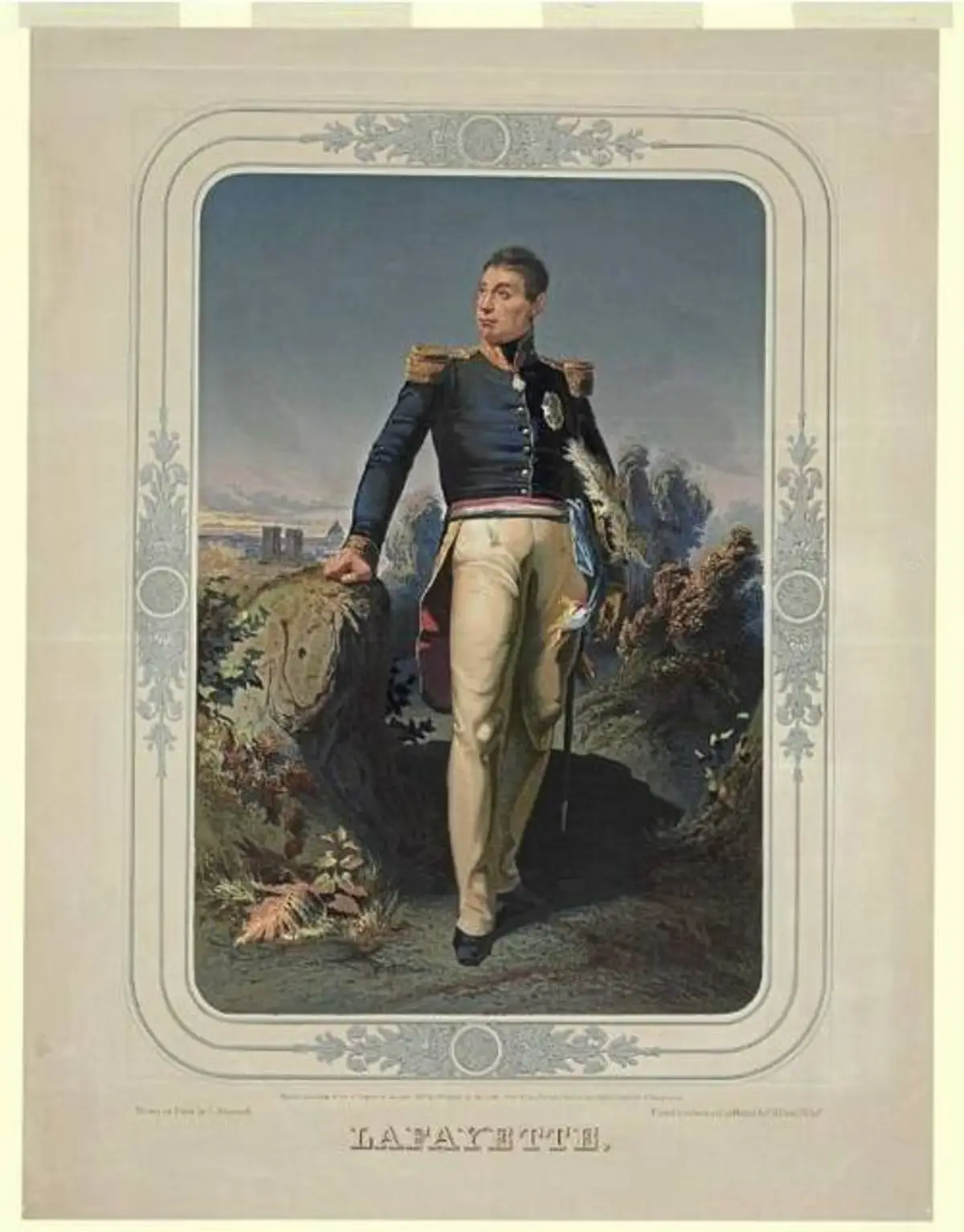
Marquis de Lafayette, a French military officer and politician, volunteered to join the Continental Army and quickly developed a close relationship with Washington. Reedy described Washington as a “father figure” to the Frenchman.
Lafayette’s father had been killed in the Seven Years War in Europe — the war Washington had sparked.
“If he did hold any animosity to George, he never said anything,” Reedy said.
Squares and circles
Fort Necessity was the site of an early skirmish between the British and French at the start of the French & Indian War and the site of George Washington’s only surrender.
But what it looked like was long open for debate among historians, since the French burned the original fort after Washington’s surrender.
The site was designated as a national battlefield in 1931. A replica of the fort was erected a year later at the National Park Service site in Wharton Township, about 60 miles south of Point State Park.
It was built in the shape of a square.
It wasn’t until 1953 that archaeologist J.C. Harrington proved that was a mistake.
Archaeological investigations eventually uncovered that the square outline originally believed to have shown the shape of the fort itself was actually what remained of the eroded earthworks around the structure.
Harrington discovered that the fort itself was a circle, about 53 feet in diameter.
The fort sitting on the site now — which was built in 2006 using oak from Butler County — shows the structure in its correct shape.
Pennsylvania takes shape
At the start of the American Revolution, colonies weren’t fighting just Great Britain.
They were also fighting one another.
Virginia and Pennsylvania were locked in a heated contest over which owned the region encompassing present-day Pittsburgh.
No one was killed in the scuffles between dueling colonial militias, said historian Patrick Spero, who heads the American Philosophical Society.
There were rival courts set up in the area, meaning those loyal to Pennsylvania would settle disputes in Pennsylvania courts, while those considering themselves Virginians handled their affairs in Virginia courts. Some people living in the area held land deeds from Pennsylvania, others from Virginia.
Thomas Jefferson in July 1776 — the same month he drafted the Declaration of Independence — penned a letter on behalf of Virginia officials to the Pennsylvania delegates in the Continental Congress, offering a truce.
“The colony of Virginia does not entertain a wish that one inch should be added to theirs from the territory of a sister colony,” he wrote.
The matter wasn’t resolved until 1779, when delegates from Pennsylvania and Virginia agreed to extend the Mason-Dixon Line to create Pennsylvania’s southern border.
They also drew a boundary up from that line to Lake Erie to create Pennsylvania’s western border, giving the state its modern shape.
Whiskey tax flip-flop
When the nascent federal government in 1791 enacted a tax on whiskey and the people of Western Pennsylvania launched a rebellion, it was John Neville who tried to enforce the tax.
Neville, a Revolutionary War veteran and friend of President George Washington, collected the whiskey tax from dozens of farmers before violence erupted. His home was ultimately burned to the ground in the uprising.
But Neville had not always been such a staunch supporter of whiskey taxes.
Neville was incensed when Pennsylvania announced a statewide whiskey tax several years before, going so far as to suggest the man who proposed the levy be hanged, said historian Robert Windhorst, vice president of Neville House Associates.
When the federal government instituted a similar excise, though, Neville fought armed rebels to support it.
In part, the change of heart may have been a savvy business decision, Windhorst said.
Neville operated a 500-gallon whiskey still, far larger than those average frontier farmers were using. He wanted to sell his whiskey to the U.S. Army, which purchased copious amounts of the drink for its troops — but only from distillers who registered their stills and paid their taxes.
“What better way to keep an eye on your competition than to collect the tax?” Windhorst said.
Neville may also have been motivated by a desire to support Washington. Neville had been a surveyor alongside the new president and the pair fought together in the French & Indian War. Neville also served as a general under Washington during the American Revolution.
Lewis meets Clark
Meriwether Lewis and William Clark are best known for leading the Corps of Discovery Expedition, a journey to explore the land acquired through the Louisiana Purchase.
The pair may have never met if Lewis hadn’t signed up to help put down the Whiskey Rebellion, said Clay Kilgore, executive director of the Washington County Historical Society.
After signing up to join the militia in Virginia, Lewis was dispatched to Western Pennsylvania to squash the uprising.
The rebellion was quickly put down, its leaders rounded up and eventually pardoned.
A small group of militiamen were left in the region to maintain the peace. Lewis volunteered to stay.
While there, Lewis in November 1795 was court-martialed over allegations he had previously gotten drunk, entered a lieutenant’s house, started a fight and challenged the man to a duel.
Lewis pleaded not guilty, and the court decided in his favor. Officials transferred him away from the lieutenant with whom he had the altercation.
He was assigned to a rifle company under the command of William Clark, a 25-year-old captain.
The two served together for six months and quickly became friends.
When President Thomas Jefferson in 1803 tapped Lewis, his personal secretary, to lead the expedition to explore the Louisiana Purchase territories, Lewis in turn asked Clark to join him.
Lewis in July 1803 ended up back in Western Pennsylvania, stopping in Pittsburgh before meeting up with Clark in Louisville, Ky., to formally set off on the expedition.
Delays on his 55-foot-long boat kept Lewis in Pittsburgh longer than expected. He used the time to recruit 11 volunteers to join the expedition and to purchase a Newfoundland dog, named Seaman.
Full circle
On December 13, 1779, James Craik was called to George Washington’s Mount Vernon home to care for the former president, who had fallen seriously ill.
Washington the day before had been caught in a snowstorm while riding horseback around his farm. He didn’t change out of his wet clothes before dinner and woke up the next morning with a sore throat.
Craik had been Washington’s friend and personal physician for years.
Their relationship dated back to the start of Washington’s military career at the very onset of the French & Indian War. Craik had been the British surgeon caring for the wounded at Fort Necessity, Reedy said.
Craik was also with Washington at Braddock’s defeat, another major battle early in the French and Indian War. The pair traveled through the Ohio River Valley on two separate occasions to check on the extensive properties Washington owned throughout the region.
During the American Revolution, Craik rose through the ranks to become the assistant director general of the Medical Department of the Continental Army. He treated well-known leaders like Marquis de Lafayette.
When the war ended, he opened a medical practice in Alexandria, Va., and often visited Washington at nearby Mount Vernon.
Craik was one of three doctors who were at Washington’s deathbed, trying repeatedly to cure the 67-year-old former president.
On Dec. 14, Washington died with his longtime friend at his side.
His last words, after confirming his secretary Tobias Lear understood what he wanted in terms of burial arrangements, were “ ’Tis well.”