
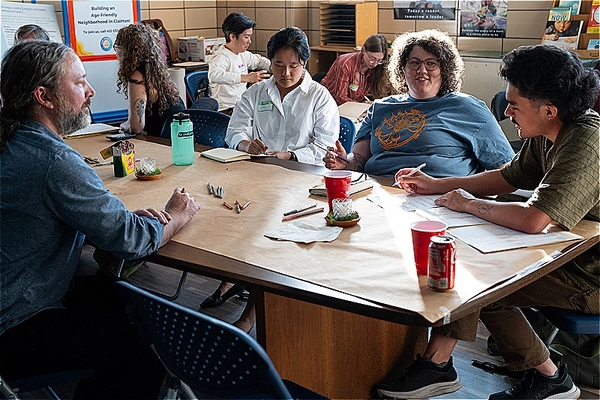
Above: Participants from the Ignite Environmental Justice Workshop – Monongahela Valley at Clairton Family Center on May 30. Photo by Rustbelt Mayberry Photography.
Aimed to educate and support community project leaders, the Ignite Environmental Justice Workshops concluded in May with over 30 participants attending the three workshops.
Strategically located in the Allegheny, Ohio, and Monongahela Valley, New Sun Rising and RiverWise hosted these events to help Environmental Justice (EJ) projects become better informed on how to develop and communicate their plans, and prepare to access federal Justice 40 grants.
"I think the more education, the more people, the more language we put [into] it, the more tangible it starts to become," said Amber Thompson, Ignite EJ - Allegheny Valley participant.
Environmental Justice communities are places that have experienced generational disinvestment " often alongside the consequences of polluting and extracting industries. The Justice 40 initiative is a historic commitment by the Federal government stating that 40 percent of the overall benefits of almost $2 trillion in certain federal investments, such as the Inflation Reduction Act (IRA) and Bipartisan Infrastructure Law (BIL), flow into these communities. Improving climate resilience and health through energy, water, air, mobility, food, and economic opportunity are core to the initiative.
Marginalized by underinvestment and overburdened by pollution, the federally designated EJ areas in the Greater Pittsburgh region have experienced the consequences of environmental injustice affecting nearly every aspect of their quality of life.
In Allegheny and Beaver Counties, there are 94 EJ census tracts that represent 233,852 residents and 16.8% of the total population. These residents, including a higher percentage of minority, racial and ethnic groups such as Black or African American, Asian, Hispanic or Latino, and Native American, face disproportionate economic and environmental challenges solely due to their location. Although minority groups represent 18% of the overall population in Allegheny and Beaver Counties, they make up 38% of the population residing in EJ communities.
How are people living in EJ communities affected by their surroundings compared to Allegheny and Beaver Counties?
Residents are less likely to own homes, but housing is more affordable.
Percentage of homeownership rates
"EJ Communities: 46.7%
"Allegheny & Beaver Counties: 63.8%
Percentage of housing affordability
"EJ Communities: 41.4%
"Allegheny & Beaver Counties: 34.7%
Public transportation is more accessible.
Percentage of access to public transit
"EJ Communities: 20%
"Allegheny & Beaver Counties: 11.7%
Adults are less likely to complete high school and adolescent birth rates are higher.
Percentage of adults who did not complete high school or the equivalency
"EJ Communities: 23.7%
"Allegheny & Beaver Counties: 17%
Percentage of adolescent girls between 15-19 years old who have given birth
"EJ Communities: 16%
"Allegheny & Beaver Counties: 4.9%
More women live below the poverty line in EJ Communities, but the median earnings gap between men and women is smaller.
Percentage of women living below the poverty line
"EJ Communities: 27%
"Allegheny & Beaver Counties: 14%
Median earnings gap between men and women
"EJ Communities: -$5,722
"Allegheny & Beaver Counties: -$14,067
Source: Vibrancy Portal.
The sources and history of environmental injustice in our region, possibly more than any in the nation, are deeply rooted in the United States' industrial past. Through fossil fuel extraction and carbon-intensive practices, particularly in coal mining and steel production, the Greater Pittsburgh area became a world-renowned industrial hub. The result: extreme levels of air and water pollution.
While strides have been made to improve the environment, the region still faces air quality challenges. In Beaver County, the ongoing industrial activities of the Shell Polymers Monaca plant continue to contribute to air and water pollution. The Shell plant, which opened in the fall of 2022, has faced 13 notices of violations and at least 26 malfunctions within a year.
In Allegheny County, U.S. Steel's Edgar Thomson Works has a decades-long history of clean air violations. In 2016 alone, air pollution from the plant included 36,100 pounds of ammonia, 3,500 pounds of manganese, and more than 300 pounds of other toxic substances. The ongoing contamination has led to various health problems for residents, including respiratory issues and increased cancer risks.
General Sisters, a community and artist collective in North Braddock, can see the Edgar Thomson Plant from their building. Ginger Brooks Takahashi of General Sisters said in 2015, the threat of hydraulic fracturing came to their neighborhood and alongside community members they "fought and resisted the placement of well pads" in the land above their building.
"Through this fight, we learned more about the existing air quality in our neighborhood. This led us to work with Create Lab to host the Breathe Cam on our roof that monitors emissions of Edgar Thomson Works," Takashi said. "The Breathe Cam provides 24-hour video monitoring of air pollution from multiple industrial sources in the Monongahela Valley and the larger region."
On May 30 at the Clairton Family Center, Takashi participated in the Ignite EJ Workshop and optional pitch competition where she won first place for her project General Sisters Environmental Study Center. The larger goal for the building is "to provide a space where we can gather with our neighbors and continue work… to advocate for our health in relationship to the legacy polluter in our neighborhood."
The pitch winners for the Allegheny and Ohio Valley workshops, Ebony Evans of Out of the End Incorporated, and David Slebodnik and Tami Gilbert of Aliquippa Food Cooperative, focused on increased food access in their communities.
In Allegheny County, 11.4% of residents face food insecurity, with the cost of a meal at $4.63, which is 14% above the state average and 16% above the national average. In Beaver County, 12.3% of residents are food insecure, with meal costs at $4.16, which is 2.7% higher than the state average and 4.3% higher than the national average.
Though EJ communities face heightened challenges compared to others within Allegheny and Beaver Counties, a detailed analysis of responses from Ignite workshop participants found that residents of Allegheny, Ohio, and Monongahela Valleys emphasized the strength, resilience, and supportive nature of their residents.
"Environmental justice is about recognizing the sacredness and living quality of the land that we live on and there are obstacles to that reciprocity and sacredness. Those obstacles are injustices and our work is the work of repair, restoration and healing," said Fitzhugh Shaw of Greater Valley Community Services and Ignite EJ - Monongahela Valley participant.
On August 1, the Launch EJ Incubator cohort began to support the development, funding, and implementation of projects working within a federally designated EJ census tract in Allegheny or Beaver Counties. The program blends monthly cohort workshops, educational speakers, and individual one-on-one technical assistance, creating a robust environment to support EJ projects. This is the second stage of development within New Sun Rising's Ignite, Launch, Grow framework.
To learn more about environmental justice and to see if you live in an EJ community, visit the Vibrancy Portal and select "Show Federal Environmental Justice Tracts" below the map. Are you working on a community project that falls within these designated areas? Get support through the Justice 40 Opportunity Navigator (J40N) by filling out this intake form.
The EJ Workshops, Incubator, and J40N is an initiative of New Sun Rising and RiverWise, in partnership with regional networks and community-based organizations.
Click here to read this article with accompanying graphics.
This content has been submitted by authors outside of this publisher and is not its editorial product. It could contain opinions, facts, and points of view that have not been reviewed or accepted by the publisher.