
Advertisement
-
Published Date
April 30, 2026This ad was originally published on this date and may contain an offer that is no longer valid. To learn more about this business and its most recent offers, click here.
Ad Text
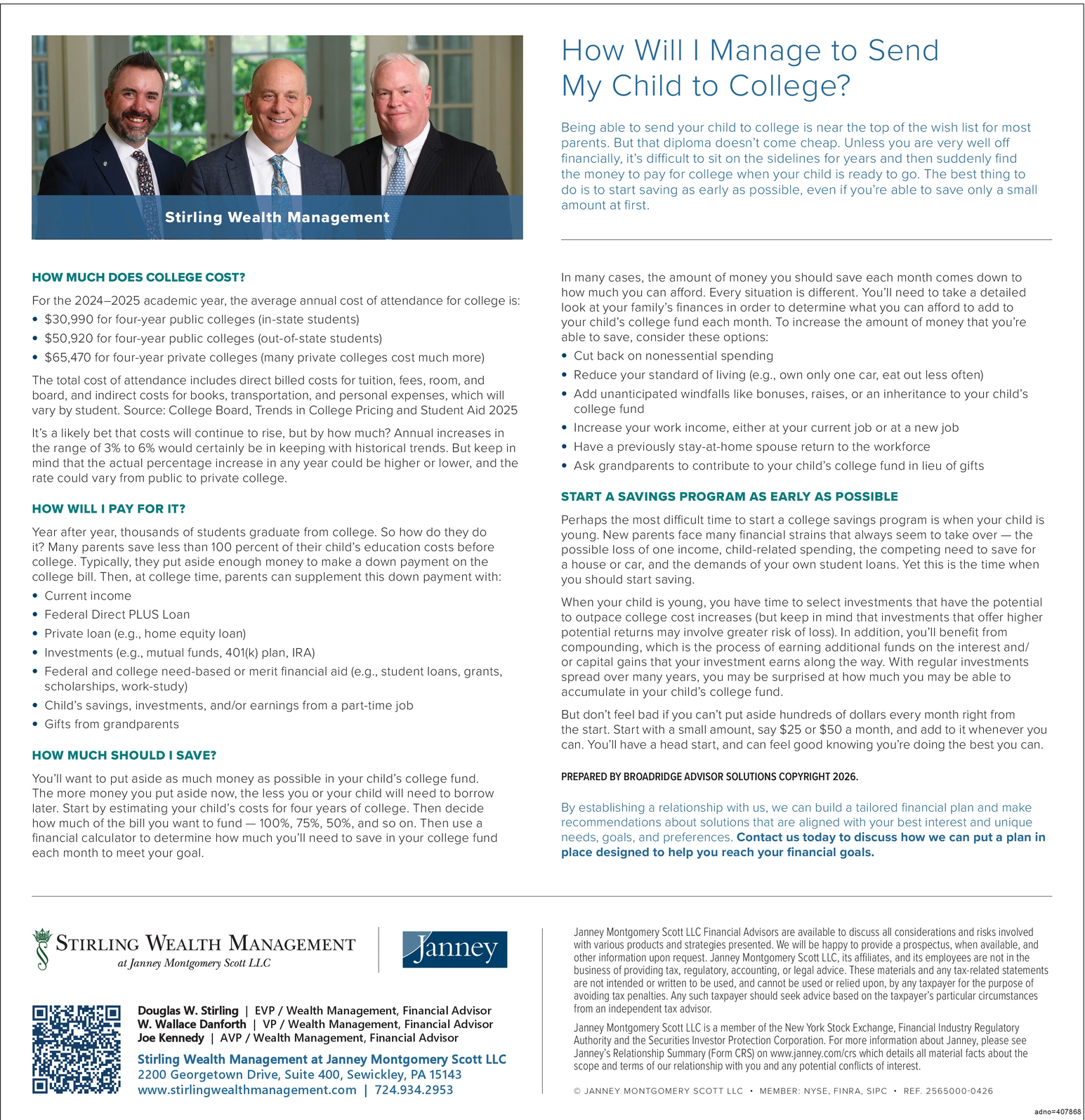
Stirling Wealth Management How Will I Manage to Send My Child to College? Being able to send your child to college is near the top of the wish list for most parents. But that diploma doesn't come cheap. Unless you are very well off financially, it's difficult to sit on the sidelines for years and then suddenly find the money to pay for college when your child is ready to go. The best thing to do is to start saving as early as possible, even if you're able to save only a small amount at first. HOW MUCH DOES COLLEGE COST? For the 2024-2025 academic year, the average annual cost of attendance for college is: $30,990 for four-year public colleges (in-state students) $50,920 for four-year public colleges (out-of-state students) $65,470 for four-year private colleges (many private colleges cost much more) The total cost of attendance includes direct billed costs for tuition, fees, room, and board, and indirect costs for books, transportation, and personal expenses, which will vary by student. Source: College Board, Trends in College Pricing and Student Aid 2025 It's a likely bet that costs will continue to rise, but by how much? Annual increases in the range of 3% to 6% would certainly be in keeping with historical trends. But keep in mind that the actual percentage increase in any year could be higher or lower, and the rate could vary from public to private college. HOW WILL I PAY FOR IT? Year after year, thousands of students graduate from college. So how do they do it? Many parents save less than 100 percent of their child's education costs before college. Typically, they put aside enough money to make a down payment on the college bill. Then, at college time, parents can supplement this down payment with: Current income Federal Direct PLUS Loan Private loan (e.g., home equity loan) Investments (e.g., mutual funds, 401(k) plan, IRA) Federal and college need-based or merit financial aid (e.g., student loans, grants, scholarships, work-study) Child's savings, investments, and/or earnings from a part-time job Gifts from grandparents HOW MUCH SHOULD I SAVE? You'll want to put aside as much money as possible in your child's college fund. The more money you put aside now, the less you or your child will need to borrow later. Start by estimating your child's costs for four years of college. Then decide how much of the bill you want to fund - 100%, 75%, 50%, and so on. Then use a financial calculator to determine how much you'll need to save in your college fund each month to meet your goal. In many cases, the amount of money you should save each month comes down to how much you can afford. Every situation is different. You'll need to take a detailed look at your family's finances in order to determine what you can afford to add to your child's college fund each month. To increase the amount of money that you're able to save, consider these options: Cut back on nonessential spending Reduce your standard of living (e.g., own only one car, eat out less often) Add unanticipated windfalls like bonuses, raises, or an inheritance to your child's college fund Increase your work income, either at your current job or at a new job Have a previously stay-at-home spouse return to the workforce Ask grandparents to contribute to your child's college fund in lieu of gifts START A SAVINGS PROGRAM AS EARLY AS POSSIBLE Perhaps the most difficult time to start a college savings program is when your child is young. New parents face many financial strains that always seem to take over the possible loss of one income, child-related spending, the competing need to save for a house or car, and the demands of your own student loans. Yet this is the time when you should start saving. When your child is young, you have time to select investments that have the potential to outpace college cost increases (but keep in mind that investments that offer higher potential returns may involve greater risk of loss). In addition, you'll benefit from compounding, which is the process of earning additional funds on the interest and/ or capital gains that your investment earns along the way. With regular investments spread over many years, you may be surprised at how much you may be able to accumulate in your child's college fund. But don't feel bad if you can't put aside hundreds of dollars every month right from the start. Start with a small amount, say $25 or $50 a month, and add to it whenever you can. You'll have a head start, and can feel good knowing you're doing the best you can. PREPARED BY BROADRIDGE ADVISOR SOLUTIONS COPYRIGHT 2026. By establishing a relationship with us, we can build a tailored financial plan and make recommendations about solutions that are aligned with your best interest and unique needs, goals, and preferences. Contact us today to discuss how we can put a plan in place designed to help you reach your financial goals. STIRLING WEALTH MANAGEMENT at Janney Montgomery Scott LLC Janney Douglas W. Stirling | EVP / Wealth Management, Financial Advisor W. Wallace Danforth | VP / Wealth Management, Financial Advisor Joe Kennedy | AVP / Wealth Management, Financial Advisor Stirling Wealth Management at Janney Montgomery Scott LLC 2200 Georgetown Drive, Suite 400, Sewickley, PA 15143 www.stirlingwealth management.com | 724.934.2953 Janney Montgomery Scott LLC Financial Advisors are available to discuss all considerations and risks involved with various products and strategies presented. We will be happy to provide a prospectus, when available, and other information upon request. Janney Montgomery Scott LLC, its affiliates, and its employees are not in the business of providing tax, regulatory, accounting, or legal advice. These materials and any tax-related statements are not intended or written to be used, and cannot be used or relied upon, by any taxpayer for the purpose of avoiding tax penalties. Any such taxpayer should seek advice based on the taxpayer's particular circumstances from an independent tax advisor. Janney Montgomery Scott LLC is a member of the New York Stock Exchange, Financial Industry Regulatory Authority and the Securities Investor Protection Corporation. For more information about Janney, please see Janney's Relationship Summary (Form CRS) on www.janney.com/crs which details all material facts about the scope and terms of our relationship with you and any potential conflicts of interest. © JANNEY MONTGOMERY SCOTT LLC MEMBER: NYSE, FINRA, SIPC REF. 2565000-0426 adno=407868 Stirling Wealth Management How Will I Manage to Send My Child to College ? Being able to send your child to college is near the top of the wish list for most parents . But that diploma doesn't come cheap . Unless you are very well off financially , it's difficult to sit on the sidelines for years and then suddenly find the money to pay for college when your child is ready to go . The best thing to do is to start saving as early as possible , even if you're able to save only a small amount at first . HOW MUCH DOES COLLEGE COST ? For the 2024-2025 academic year , the average annual cost of attendance for college is : $ 30,990 for four - year public colleges ( in - state students ) $ 50,920 for four - year public colleges ( out - of - state students ) $ 65,470 for four - year private colleges ( many private colleges cost much more ) The total cost of attendance includes direct billed costs for tuition , fees , room , and board , and indirect costs for books , transportation , and personal expenses , which will vary by student . Source : College Board , Trends in College Pricing and Student Aid 2025 It's a likely bet that costs will continue to rise , but by how much ? Annual increases in the range of 3 % to 6 % would certainly be in keeping with historical trends . But keep in mind that the actual percentage increase in any year could be higher or lower , and the rate could vary from public to private college . HOW WILL I PAY FOR IT ? Year after year , thousands of students graduate from college . So how do they do it ? Many parents save less than 100 percent of their child's education costs before college . Typically , they put aside enough money to make a down payment on the college bill . Then , at college time , parents can supplement this down payment with : Current income Federal Direct PLUS Loan Private loan ( e.g. , home equity loan ) Investments ( e.g. , mutual funds , 401 ( k ) plan , IRA ) Federal and college need - based or merit financial aid ( e.g. , student loans , grants , scholarships , work - study ) Child's savings , investments , and / or earnings from a part - time job Gifts from grandparents HOW MUCH SHOULD I SAVE ? You'll want to put aside as much money as possible in your child's college fund . The more money you put aside now , the less you or your child will need to borrow later . Start by estimating your child's costs for four years of college . Then decide how much of the bill you want to fund - 100 % , 75 % , 50 % , and so on . Then use a financial calculator to determine how much you'll need to save in your college fund each month to meet your goal . In many cases , the amount of money you should save each month comes down to how much you can afford . Every situation is different . You'll need to take a detailed look at your family's finances in order to determine what you can afford to add to your child's college fund each month . To increase the amount of money that you're able to save , consider these options : Cut back on nonessential spending Reduce your standard of living ( e.g. , own only one car , eat out less often ) Add unanticipated windfalls like bonuses , raises , or an inheritance to your child's college fund Increase your work income , either at your current job or at a new job Have a previously stay - at - home spouse return to the workforce Ask grandparents to contribute to your child's college fund in lieu of gifts START A SAVINGS PROGRAM AS EARLY AS POSSIBLE Perhaps the most difficult time to start a college savings program is when your child is young . New parents face many financial strains that always seem to take over the possible loss of one income , child - related spending , the competing need to save for a house or car , and the demands of your own student loans . Yet this is the time when you should start saving . When your child is young , you have time to select investments that have the potential to outpace college cost increases ( but keep in mind that investments that offer higher potential returns may involve greater risk of loss ) . In addition , you'll benefit from compounding , which is the process of earning additional funds on the interest and / or capital gains that your investment earns along the way . With regular investments spread over many years , you may be surprised at how much you may be able to accumulate in your child's college fund . But don't feel bad if you can't put aside hundreds of dollars every month right from the start . Start with a small amount , say $ 25 or $ 50 a month , and add to it whenever you can . You'll have a head start , and can feel good knowing you're doing the best you can . PREPARED BY BROADRIDGE ADVISOR SOLUTIONS COPYRIGHT 2026 . By establishing a relationship with us , we can build a tailored financial plan and make recommendations about solutions that are aligned with your best interest and unique needs , goals , and preferences . Contact us today to discuss how we can put a plan in place designed to help you reach your financial goals . STIRLING WEALTH MANAGEMENT at Janney Montgomery Scott LLC Janney Douglas W. Stirling | EVP / Wealth Management , Financial Advisor W. Wallace Danforth | VP / Wealth Management , Financial Advisor Joe Kennedy | AVP / Wealth Management , Financial Advisor Stirling Wealth Management at Janney Montgomery Scott LLC 2200 Georgetown Drive , Suite 400 , Sewickley , PA 15143 www.stirlingwealth management.com | 724.934.2953 Janney Montgomery Scott LLC Financial Advisors are available to discuss all considerations and risks involved with various products and strategies presented . We will be happy to provide a prospectus , when available , and other information upon request . Janney Montgomery Scott LLC , its affiliates , and its employees are not in the business of providing tax , regulatory , accounting , or legal advice . These materials and any tax - related statements are not intended or written to be used , and cannot be used or relied upon , by any taxpayer for the purpose of avoiding tax penalties . Any such taxpayer should seek advice based on the taxpayer's particular circumstances from an independent tax advisor . Janney Montgomery Scott LLC is a member of the New York Stock Exchange , Financial Industry Regulatory Authority and the Securities Investor Protection Corporation . For more information about Janney , please see Janney's Relationship Summary ( Form CRS ) on www.janney.com/crs which details all material facts about the scope and terms of our relationship with you and any potential conflicts of interest . © JANNEY MONTGOMERY SCOTT LLC MEMBER : NYSE , FINRA , SIPC REF . 2565000-0426 adno = 407868